






MP challenges ministers to explain whether workers who already pay little wage tax could lose purchasing power, while questioning TEATT’s capacity to deliver its proposed projects.
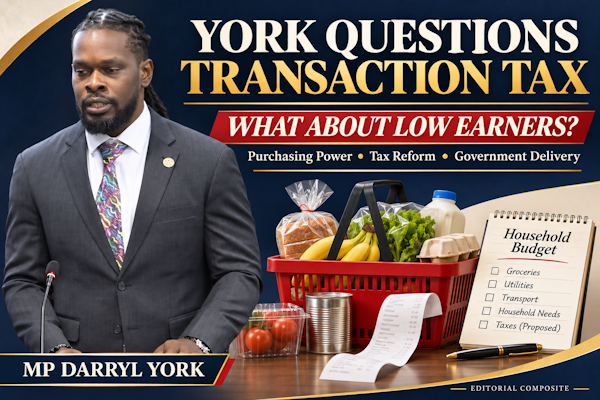 PHILIPSBURG:--- MP Darryl York has challenged the government to explain how a proposed financial transaction tax would affect minimum-wage and lower-income workers, warning that reductions in existing taxes might offer them little compensation for an additional charge on transactions.
During the 2027 budget debate, York welcomed TEATT Minister Grisha Heyliger-Marten's revenue-generating proposal but questioned whether its effects on vulnerable households had been adequately examined.
His central question was straightforward: what happens to workers who already pay little wage tax if that tax is reduced but they face a new transaction charge?
“What does that mean for the minimum wage earner?” York asked.
He also questioned whether TEATT and Finance were working together on the proposal and demanded clarity about the research behind it.
A tax reduction may not benefit everyone equally
York said he understood the transaction tax concept could involve substantially reducing or potentially replacing certain existing taxes, including wage and profit taxes.
He questioned whether that exchange would provide comparable benefits across income groups.
For a worker already paying little wage tax, he argued, a reduction might leave take-home pay largely unchanged. An additional transaction charge could nevertheless reduce what that income could purchase.
York used hypothetical rates of five to ten percent to illustrate his concern. Those figures were examples in his questioning, not confirmed rates under an adopted government policy.
His argument was conditional: if earnings remained unchanged while transactions attracted an additional charge, lower-income households could face weaker purchasing power.
“That’s a significant part of the economy that can’t afford any more decreasing in buying power,” he said.
He added that households would still have to contend with inflation alongside any tax change.
York did not present a completed economic model establishing that outcome. He asked ministers to show whether they had examined the risk and how the proposal would address it.
What research supports the proposal?
York asked Heyliger-Marten to explain the work undertaken before bringing the transaction tax concept back to Parliament.
He acknowledged that the discussion stretched back years and suggested that earlier studies or policy papers might already exist.
He wanted to know which materials the ministry had reviewed, what research it had conducted, and whether it had discussed the implications with Finance.
His contribution stopped short of rejecting the concept.
“The only minister to come with a revenue-generating idea,” he said of Heyliger-Marten, adding that MPs had been asking for such proposals.
“But I do have some questions.”
Those questions sought to move the discussion beyond the potential size of a revenue source toward the practical consequences for those expected to pay it.
Is Finance working with TEATT?
York also asked Finance Minister Marinka Gumbs to state her ministry’s position.
He recalled that the transaction tax had not appeared on an earlier list of taxes under consideration provided in response to parliamentary questions.
He asked whether it was now being studied and whether MPs should expect a proposal in a future budget or budget amendment.
York additionally noted references to point-of-sale systems in the TEATT presentation and said Finance had also been working on such systems.
He requested an explanation of the coordination between the ministries.
“Is it something that the Ministry of Finance is working on along with the Ministry to make this happen?” he asked.
The questions sought clarity on responsibility, implementation and whether the proposal had progressed beyond an idea presented by one ministry.
Strong presentations need staff and deadlines
York’s scrutiny of TEATT extended beyond taxation.
Although he praised the minister’s presentation, he questioned whether the ministry had sufficient personnel to execute its project list.
According to York, departments responsible for many of the initiatives were operating at approximately 60 percent staffing.
He asked how those departments could deliver the proposed workload.
His concern was that government repeatedly accumulated projects without matching them to the people available to carry them out.
“There are too many projects for the capacity, the human capacity that we have,” he said.
York described that as a recurring issue across several ministries, rather than a criticism limited to TEATT.
He also said he had not seen clear timelines accompanying the projects.
“I know everything doesn’t have a time or date, but something needs to happen,” he said.
He asked what would happen to TEATT initiatives dependent on capital financing if implementation funds were delayed.
York also requested the status of the ministry’s function book, including when it was last reviewed and whether an update was underway.
Throughput fee: Give Parliament the total
York requested a specific financial figure concerning the throughput fee.
He asked the minister to state how much had been collected since its introduction.
“A number,” he emphasized.
The request formed part of his wider demand for concrete information about existing revenue arrangements alongside discussion of new measures.
Casino licensing requires a clear explanation
York also returned to a casino licensing matter he said he had raised with the minister approximately two years earlier.
He referred to a hotel that, according to his account, had not met the 200-room requirement for casino-license eligibility.
He said condominium-style hotel units were now being built at the property and asked whether those units would count toward the required room total.
York did not identify the hotel in the supplied statement.
His question concerned how the ministry interpreted the room requirement and whether the new units would affect the property’s eligibility.
He acknowledged that the minister had been pursuing the matter but requested an explanation of its current position.
Taxi fare correspondence still awaiting an answer
York said letters concerning the taxi fare list and its revision, dating back to January, remained unanswered.
He asked what work had been done and whether an update was imminent.
The complaint reinforced his broader criticism of the distance between parliamentary questions, government presentations and information actually delivered to MPs.
Across the economic portfolio, York asked ministers to establish the practical foundations of their proposals: the research, the responsible officials, the available staff and the implementation timetable.
On the transaction tax, the question remained particularly consequential for households with little financial room to absorb another cost.
Before the government moved forward, York wanted an explanation of what lower earners would gain, what they might pay, and whether their purchasing power would be protected.