






MP Darryl York challenges the government’s emphasis on an on-time budget, questions whether promised projects can be delivered and warns that a transaction tax could weaken low earners’ purchasing power.
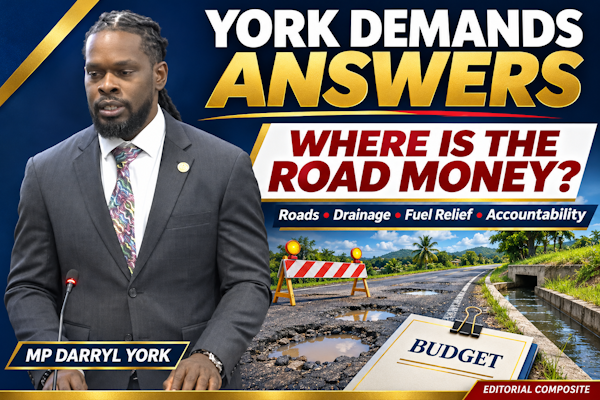 PHILIPSBURG:--- MP Darryl York challenged the government to distinguish between money announced and money actually available during the 2027 budget debate, demanding a clear account of road funding, deadlines for promised relief and explanations for delayed investments.
York questioned Finance Minister Marinka Gumbs and VROMI Minister Patrice Gumbs Jr. about differing public statements on road expenditure and asked how much could actually be spent from January 1, 2027.
“What is the truth and how much money is really available?” he asked.
His contribution spanned government, including the implications of the Committee for Financial Supervision’s advice, GEBE’s generator procurement, Justice’s vehicle expenditure, tourism project capacity, and the effects of a proposed transaction tax.
York began by thanking civil servants, particularly those in Finance, for preparing the budget. He then argued that recognizing their work did not remove Parliament’s responsibility to scrutinize the policies and promises built around it.
Timely submission does not answer questions about quality
York said MP Franklyn Meyers’ criticism that St. Maarten had become a nation of talkers resonated with him.
He listed issues that had repeatedly occupied public debate — traffic, SZV’s financial position, general health insurance, pensioner relief, gasoline prices and GEBE’s fuel costs — and argued that the budget presentations had not supplied adequate solutions.
He also criticized what he described as another budget without new revenue-generating measures.
York contrasted the celebration of the 2027 budget’s timely submission with the CFT’s inability to issue positive advice on the 2026 capital investment loan request.
He asked whether the government had corrected the weaknesses identified in 2026 before proceeding with the next budget.
He asked the Finance Minister to walk Parliament through each relevant recommendation and explain, step by step, what had been changed.
York’s criticism of the 2027 budget was his assessment of the risk of carrying unresolved problems forward. The unfavorable financing advice he discussed concerned the 2026 request; it did not itself establish that the CFT had rejected the 2027 budget.
He also pointed to criticism from MP Dimar Labega, the Finance Minister’s own Democratic Party colleague, as evidence that dissatisfaction was coming from within the governing ranks as well.
“Open for gas relief” needs a date
York challenged the Finance Minister’s statement that she was open to gasoline price relief.
“Open for gas relief means what?” he asked. “Is that a yes? Is that a no?”
If government intended to provide relief, he wanted a timetable.
He argued that an open-ended expression of willingness gave consumers no certainty because government could remain open to an idea indefinitely without implementing it.
York made the same demand concerning pensioners.
He recalled that relief had featured prominently during campaigning and asked when pensioners could expect it.
“Give a timeline, please, Minister,” he said.
He also requested Finance’s formal position on TEATT’s transaction tax proposal, asking whether it was being studied and whether Parliament should expect it in a future budget or amendment.
Road funding: What is available on January 1?
York’s most sustained challenge concerned the Road Fund and planned road works.
He said he had spent months asking Finance and VROMI for clarity while ministers offered different explanations through the media.
He referred to statements involving approximately nine million guilders for 2027 road projects, a five-million-guilder figure discussed by VROMI and a smaller current allocation of approximately 650,000.
York questioned the description of funding as “secured” when a substantial portion appeared dependent on capital financing.
He demanded an answer that separated immediately accessible money from funding expected later.
“I don’t want to hear what’s going to be available throughout the year,” he said. “I want to know how much money is available from that nine million to do road projects as of January 1st.”
He linked the question to potholes, drainage problems and the daily experience of road users.
York also asked whether the legal basis for the Road Fund now existed and, if so, when it was established.
His questions required the ministers to distinguish the proposed fund’s legal status, ordinary road allocations and loan-dependent investments rather than present them as interchangeable sources of money.
GEBE and Sol: What did the meeting achieve?
York asked Prime Minister Dr. Luc Mercelina to explain the purpose and tangible outcome of the meeting involving faction leaders and Sol.
He also wanted to know whether TEATT Minister Grisha Heyliger-Marten supported the meeting in the context of her ministry’s work involving the company and BTP.
York contrasted the minister’s public discussion of further scrutiny with the Prime Minister’s engagement with Sol, questioning whether the approaches formed part of a coordinated strategy.
“What is the goal?” he asked.
He renewed a request for one designated communicator on GEBE matters, saying Parliament and the public should not have to interpret separate messages from several ministers.
Who answers for the generator procurement delay?
York alleged that a generator investment approved approximately two years earlier had not been ordered promptly, allowing inflation to reduce what the financing could purchase.
According to his account, an investment initially associated with three generators would now deliver two.
He asked who would be held responsible for the difference and why the order had not proceeded earlier.
Those statements were York’s account of the procurement history. His contribution did not include the contracts, technical specifications or a cost comparison establishing the complete reasons for the change.
His parliamentary demand was nevertheless specific: explain the delay, explain the altered outcome and identify responsibility.
More autonomy for GEBE?
York also asked whether government would support giving GEBE greater decision-making autonomy.
He argued that shareholder intervention could constrain investments while leaving the company to absorb blame when problems emerged later.
He alleged that political interference had obstructed earlier opportunities involving fuel storage and gasoline stations.
His statement did not include supporting records for those historical allegations.
York used them to question whether the utility’s governance arrangements should change so it could make longer-term investment decisions with greater independence.
He maintained that consumers deserved relief but that GEBE also needed to be placed in a financial and operational position to provide it.
Separately, York asked when the outstanding parliamentary meeting concerning integrity matters involving the Prime Minister would be held. He argued that scrutiny should not remain unresolved because it concerned the head of government.
Justice vehicle spending: Show what happened to the last purchases
York challenged a proposed 2.2 million in Justice vehicle expenditure while saying his earlier requests for a fleet inventory remained unanswered.
He wanted the total number of vehicles, their operational status, purchase dates, and information on vehicles no longer in service.
York said he had offered to receive sensitive information through confidential channels but had not obtained a response.
He questioned why relatively new vehicles were reportedly spending extended periods in garages and whether maintenance arrangements were suitable.
“We’re throwing away money,” he said.
York proposed examining a more standardized government fleet and a centralized maintenance facility with properly trained, certified mechanics.
His suggestion was an alternative to consider, not a demonstrated finding that government ownership of a garage would be cheaper.
He also asked Acting Justice Minister Marinka Gumbs about plans for the Miss Lalie Center.
Collect outstanding fines and examine other revenue options
York questioned the failure to hold a requested revenue-generation meeting, saying MPs had ideas they wanted government to consider.
He referred to a reported backlog of more than 3,000 fines at the Prosecutor’s Office and asked whether some matters could be handled through administrative fines rather than the criminal process.
He argued that issuing fines served little purpose if people believed collection would never follow.
York also asked about higher immigration-related fees and a “pay to stay” approach, as well as reviewing fine levels against those in other jurisdictions.
He renewed a question about a tourist licensing charge, challenging an earlier response that treaty obligations prevented it, and asked the government to examine the example he said he had found in Barbados.
His remarks did not establish that the same legal arrangement could automatically be adopted in St. Maarten.
York further requested consideration of the taxation of overtime earned by Justice workers, arguing that understaffing required employees to work additional hours and that their compensation deserved attention.
Can TEATT deliver its project list?
York praised Heyliger-Marten’s presentation but questioned whether the ministry had enough staff to execute its plans.
He said departments responsible for many initiatives were operating at approximately 60 percent staffing and asked how the proposed workload could be delivered.
He also criticized the absence of clear project timelines.
His concern extended to projects dependent on capital financing that could be delayed before implementation began.
York requested an update on TEATT’s function book and asked when it had last been reviewed.
He also asked for the total amount collected through the throughput fee since its introduction.
Transaction tax: What happens to minimum-wage earners?
York welcomed the revenue-generating idea but demanded an assessment of its distributional effects.
He asked how TEATT and Finance were coordinating their work, including any overlap involving point-of-sale systems.
His central concern was whether low earners would receive enough benefit from reductions in existing taxes to offset a new transaction charge.
Using hypothetical rates of five to ten percent, York asked what would happen to workers who already paid little wage tax.
If their salaries remained unchanged while transactions attracted an additional charge, he argued, their purchasing power could fall.
The percentages were examples used in his question, not confirmed rates of an adopted proposal.
York asked whether this effect had been researched and what existing studies had informed the concept before it returned to Parliament.
Casino licensing, taxi fares and cemetery consultation
York also requested an update on a longstanding casino licensing question involving a hotel.
He asked whether condominium-style hotel rooms under construction would count toward the room requirement he said applied to eligibility.
He did not name the hotel in the statement he provided.
On taxi fares, York said correspondence dating back to January remained unanswered and asked whether an updated fare list was imminent.
His final questions concerned the proposed cemetery in Belvedere.
York asked whether residents had been consulted and whether they knew its intended location and timetable.
“You can’t put a cemetery in the people’s backyard without having a public consultation,” he said.
The supplied statement ended with an adjournment following that question. Across the portfolios, York’s demand remained consistent: identify the money, establish the timetable and explain who is responsible when promised results do not materialize.