





MP Franklin Meyers asks ministers to identify their three most important deliverables, explain rising expenditure and account for long-term financial commitments.
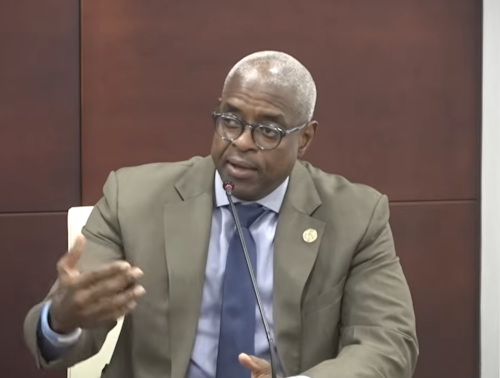 PHILIPSBURG:--- Member of Parliament Franklin Meyers commended government for presenting the draft 2027 budget on time, but pressed the Council of Ministers to explain what the proposed spending will deliver for Sint Maarten’s residents.
During the parliamentary discussion, Meyers described timely budget submission as an important achievement after years of difficulty meeting that obligation. He congratulated Finance Minister Marinka Gumbs and the Council of Ministers, while making clear that punctuality does not settle questions about the budget’s contents.
For Meyers, the next test is whether ministers can connect their allocations to concrete improvements, realistic deadlines and measurable results.
He ended his intervention with a request to every minister: identify the three most important deliverables for 2027, state their budgeted costs and provide dates when Parliament’s budget committee can check progress.
Rising expenditure and an ENNIA commitment stretching decades
Addressing the Finance Minister, Meyers questioned an approximately Cg. 10 million increase in material expenditure and asked government to distinguish spending financed externally from obligations paid by Sint Maarten itself.
He also sought milestones for the financial reform programme and an explanation of how improvements in tax collection and compliance would be measured.
On ENNIA, Meyers referred to a provision of up to Cg. 3 million annually, potentially extending over the next 30 years, with the final contribution still dependent on calculation.
He asked when the definitive amount would be known and how government would reflect that commitment in future budgets. His questions also addressed the effect of high interest costs on the country’s financial room in 2027 and subsequent years.
The concern underlying those questions was the relationship between today’s commitments and tomorrow’s ability to finance public services.
General Affairs must explain its increases
Meyers questioned an increase in gross spending for General Affairs from approximately Cg. 90 million in 2026 to Cg. 101 million in 2027.
He asked which activities account for the additional expenditure and which would produce measurable results during the budget year.
With phased expansion planned for the Fire Department and ICT, he requested details of what would actually be delivered in 2027 and what additional costs would follow in 2028.
He also questioned a rise in the facilities budget from approximately Cg. 34.1 million to Cg. 43.6 million, asking which contracts or obligations explain the increase and what savings government had considered.
Vacancies, he argued through his questions, should also be linked to delivery: which funded positions are essential to the ministry’s priorities, and when will they be filled?
Justice ambitions face a largely unchanged allocation
Meyers challenged an earlier characterization of Justice Minister Nathalie Tackling’s appeal for parliamentary budget amendments.
He rejected the suggestion that she had “begged” Parliament for money, saying she had encouraged MPs to consider amendments that would provide additional resources.
Nevertheless, he asked whether a largely unchanged Justice allocation of approximately Cg. 113.8 million could support planned improvements in policing, detention and border control.
He requested the current prison timetable, together with the staffing and operating costs expected in 2027 and 2028.
Meyers also asked which vacancies pose the greatest risk to the justice system and how government would report the results of crime prevention and youth protection programmes alongside their expenditure.
Those questions place the focus on whether the ministry’s ambitions can be delivered within the resources proposed.
Education spending must reach students
For Education, Culture, Youth and Sport, Meyers questioned a reduction in subsidies from approximately Cg. 75.2 million to Cg. 74.2 million.
He asked which schools or programmes would receive less funding and how changes in enrolment had been calculated.
At the same time, he pointed to an increase in spending on projects and activities from approximately Cg. 7.8 million to Cg. 11.8 million. He requested the projects behind that increase, confirmation of external financing and the results expected by 2027.
He also asked how teaching quality and school maintenance would be protected when much of the ministry’s expenditure is described as fixed.
Student support, school transportation and study financing should be assessed by whether they reach the students who need them, his questions indicated.
Sixteen years later, Meyers wants an anthem
Meyers also raised a nation-building issue that he said had become a personal concern: the continued introduction of the island’s song at official functions as the “Sint Maarten song.”
Referring to the opening of Parliament, he argued that the country should move toward formally recognizing an anthem.
Whether the choice is “O Sweet Saint Martin’s Land” or another song, he said the country needs a clear expression of national identity.
“I think it’s time,” Meyers said, linking the issue to the 16 years since Sint Maarten attained country status.
He emphasized that the matter was not a personal criticism of ECYS Minister Melissa Gumbs, but a responsibility the country had left unresolved.
Health, assistance and tourism funding under scrutiny
Turning to Public Health, Social Development and Labor, Meyers questioned a reduction in the ministry’s total allocation from approximately Cg. 108 million to Cg. 103.7 million, including the effect of declining external programme funding.
He asked what reforms would begin in 2027 to address the health fund’s annual deficits and what financial effects government expected from each reform.
He also sought the number of people expected to receive increased financial assistance, confirmation that the full annual cost was included, and a timetable for the social registry.
For TEATT, Meyers asked which activities depend on external funding and whether that financing is secure.
He questioned the deadlines and deliverables for two large externally funded projects, as well as the recipients and expected results of an increase in subsidies from approximately Cg. 1.4 million to Cg. 2.4 million.
With marketing expenditure declining, he asked which visitor or economic indicators would be used to assess the effectiveness of the ministry’s tourism approach.
Meyers acknowledged the business community’s longstanding role in driving the economy and promoting Sint Maarten’s tourism product. He also argued that successive governments’ investments in the cruise facilities and international airport had provided the infrastructure needed to bring visitors to the island.
Roads and housing: what will residents see completed?
For VROMI, Meyers questioned an increase in net expenditure from approximately Cg. 31.8 million to Cg. 38.4 million.
He asked which services and projects account for the increase and what residents would see completed in 2027.
With provision for 13 vacancies, he sought clarification on which positions should be filled first to improve permitting, inspections, maintenance and housing work.
He also requested a funded schedule for road maintenance and improvements, including how the 2027 programme relates to the planned use of motor vehicle tax revenue through a road fund in 2028.
Meyers noted that road tax revenue currently enters government’s general coffers, making the proposed arrangements for dedicated road financing an important question.
He further asked how much money would remain for new housing and infrastructure after existing operating commitments, and which projects were ready to proceed.
His intervention combined support for timely financial planning with a demand for accountability: ministers must explain what their budgets will produce, what those results will cost and when Parliament can verify delivery.