





Parliament Chair calls for a rethink of capital spending and demands clearer reporting on public finances, government companies and the results promised in the 2027 budget.
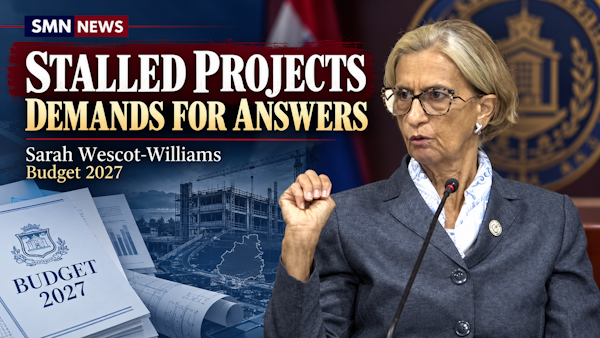 PHILIPSBURG:--- Chair of Parliament Sarah Wescot-Williams called for a fundamental review of how Sint Maarten finances and executes capital projects, warning that repeatedly carrying projects into another budget year is failing to produce progress quickly enough.
During her contribution to the draft 2027 budget discussion, Wescot-Williams questioned government across its ministries on project readiness, financial transparency, poverty alleviation, healthcare, public safety and national development.
Her central concern was whether Parliament can establish what government will deliver and hold ministers accountable for the results.
“We need a redo of the capital budget and the way that we manage it,” she said.
Projects keep returning, but where is the execution?
Wescot-Williams argued that the problem with capital spending extends beyond the 2026 and 2027 budgets.
In her assessment, government continues to place projects in the capital budget because borrowing room exists, while many of those projects are subsequently rolled into the next year.
She asked how many projects listed in the two budgets are genuinely ready to begin once financing is approved.
That distinction matters: a project appearing in a budget does not necessarily have the preparation, approvals or execution arrangements required for work to start.
She asked whether an investment bank or development bank could help address the country’s needs. If government does not support such an approach, she asked for an alternative to overcome limited project execution capacity across ministries.
Her challenge was directed at the entire Council of Ministers, rather than a single department.
Confidentiality must not weaken parliamentary oversight
Wescot-Williams renewed her concerns about the government’s use of confidentiality when sharing information with Parliament.
She referred to her longstanding criticism that an earlier agreement had been withheld and urged the government to exercise greater care in deciding what should follow a confidential procedure.
She also requested a legal explanation of who may represent the Government of Sint Maarten in agreements and how that authority must be granted.
In her view, someone signing or acting on behalf of government must be specifically authorized. She asked government to clarify the applicable requirements, acknowledging that her understanding could be corrected.
The issue goes beyond access to documents: Parliament needs to understand who can bind government to commitments and the legal authority under which it acts.
Government cannot wait indefinitely to account for its bills
The Chair questioned an earlier government response indicating that an overview of outstanding payables was not currently maintained and would become available through a new financial system.
She asked why the information could not be extracted under existing arrangements and whether an interim report could be produced, including manually if necessary.
Both Parliament and government need to know what remains unpaid, she argued.
She also requested information about expected taxes based on the tax administration’s records, rather than relying solely on cash already collected.
Referring to a Central Bank observation about wage tax collection and budgeted amounts not keeping pace with economic activity, she asked whether the concern had been communicated directly to government and what the Finance Ministry intended to do about it.
She also asked whether the 2026 indexation of civil servants’ salaries had been paid and whether the 2027 budget included provision for indexation.
Revenue proposals need amounts and legislative deadlines
Wescot-Williams sought clarity on which proposed revenue measures are included in the 2027 projections and how much each is expected to generate.
Her questions covered gambling taxation, revisions to formal tax legislation and measures concerning the withholding of remuneration, alongside the entry fee already addressed in the minister’s presentation.
She asked for the legislative status of each measure, linking projected income to the legal steps needed to collect it.
On short-term rentals, including Airbnb and VRBO, she asked what collection arrangements the government was developing with CARTAC.
She also questioned how properties owned by people living abroad would be treated when rented out, and whether such vacation ownership would fall within the same category.
For the wider tax administration reform, she requested specific, measurable targets for 2027. She also asked about anticipated fees and supervisory levies under gaming reform.
Capacity constraints are not a complete answer
Wescot-Williams returned to the government’s earlier explanation that capacity limitations prevented it from committing to reports on policy outcomes, performance indicators and implementation milestones.
She asked what staffing or systems would be required to provide that information in 2027.
Recalling budget execution reporting received during the early years of country status, she questioned why comparable reporting could not be provided now.
She also sought progress on the disaster reserve fund’s governance framework, capitalization strategy and withdrawal criteria.
Her questions challenged government to identify what is needed to improve reporting, rather than allow capacity constraints to remain an indefinite explanation.
Government companies must report
For government-owned companies, Wescot-Williams asked whether government had sent the promised communication about audited financial statements and annual reports, and whether the companies had responded.
She requested a timetable for approval of the participation policy and questioned how the applicable corporate reporting requirements were being enforced.
Her concern about confidentiality resurfaced here: Parliament must receive the information needed to perform its oversight responsibilities.
She also asked when the updated digital government and artificial intelligence strategy would be presented, arguing that government needs to address AI’s opportunities, uses and risks.
Cross-border cooperation should address daily barriers
Wescot-Williams identified taxation, crime and financial systems as priorities she wanted addressed in cooperation with the French side.
She questioned the limitations faced by Dutch-side residents seeking access to banking and financial platforms available across the border.
Drawing on her own experience, she described the difficulty of opening a French-side bank account despite being born there and now residing on the Dutch side.
She asked government how Sint Maarten could modernize access to financial services and whether closer connections with European systems could help.
The questions placed practical financial access within the wider discussion of cross-border cooperation.
Tourism infrastructure, lagoon safety and development pressure
Wescot-Williams requested confirmation that the proposed meteorological and civil aviation building is ready to proceed once funds become available. She also asked what portion of its 2026 capital allocation would carry into 2027.
For the Simpson Bay Bridge, she sought the technical assessment, cost estimate, and phased upgrade plan that government had instructed the Port St. Maarten Group to prepare.
She asked whether the first phase was budgeted for 2027 or would be financed by the port.
Her questions also addressed management of the shared Simpson Bay Lagoon: who is responsible, what activities are controlled, and what arrangements exist with French counterparts?
After observing jet ski activity at night, she sought clarification on safety oversight and enforcement.
She further requested updates on Philipsburg beautification, public-private partnerships, and the proposed multi-story parking facility.
On the anticipated carrying capacity study, she asked whether government was already taking interim decisions based on the development pressures it knows the country faces.
Justice staffing and traffic enforcement need dates
For Justice, Wescot-Williams asked what progress had been made in filling vacancies identified in 2026 and what recruitment was funded for 2027.
She also requested baselines and targets for reducing recidivism and violence under the relevant justice project.
On traffic enforcement, she sought concrete timelines for expanding the Traffic Department, introducing a digital fine system and modernizing road traffic legislation.
She questioned how Justice had executed its 2026 allocation, given that the proposed 2027 budget was essentially unchanged.
The emphasis was on identifiable steps and dates that would allow Parliament to assess whether implementation was advancing.
Poverty requires a clearer government response
Wescot-Williams said she did not see sufficient attention being given to poverty alleviation.
She asked when the household expenditure study and work on a social minimum would be completed, whether social assistance reform would follow in 2027 and how living costs would be reflected.
She urged government to explain its poverty response collectively, rather than leave related measures scattered across separate ministries.
She also questioned the future direction of the Sint Maarten Development Fund, saying it was originally intended to focus particularly on young people and the elderly but had since been assigned other government-related tasks.
On healthcare, she asked whether the existing structure could continue to manage the country’s needs and costs, or whether alignment with larger healthcare systems should be considered.
She sought an update on general health insurance legislation and a clearer explanation of what government means by phased introduction.
School meals, English and zoning remain unresolved
For ECYS, Wescot-Williams asked whether a structured school meal programme was provided for in 2027 and, if not, why.
She commended the interministerial Healthier Habits initiative but questioned whether it was a sustained programme or a one-time project.
She also requested a timetable for the 2028–2032 study financing priority list, clarification on a proposed fuel levy for sports and an explanation of whether increased school transportation spending would expand or improve services.
Building on MP Franklin Meyers’ call for an anthem, she urged government to address the legal and practical position of English.
She referred to three parliamentary motions she had initiated on the language and asked what action had followed, including a plan for its use within the civil service.
For VROMI, she sought measurable project indicators, an update on recruiting the island-wide zoning plan’s project manager, and a completion timetable.
After years of raising zoning in Parliament, she asked whether the country was any closer to resolving it.
She also requested government’s position on the proposed Mullet Bay master plan, including its involvement in road planning, and an update on the longstanding Cg. 300,000 subsidy for the Sint Maarten Housing Development Foundation.
Across her contribution, Wescot-Williams pressed the same demand: government must move beyond listing intentions and provide Parliament with the information, schedules and measurable results needed to judge its performance.