




~MPs challenge the government on revenue generation, GEBE, healthcare, policing, housing, tourism, and billions in public spending.~
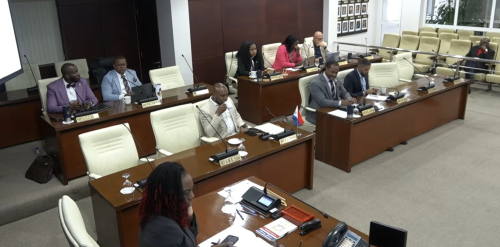 PHILIPSBURG:--- What began as Finance Minister Marinka Gumbs' presentation of a Cg. 647 million national budget quickly turned into a marathon of scrutiny as Members of Parliament fired hundreds of questions at the Council of Ministers, demanding concrete timelines, measurable results, and accountability for virtually every ministry.
Rather than focusing solely on expenditure, opposition MPs repeatedly challenged the government to explain how it intends to generate additional revenue, deliver long-delayed projects, and ensure taxpayers receive value for money from the largest budget in the country's history.
One of the dominant themes throughout Friday's Central Committee meeting was that St. Maarten cannot continue increasing government spending without simultaneously increasing government income.
MP Francisco Lacroes made that point clear when he argued that every budget debate focuses on expenditure, while revenue generation remains largely absent.
"No budget debate is complete without a credible plan to earn, collect, enforce, and protect St. Maarten's revenue," he stated before announcing that many of his questions would focus specifically on the government's revenue strategy.
Revenue generation under the microscope
MP Omar Ottley questioned why the government has not reintroduced temporary fuel tax relief similar to measures implemented in 2021 and 2022 when gasoline prices surged.
He reminded Parliament that previous governments successfully provided relief at the pumps and asked Finance Minister Marinka Gumbs why similar measures cannot be implemented now, despite the government's stronger-than-expected first-quarter financial results.
MP Lacroes also questioned why Parliament has still not held the long-requested meeting dedicated exclusively to revenue-generating measures.
He noted that Parliament requested the meeting in December 2025 but said it was repeatedly postponed without explanation, despite the government continuously complaining about insufficient financial resources.
Among his proposals were introducing annual licensing fees for foreign company directors, maintaining property taxation for foreign investors while exempting locals, and examining additional revenue streams similar to neighboring islands.
MP Lyndon Lewis also pressed the government on its projected increase in tax revenues, asking what assumptions underpin the projected Cg. 647 million revenue target and how much additional revenue the government expects to generate through stronger tax compliance rather than higher taxation.
He demanded updated figures on outstanding tax arrears, the value of collectible taxes, and the government's strategy for modernizing tax administration and digitizing financial services.
GEBE dominates questioning
The troubled utility company again emerged as one of Parliament's biggest concerns.
MP Ottley demanded an update on the approximately Cg. 74 million to Cg. 76 million loan approved to purchase new generators, asking why no generators have yet been delivered despite taxpayers already assuming responsibility for repayment.
He questioned whether inflation has made the generators unaffordable and asked the government to explain exactly where the procurement process currently stands.
MP Lacroes expanded the questioning significantly.
He asked who is politically responsible for GEBE, whether the Prime Minister or another minister serves as shareholder representative, what legal authority the Bureau of Telecommunications and Post (BTP) actually possesses over electricity tariffs, and requested clarification on the resignation of a GEBE Supervisory Board member.
He further requested the curriculum vitae of every current board member, questioned whether their vision aligns with the government's policy objectives, and sought a detailed chronological timeline explaining why Parliament-approved financing for new generators has yet to result in their purchase.
Healthcare and SAHA
Healthcare financing generated another lengthy exchange.
MP Ottley warned that General Health Insurance, now referred to as SAHA, can no longer remain on the drawing board while healthcare deficits continue increasing.
He asked whether government still intends introducing the legislation this year, questioned the planned Cg.800,000 allocation for SAHA, and warned that continued delays could deepen the financial problems facing SZV.
He also called for the government to finally implement health insurance coverage for sole proprietors, bus operators, and taxi drivers—legislation he said has been awaiting action since receiving advice from the Council of Advice in 2024.
Questions for every ministry
Members also challenged ministers across the entire Council of Ministers.
Among the issues raised were:
- Fire Department staffing shortages, outstanding overtime, salary corrections, and retroactive payments.
- Police manpower, Coast Guard salary allocations, and delayed justice reforms.
- Affordable housing, cemetery space, drainage works, and road rehabilitation.
- Tourism marketing effectiveness and diversification beyond cruise tourism.
- Delays in business licenses and building permits.
- Teacher shortages, school maintenance, youth programs, and sports funding.
- Mental healthcare, ambulance capacity, and specialist waiting lists.
- Public sector vacancies, reliance on consultants, and digital government initiatives.
The budget debate now moves into the response phase, where ministers will be expected not only to defend their spending requests but also to answer one of Parliament's recurring questions: how the government intends to pay for its expanding responsibilities while delivering measurable improvements to the people of St. Maarten.