






Wescot-Williams calls the illustrative 5% rate unrealistic, Irion questions contradictions in the presentation, York exposes apparent divisions within government, and Doran announces an urgent parliamentary meeting request to address national tax reform.
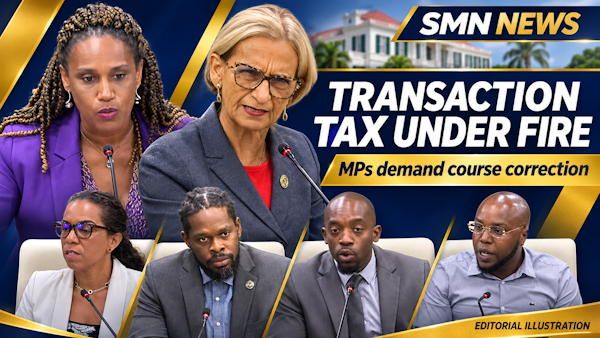 PHILIPSBURG:--- Minister of Tourism, Economic Affairs, Transport and Telecommunication (TEATT) Grisha Heyliger-Marten came under heavy criticism in Parliament on Wednesday over her ministry's proposed Financial Transaction Tax (FTT), as several Members of Parliament questioned the government's direction, the credibility of its financial projections and the conspicuous absence of Finance Minister Marinka Gumbs, whose ministry is ultimately responsible for national tax reform and revenue collection.
What began as a presentation outlining an ambitious restructuring of Sint Maarten's taxation system became a contentious parliamentary discussion that exposed apparent policy differences within the government.
MPs Ludmila de Weever, Darryl York, Ardwell Irion, Egbert Jurendy Doran and Parliament Chairlady Sarah Wescot-Williams raised fundamental questions about the initiative.
Wescot-Williams, who also leads the Democratic Party, called for a course correction in the government's approach to tax reform and described the TEATT delegation's illustrative 5% transaction tax rate as unrealistic.
The interventions were particularly significant considering that both Heyliger-Marten and Finance Minister Marinka Gumbs represent the Democratic Party in the governing coalition.
Two Ministries Pursuing Different Tax Reform Agendas
Heyliger-Marten appeared before Parliament alongside Secretary-General Miguel de Weever, Senior Policy Advisor and former MP Rolando Brison, and other members of her technical team.
The delegation presented a model examining the possibility of eliminating turnover tax, profit tax and the existing 1% license fee while reducing wage tax by 50%.
Using historical payment data from 2022, the ministry calculated that applying an illustrative 5% transaction tax to approximately 11.816 billion guilders in financial transactions could theoretically generate 590.8 million guilders.
However, the presentation exposed a fundamental governance issue. The Ministry of TEATT is actively exploring a comprehensive restructuring of the country's taxation system, while the Ministry of Finance is pursuing its existing tax reform agenda.
Several MPs questioned how Parliament could meaningfully assess the proposal without the participation and commitment of the ministry responsible for implementing it.
The absence of Finance Minister Marinka Gumbs, or even a representative of her ministry, became one of the meeting's most contentious issues.
Parliament Chairlady Sarah Wescot-Williams Demands Course Correction
One of the most politically damaging interventions came from Parliament Chairlady Sarah Wescot-Williams, who took issue with how the proposal was being advanced.
Wescot-Williams acknowledged that she had previously received and reviewed an earlier version of the presentation, although additional information had since been incorporated.
She questioned what Parliament was expected to do at this stage and whether MPs should wait for the proposed joint task force to be established and its findings before engaging in further substantive discussion.
Her criticism went beyond the technical details of the proposed tax.
Wescot-Williams questioned whether the government was prepared to abandon its existing tax reform trajectory under the Country Package and redirect its resources toward a fundamentally different system based on indirect taxation.
She said the government must decide whether it intends to correct course and pursue a unified national tax reform strategy.
Wescot-Williams Calls 5% Transaction Tax Unrealistic
The Parliament Chairlady recalled that following Hurricane Irma, an economic recovery proposal had already examined introducing a Financial Transaction Tax.
According to Wescot-Williams, that earlier proposal contemplated a rate of approximately 0.25%, while even a rate approaching 1% was considered problematic because of its potential economic consequences.
She questioned what had changed sufficiently to justify the current ministry's use of a 5% illustrative rate.
|
Transaction tax rate |
Position described during the meeting |
|
0.25% |
Earlier post-Irma proposal |
|
1% |
Previously considered problematic, according to Wescot-Williams |
|
5% |
Current illustrative rate used in TEATT's presentation |
Wescot-Williams urged the ministry to remove the 5% figure from its presentations.
“It's not realistic,” she said, warning that applying such a rate could distort the economy.
She further recalled that the Ministry of Finance had previously opposed introducing a Financial Transaction Tax and questioned what had changed since that assessment.
Chairlady Must Also Answer for Coalition Governance
While Wescot-Williams raised several legitimate concerns, her intervention also placed her own political leadership under scrutiny.
As leader of the Democratic Party, Wescot-Williams holds a particularly influential position relative to both the Minister of Finance and the Minister of TEATT.
Both ministers serve in the same government, represent her political party and operate under a governing program their coalition has endorsed.
Parliament had to spend considerable time questioning whether these ministers share a common direction on national tax reform, exposing a troubling failure of political coordination.
Wescot-Williams acknowledged that she had seen the presentation before. That raises an important question about what efforts her party made to resolve the apparent policy differences before the matter reached Parliament.
Why were these fundamental questions about ministerial responsibility, the proposed tax rate and the government's existing reform agenda still unresolved?
The Democratic Party leader cannot reasonably place the entire burden of resolving these issues on Heyliger-Marten when a minister from her party also holds the Finance Ministry.
Furthermore, as Chairlady of Parliament, Wescot-Williams must account for how earlier parliamentary requests concerning revenue-generating measures and comprehensive tax reform have been handled.
The country cannot afford parallel tax reform agendas under two ministers belonging to the same political party while Parliament continues to await a coherent government position.
Ardwell Irion Accuses TEATT Team of Presenting Contradictory Information
Former Finance Minister and National Alliance MP Ardwell Irion delivered extensive criticism of the presentation, questioning both its substance and the circumstances under which the initiative was brought before Parliament.
Irion recalled that discussions surrounding a Financial Transaction Tax date back to approximately 2020 and 2021.
He questioned why the initiative remained in an exploratory phase in late 2026, despite years of discussions, earlier research and international consultations.
“Are we still today in 2026 exploring?” Irion questioned.
He also challenged the wording of a presentation slide titled “Why It Will Work in Sint Maarten.”
Irion argued that such definitive language contradicted repeated statements by the delegation that the proposal was still being explored and that its feasibility had yet to be established.
He questioned whether the technical team had sufficient fiscal and legal expertise to undertake such a comprehensive assessment.
Among his questions were:
- Who conducted the original exploratory research?
- Were tax lawyers and fiscal specialists involved?
- What is the legal status of the team appearing before Parliament?
- Why was the presentation made before the joint task force had been formally established?
- What would it cost to introduce and administer the proposed system?
Irion expressed concern that government representatives were presenting financial figures with considerable confidence while acknowledging that the underlying assumptions remained unverified.
Irion Challenges Projected Revenue of 590.8 Million Guilders
The former Finance Minister questioned why the ministry had selected a 5% figure for its illustrative calculation instead of presenting a broader range of possible rates.
|
Illustrative rate |
Gross calculation using 2022 transaction volume |
|
0.25% |
29.54 million guilders |
|
1% |
118.16 million guilders |
|
2% |
236.32 million guilders |
|
3% |
354.48 million guilders |
|
4% |
472.64 million guilders |
|
5% |
590.80 million guilders |
These calculations are based solely on the historical transaction volume of 11.816 billion guilders. Actual collectible revenue would depend on exemptions, transaction duplication, behavioral changes and other factors.
Irion's argument was that selecting a specific illustrative percentage capable of producing substantial headline revenue could create unrealistic expectations among the public.
Cascading Tax Could Increase Consumer Prices
Irion also challenged the delegation on the cumulative effect of taxing multiple transactions associated with the same product.
Using an illustrative commercial supply chain, he suggested that repeated transaction charges could produce an effective cumulative tax burden of approximately 12.06% under his assumptions.
He questioned how such a system could benefit consumers if goods were subject to transaction charges during importation, freight, distribution, retail purchases and final consumption.
He also challenged the assumption that the existing banking infrastructure used to collect the 1% license fee could automatically accommodate the proposed transaction tax.
Irion requested written confirmation from the Central Bank of Curaçao and Sint Maarten (CBCS), along with documentation concerning its assessment of implementation costs and technical requirements.
The French Side Presents a Major Challenge
Irion questioned how the government intends to address the island's open border and the possibility of commercial activity shifting to French Saint Martin.
He argued that businesses might reorganize their purchasing and import arrangements in response to additional financial transaction costs on the Dutch side.
The unique economic relationship between both sides of the island makes this an essential consideration.
Without comprehensive assessment of cross-border commerce and consumer behavior, the government cannot reliably determine how businesses and individuals would respond to a transaction tax.
Darryl York Exposes Apparent Disconnect Between TEATT and Finance
National Alliance MP Darryl York questioned whether the Finance Minister actually supports the concept being promoted by Heyliger-Marten and her technical team.
York recalled the enthusiasm the TEATT Minister showed during the budget debate when discussing the transaction tax.
He said that when similar questions were later put to Finance Minister Marinka Gumbs, the enthusiasm was considerably lower.
York argued that national tax reform must reflect the government's collective position.
He questioned whether TEATT was driving the proposed initiative without sufficient commitment from Finance.
“It should be what the government is trying to bring for Sint Maarten,” York stated.
The MP further recalled a principle previously expressed by Wescot-Williams, namely that legislative initiatives require the support of the minister responsible for their eventual implementation.
Without that support, York argued, considerable time and resources could be spent advancing legislation that never materializes.
York Demands Evidence of IMF's Alleged Change in Position
York also challenged statements made regarding the International Monetary Fund's assessment of the proposed transaction tax.
Former MP Rolando Brison said discussions with international organizations had progressed and that certain earlier objections had been addressed.
York requested documentary evidence showing whether the IMF had formally changed its position.
He also requested:
- Copies of government correspondence with the IMF.
- Documentation of the government's responses to international concerns.
- Details of stakeholder consultations.
- Comparable examples of countries using similar taxation systems.
- Information concerning the estimated cost of a feasibility study.
- Analysis of the potential economic disadvantages.
York questioned whether the presentation had adequately reflected both the potential benefits and disadvantages of the proposed reforms.
Referencing economist Adam Smith's concept of the invisible hand, he warned that consumers, businesses and investors could adjust their behavior in ways that alter the government's anticipated revenue projections.
Ludmila de Weever Says Discussion Was Premature
Former TEATT Minister and MP Ludmila de Weever acknowledged the need for fundamental changes to Sint Maarten's taxation system but questioned whether the current proposal should have been presented publicly at such an early stage.
De Weever described aspects of the presentation as contradictory and suggested that the discussion was premature without meaningful participation from the Ministry of Finance.
She maintained that Sint Maarten continues to rely excessively on the same pool of registered and compliant taxpayers.
Millions Could Be Escaping the Existing Tax System
De Weever directed particular attention toward foreign-owned real estate, condominium developments and short-term accommodation businesses.
She questioned whether owners residing overseas are adequately registered with Sint Maarten's Tax Administration and whether rental income generated by properties on the island is being captured by the existing tax system.
She pointed to situations where substantial rental proceeds may be collected outside Sint Maarten without passing through local financial institutions.
“There is a hole, literally a hole of money that we're losing here that a transaction tax won't cover,” De Weever said.
She argued that the government must address these existing deficiencies before placing additional pressure on the same population already contributing to government revenue.
De Weever also highlighted the need for greater coordination between fiscal policy and economic development policy.
She stressed that the Ministry of Finance and the Ministry of TEATT must work together to determine how taxation affects residents, businesses, consumer spending and investment.
She said the discussion could ultimately produce worthwhile reforms, provided the appropriate ministries and stakeholders participate.
Egbert Doran Demands Urgent Public Meeting with Finance Minister
National Alliance leader MP Egbert Jurendy Doran delivered one of the afternoon's strongest political criticisms.
Doran questioned why the Minister of Finance was absent when, in his view, about 95% of the questions concerned financial and fiscal matters.
He acknowledged that Heyliger-Marten had made herself available to Parliament but questioned why the responsible Finance Ministry had failed to participate.
“I think the course correction is needed sooner rather than later,” Doran declared.
The National Alliance leader recalled that Parliament had previously received a request for a meeting addressing several related matters, including:
- Government revenue-generating measures.
- The status and timeline of national tax reform.
- Operational conditions at the Tax Administration.
- Measures to address economic challenges.
According to Doran, a request dating back to May 2025 had still not resulted in the substantive discussion MPs sought.
He questioned how the country could continue approaching the end of 2026 without meaningful progress on these matters.
Doran Takes Aim at Parliamentary Leadership
Doran announced that the National Alliance faction would submit an urgent request for a public meeting involving the Minister of Finance and the Minister of TEATT.
He said he would monitor how the Chairlady of Parliament handles the new request.
The MP asked whether the request would face the same delays as previous parliamentary requests on revenue-generating measures.
He also referred to parliamentary statistics showing fewer meetings during the previous parliamentary year.
Doran expressed frustration over repeated delays, absent ministers and uncertainty regarding ministerial responsibilities.
“At a point in time, the games have to stop,” he stated.
His intervention placed additional pressure on Wescot-Williams, whose responsibilities as Parliament Chairlady include providing institutional leadership while MPs exercise their oversight functions.
The public deserves an explanation as to why a comprehensive parliamentary discussion on revenue generation and tax reform has remained outstanding since May 2025, particularly when the government continues to identify financial constraints as a major obstacle to development.
Heyliger-Marten Hits Back and Defends Her Work Ethic
Following the extensive criticism, Heyliger-Marten strongly defended her ministry's actions and her personal commitment to finding economic solutions.
She reminded Parliament that exploring a Financial Transaction Tax is included under TEATT's responsibilities in the governing program.
The minister also confirmed that the final legal review of the instrument establishing the joint TEATT-Finance task force was received only on Wednesday.
She explained that her ministry would share its findings with Finance once the task force is officially established.
Heyliger-Marten rejected suggestions that her presentation wasted parliamentary time.
“I don't come to Parliament to waste people's time,” she declared.
The minister further stated that when Parliament had previously requested her attendance, she had been ready to appear but had to wait for another minister to be prepared.
Her statement added further weight to questions concerning internal government coordination.
Heyliger-Marten maintained that economic policy falls directly within her ministry's responsibilities and that TEATT has an obligation to develop solutions when residents and businesses are experiencing financial difficulties.
“I work. I don't waste people's time. I come with solutions,” she said.
She committed to returning to Parliament with responses to MPs' questions, suggesting a continuation within one or two weeks.
The Democratic Party Leadership Faces Its Own Test
Wednesday's meeting revealed a serious political problem for the Democratic Party.
The party's TEATT Minister is promoting a potentially revolutionary restructuring of the country's tax system. Its Finance Minister is responsible for the national tax reform process. Its political leader, who also chairs Parliament, is publicly questioning the initiative's viability, timing, and direction.
These are fundamental differences that require political and administrative resolution.
Wescot-Williams's demand for a course correction must therefore extend to her own party's leadership and the coordination of its ministers.
After years of discussions concerning tax reform, Sint Maarten cannot continue investing public resources in separate initiatives without establishing which direction the government intends to pursue.
Parliament is entitled to demand a unified position from the Council of Ministers, supported by credible economic modeling, reliable revenue projections and comprehensive analysis of the consequences for taxpayers.
Wednesday's meeting was subsequently adjourned, with numerous questions remaining unanswered.
For now, Sint Maarten has an ambitious transaction tax proposal, two ministries pursuing different aspects of tax reform, a joint task force awaiting formal establishment and a Parliament demanding answers. The country is still waiting for a coherent, executable national tax reform policy.