






VSA minister defends social assistance allocation, outlines ambulance improvements and faces demands for clearer answers on patient care, consultancy spending and support for vulnerable households.
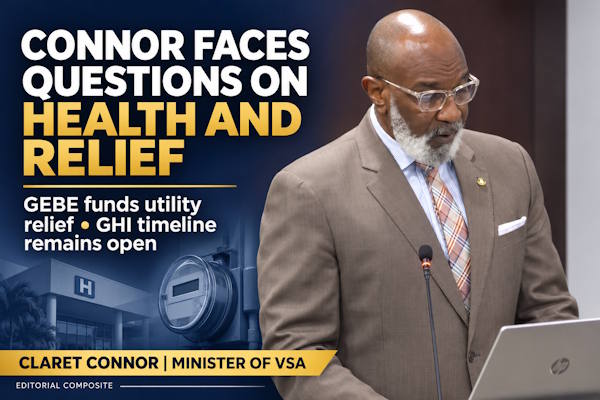 PHILIPSBURG:--- Minister of Public Health, Social Development and Labor Claret Connor told Parliament that GEBE is financing the entire announced 400,000 utility relief allocation, while the government administers the program without contributing funds. The disclosure prompted MP Omar Ottley to announce his intention to bring a budget amendment requiring government to contribute toward helping vulnerable households.
Connor’s responses during deliberations on the proposed 2027 budget covered general health insurance, financial assistance, ambulance staffing, overseas medical referrals, labor legislation and the new hospital. However, several MPs challenged the completeness of his answers and requested outstanding information before the next round of debate.
The exchange ended with a ten-minute adjournment to allow the minister to prepare responses to those requests for clarification.
GEBE Pays; Government Administers
Connor explained that the Department of Labor Affairs and Social Services handles utility relief applications, with the ministry providing oversight.
“GEBE finances the entire amount,” he said. “The government contributes no funds.”
Ottley objected, arguing that GEBE was carrying a responsibility that government should help finance. He said the utility company had requested matching support and announced that he would bring an amendment to secure a government contribution. No vote on that proposed amendment occurred during the exchange.
Connor said eligibility is determined under the financial aid ordinance and depends on household income and financial circumstances. Existing financial aid recipients and qualifying new applicants can receive assistance.
Working households and single-income families may qualify, he explained, but an unaffordable electricity bill alone does not establish eligibility. Small businesses are excluded because the program serves residential households, although self-employed individuals may qualify based on their household circumstances.
Renters whose electricity accounts remain in their landlords’ names face another restriction. Connor said they must transfer the account into their own names and that the renewed program would help with that transition.
According to the minister, only one application had been denied because the applicant had sufficient means under the applicable criteria. He also said the renewed agreement includes assistance involving arrears and payment arrangements.
He promised quarterly public reporting will begin with January 2027 figures. Reports are to show allocations, assistance applied, participating households, applications and denials, and the remaining balance, with information aggregated to protect beneficiaries’ privacy.
Social Assistance Entitlement Despite Budget Gap
MPs questioned why the proposed financial assistance allocation stood at approximately 8.2 million when expected needs had been described as higher.
Connor said the allocation reflected estimates available when the budget was prepared. Demand began trending upward later in 2026, he explained.
He rejected the suggestion that the difference automatically represented assistance being withdrawn or families being removed from support.
“Financial assistance is a statutory entitlement and eligible persons must be assisted,” Connor said.
However, his response did not identify a specific additional appropriation to close any eventual funding gap. Instead, he emphasized employment services, training and cooperation with other ministries to reduce dependence on financial aid.
Connor said approximately 32 million across the ministry’s budget goes to vulnerable households through financial aid, medical aid, food and poverty programs, subsidized services, employment support and the social registry.
He also outlined plans to improve response times, train social workers and strengthen assistance for seniors, people with disabilities, at-risk families and households experiencing domestic violence.
No Firm Start Date for General Health Insurance
Connor said the general health insurance legislation has completed the Council of Advice stage. Adjustments have been made to the process, and the accompanying further report is being finalized.
Submission to Parliament is intended within the coming months, following Council of Ministers approval.
The minister did not commit to a January 2027 implementation date. He said parliamentary approval must come first, followed by the necessary financial, administrative and information technology preparations.
Implementation, he stressed, must proceed without creating undue operational or financial risks.
An allocation of 800,000 is intended for preparations, including implementing regulations, legal and financial work, systems and processes at executing organizations, and public communication.
MP Veronica Jansen-Webster pressed for a clearer submission period and a phased implementation schedule. She recalled earlier expectations that the legislation would reach Parliament in December 2025 and questioned the continuing delay.
Hospital Savings Remain Unquantified
Responding to MP Darryl York, Connor said he could not provide a definitive estimate of savings from the new St. Maarten General Hospital over its first three years.
He explained that the immediate scope for reducing overseas referrals is limited because many procedures planned for the new hospital are already performed locally.
Connor also acknowledged that a high-level analysis undertaken in 2017 as part of the original hospital business case had not been followed by an updated assessment of whether additional overseas treatments could now be delivered locally safely and economically.
He said further work would be undertaken with St. Maarten Medical Center and SZV.
Other hospital questions remained outstanding. Connor said the hospital director had assured him that written responses were being prepared, tentatively for the following Tuesday.
York requested those answers by Monday morning, saying receiving them later could leave him without essential information before the second round of budget deliberations.
On the hospital construction dispute involving reported unpaid wages, Connor said SMMC remained in discussions with the contractor concerning the contractor’s claim. He did not announce a resolution.
Overseas Patient Support Challenged
Connor outlined SZV’s arrangements for patients referred abroad, saying patients aged 65 and older and minors are automatically approved for an accompanying person.
He acknowledged that some patients do not have someone available, while companions may be unable to remain abroad throughout treatment. Companions can therefore rotate every 30 days.
Where no companion is available, Connor said SZV arranges nursing support through the treating institution. He added that SZV does not maintain a separate record of patients traveling without companions.
Jansen-Webster challenged whether these arrangements adequately reflected patients’ experiences. She said she personally knew of patients sent abroad alone and raised concerns about their ability to obtain meals and manage complications without assistance.
She renewed her request for a closed-door meeting with the minister and SZV to discuss individual cases.
Connor also said SZV covers treatment-related complications arising from authorized overseas referrals, while liability for established medical wrongdoing rests with the treating institution and its liability insurer.
Ambulance Staffing and Fleet Under Pressure
Connor acknowledged staffing challenges affecting continuous ambulance coverage.
He said three positions were being finalized and that a certified ambulance nurse from the Netherlands was already providing temporary support. Assistance from elsewhere in the Kingdom remains an option.
His response did not confirm the precise claim that only one ambulance team was covering the entire Dutch side.
Non-operational ambulances will be assessed individually to determine whether repairs are safe and economical or whether disposal and replacement should be recommended.
One new ambulance purchase was being finalized in 2026, with another planned for procurement in 2027. Connor also promised a written reconciliation of fleet, equipment and other vehicle allocations questioned by MPs.
Labor Reform, Seniors and Outstanding Clarifications
Connor said labor inspectors currently cannot impose administrative fines directly and must refer violations to the Public Prosecutor’s Office. Legislation and implementation tools intended to expand enforcement powers are being finalized.
On successive temporary contracts, he said he would monitor the Civil Code provisions introduced in 2022. MP Sjamira Roseburg sought clarification about a subsequent draft amendment she said had already received Social Economic Council advice, asking whether it was on the legislative priority agenda.
Connor also outlined the proposed Second Chance Builders initiative, combining construction training, supervised community service and pathways to employment. The Ministry of Justice is developing the pilot, with the first group targeted for mid-2027.
For seniors and vulnerable households, he reported that the social registry pilot had registered approximately 1,200 households comprising more than 2,000 people, including 555 individuals aged 65 and older. Structured implementation is planned for 2027.
MP Sarah Wescot-Williams requested an update on the elderly council and called for a comprehensive government policy addressing seniors’ needs.
Meanwhile, Jansen-Webster continued to question consultancy entries labeled “other,” saying a general explanation of strategic and legal support did not identify which individual contractors were being paid.
Roseburg also requested answers on school breakfast funding and the youth pilot previously raised with ECYS.
Those follow-up questions remained pending when Parliament adjourned briefly, leaving the minister to return with further clarification on several of the budget’s most immediate service and accountability concerns.