






ECYS Minister reads emails into Parliament, but York says the correspondence does not resolve his complaint that her position changed after their original discussion. MPs also demand answers on school-meal funding.
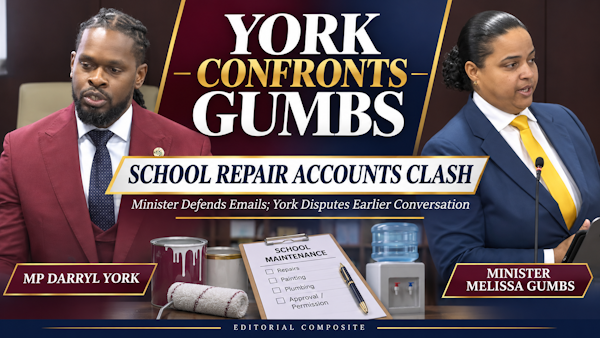 PHILIPSBURG: --- MP Darryl York confronted Minister of Education, Culture, Youth and Sport Melissa Gumbs over her account of discussions concerning structural repairs at Marie Genevieve de Weever School, prompting a defensive response from the minister during the November 6 budget debate.
Gumbs read January 2026 correspondence into the parliamentary record to support her position that structural repairs could not form part of York’s Adopt-a-School initiative. York countered that the emails did not settle his central complaint: he maintained that their original face-to-face conversation in January 2025 had allowed repairs under departmental supervision, before that position changed.
“I don’t take too kindly to being called a liar on the floor of Parliament,” Gumbs said as she returned to the dispute.
The confrontation unfolded alongside renewed demands from MPs Sjamira Roseburg and Omar Ottley for a practical funding solution to student hunger. They questioned whether money being considered for school repairs could also help finance meals for children struggling to learn without adequate nutrition.
Gumbs turns to correspondence to defend her account
Gumbs said she wanted to clarify an email from which one passage had previously been read.
She then presented York’s January 20, 2026 message concerning the Adopt-a-School initiative.
According to the email as read into the record, the project initially concerned painting, new water coolers, and minor roof repairs, financed through public sponsorship without a direct transfer of money to the school.
The email referred to a previous meeting in which York said Gumbs had given her blessing and directed him to coordinate with the head of the Division of Public Education for the necessary approvals.
It also contained the passage at the center of York’s argument: that structural repairs, such as work on the roof, should have proper departmental oversight to avoid liability issues.
Gumbs disputed that interpretation, maintaining that she had explained the ministry’s liability concerns and had not authorized structural repairs.
The email went on to state that, following further discussions with Public Education, York would proceed only with painting and installing water coolers.
He reported having 18 buckets of paint and two new water coolers and requested approval to execute those non-structural elements.
Cabinet response expressly excluded structural work
Gumbs said her Chief of Staff replied that same afternoon while she was on vacation.
The response thanked York for supporting the school and confirmed that the proposed donation could proceed, with the Cabinet and Public Education facilitating administrative coordination and supervisory support.
It explained that school leadership and the head of Public Education were responsible for submitting and tracking donations through the ministry’s internal process.
The protocol, the correspondence stated, was intended to ensure coordination, transparency, and alignment with needs across public schools, rather than burden donors.
However, the reply expressly stated that structural and infrastructural repairs could not form part of an Adopt-a-School arrangement.
The ministry remained responsible for major repairs, safety, and insurance.
Gumbs also told Parliament that she subsequently asked York to hold off on painting because planned repair work could damage newly painted surfaces. She said it would be wasteful for sponsors to finance painting that would then be disturbed by drilling or other repairs.
“I support reading comprehension training development for all,” the minister added at the conclusion of her explanation.
York says the dates are central to the dispute
York responded directly to that remark.
“An important part of reading comprehension is not only letters, but it’s also numbers,” he said.
He emphasized that the meeting he was discussing occurred in January 2025, while the email Gumbs had read was written in January 2026.
His complaint, he said, concerned what happened between those two points.
According to York, the original conversation had left him with the understanding that he could proceed with structural assistance provided the department supervised the work.
He maintained that the position subsequently changed from permission with oversight to a prohibition on structural work.
“The script changed,” York said.
He did not deny that he later agreed to limit the initiative to painting and water coolers. Instead, he said that was a practical decision to secure some benefit for the school rather than continue fighting over work he had been told was no longer permitted.
“Something is better than nothing,” he said.
Emails establish the later restriction, not agreement on the earlier conversation
York argued that his acceptance of the restriction in 2026 did not mean the original discussion had happened as Gumbs described it.
He demanded that the minister acknowledge the difference between their earlier conversation and the subsequent instruction.
“You’re allowed to change your mind, but don’t act like it was never said,” York told her.
The exchange left their accounts of the original meeting unresolved. The correspondence read into the record established that structural repairs were expressly excluded in the Cabinet’s January 2026 response. It did not, by itself, establish exactly what had been said during the January 2025 meeting or that the minister knowingly misled Parliament.
Gumbs’s defensive presentation of the emails therefore did not end the disagreement. York continued to distinguish between the later written restriction—which he accepted—and the earlier verbal guidance—which remained contested.
Roseburg presses for funding to feed children
While the repair dispute occupied parliamentary attention, Roseburg returned to student meals.
She referred to the 50,000-guilder allocation approved during the 2025 budget process and said her concern went beyond identifying which ministry should provide an implementation update.
She wanted to know how the government would finance a sustainable program and whether ECYS would support directing additional resources toward feeding children.
Roseburg cited a proposal to provide breakfast and a mid-morning snack to approximately 400 students, with an estimated annual funding requirement of 576,000 guilders.
She linked that need to MP Raeyhon Peterson’s announced intention to redirect part of Parliament’s travel budget toward school repairs.
If an amendment made additional resources available, Roseburg asked, would the minister support allocating some of that money to meals?
“School needs repairs. But if a child is still hungry, the child cannot focus,” she said.
Her argument was that school buildings and student nutrition both required attention, and Parliament needed a clear funding response.
Ottley calls for an “ultimate solution”
Ottley supported the demand for clarity.
He recalled an earlier nutrition initiative that, according to his account, had fed more than 160 children during his tenure as VSA Minister.
He said the program was intended to continue in collaboration with education and referred to subsequent budget arrangements that he understood had moved funding toward education.
Those statements were not reconciled with the current budget allocations during the supplied exchange.
Ottley asked whether insufficient funding was preventing continuation and whether Parliament needed to amend the budget.
He also urged the minister and MPs to move beyond the argument over repair permissions.
“I need the ultimate solution,” he said.
At the center of his intervention were two immediate needs: schools requiring repairs and children requiring food. If money was the obstacle, he argued, Parliament needed to know so it could decide what to do.
Questions remain on the government’s preferred approach
Roseburg also sought confirmation that her question about the CRT pilot program had been forwarded to VSA after ECYS identified that ministry as responsible for implementation.
Returning to meals, she referred to the 2025 parliamentary decision requiring VSA to work closely with ECYS and existing NGO partners.
If government did not support another amendment, she asked whether other budget allocations could be made available to keep the initiative going.
She requested the ministry’s preferred approach rather than another referral between portfolios.
The supplied excerpt ended before Gumbs answered those follow-up funding questions. It therefore did not establish whether she supported dividing a proposed reallocation between repairs and meals, or whether government would identify additional resources elsewhere.
Gumbs outlines work under the governing accord
Earlier in this portion of her responses, Gumbs addressed MP Sarah Wescot-Williams’s request for ministers to explain how commitments in the governing accord were being implemented.
She grouped ECYS’s work into equal opportunity and access, human capital development and economic growth, and nation-building, identity and social cohesion.
Gumbs said the study financing ordinance was finalized and awaiting ratification.
She identified initiatives at different stages involving special-needs education, higher education financing, school transportation, student insurance, early childhood development, school reconstruction, literacy, numeracy and school safety.
Teacher development and retention, career guidance, coding and robotics, and a national artificial intelligence education policy framework also formed part of the agenda.
In culture and youth development, she referred to creative-industry initiatives, support for an artists’ guild, youth participation, child protection, positive parenting, heritage preservation and library reconstruction.
Gumbs acknowledged that some commitments were completed, others were being implemented, and others still required policy development and decision-making.
Personal-device restrictions still being considered
Responding to Wescot-Williams on classroom devices, Gumbs said she supported moderate technology use for legitimate educational purposes.
However, she did not believe students’ personal devices belonged in lessons unless their use was specifically authorized for learning.
She said the issue had been discussed briefly with the head of Public Education and her youth cabinet.
Parents needing to reach children during an emergency could contact the school, she argued.
The minister also reported youth-cabinet feedback that some students had allegedly been charged to use school telephones to contact their parents. She called that unreasonable, particularly in emergencies.
“It is a school, not a prison,” Gumbs said.
She encouraged schools to consider appropriate network filtering while the ministry continued examining the implications of personal-device restrictions. She did not announce an island-wide ban or an implementation date.
Regional cooperation supported
Gumbs deferred formal questions about CARICOM associate membership to the Prime Minister but advocated greater government-to-government engagement across the Caribbean.
Cooperation with CARICOM countries and institutions such as the Caribbean Development Bank could contribute to nation-building, she said.
She also called for fiscal discipline, respect for rules and a willingness across government, Parliament and the business community to set egos aside when determining the country’s direction.
Labega confirms overdue contractor received payment
During the clarification round, MP Dimar Labega said a company whose overdue payment he had raised earlier had informed him the money had arrived.
The company had repaired the Receiver’s Office and, according to Labega’s earlier complaint, had waited eight months for payment.
He thanked the government and an official from the Prime Minister’s Office who had contacted him about resolving the matter.
That announcement provided an immediate outcome during proceedings in which the school repair dispute remained unsettled and MPs were still awaiting answers on how the government would sustain meals for vulnerable students.