






Minister targets end of November for draft decree, declines to promise refunds without financial verification and faces MPs’ demands for immediate consumer relief.
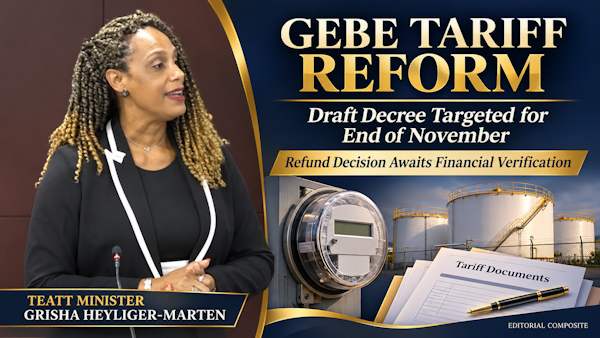 PHILIPSBURG:--- TEATT Minister Grisha Heyliger-Marten told Parliament that GEBE failed to submit a requested proposal addressing deficiencies in its electricity tariff calculations, prompting Bureau Telecommunications and Post to prepare the fuel-clause framework itself.
Responding to MPs during the November 6 debate on the 2027 draft budget, the minister said a draft national decree containing general measures was expected by the end of November. She subsequently clarified that this would mark the beginning of the decree’s formal process, rather than the immediate implementation of new tariffs.
Heyliger-Marten also declined to commit to refunds or credits based solely on the fuel-cost surplus identified in the April 2025 RAC/BTP evaluation. She maintained that a broader, verified financial assessment was needed before the government could determine whether to return money to customers.
Her detailed responses drew acknowledgment from MP Sarah Wescot-Williams, but also renewed pressure to establish the proper tariff framework and deliver tangible relief.
GEBE did not provide the requested corrections
Addressing Wescot-Williams’s questions about implementing the RAC/BTP recommendations, Heyliger-Marten said the evaluation identified several deficiencies in the existing fuel-clause methodology.
These included timing mismatches in calculations, allocating electricity fuel costs to potable water production, and using a fixed percentage for non-revenue electricity instead of a dynamic calculation.
According to the minister, the government required GEBE to submit a proposed structure addressing those matters, together with its own consumption, allocations associated with Seven Seas and a correction to the N1 calculation.
“GEBE failed to provide the requested proposal,” she said.
Consequently, BTP was preparing the structure for submission to government.
Heyliger-Marten argued that the formula could and should be corrected, but through a verified and legally established methodology rather than arbitrary changes to individual figures.
End-of-November target is for a draft
Following requests from MPs for a specific timeline, the minister identified the end of November 2026 as the expected delivery point for the draft fuel-clause decree.
MP Sjamira Roseburg immediately sought clarification, noting that a draft would still have to pass through the applicable advisory process.
Heyliger-Marten confirmed that distinction.
It would be a draft “for us to start,” she said, rather than a completed instrument already in force.
The minister said a separate draft concerning the base tariff structure, including categories of utility connections, would follow.
She also referred to provisions for vulnerable consumers, including Tariff 16.
Her response did not establish when the complete framework would take effect or when customers would see resulting adjustments on their bills.
Minister acknowledges a longstanding legal gap
Heyliger-Marten said the evaluation found that electricity tariffs were not being established through the mechanism prescribed by the Electricity Concession Ordinance.
In her explanation, the ordinance required tariffs to be determined by a national decree containing general measures, based on cost orientation and allowing departures for social considerations.
During clarification, she said the required decree had not been established since 2010.
That was the minister’s account of the regulatory gap. The debate itself did not constitute a court determination concerning the legality of individual bills or customers’ entitlement to compensation.
Wescot-Williams nevertheless stressed the urgency, saying she had requested and examined the basis GEBE was using and found it insufficient for current operations.
She also noted that consumers had brought the matter of electricity and water charges before the courts, while acknowledging that the outcome was unknown.
MP Omar Ottley called for a firm timetable and said Parliament should be informed promptly if a deadline could not be met.
No refund commitment on the surplus figure alone
Asked whether government could return or credit the fuel-cost surplus identified in the evaluation, Heyliger-Marten refused to treat the reported figure as sufficient on its own.
“Not responsibly on the basis of the reported figure alone,” she said.
According to her explanation, the report called for a broader cost-coverage analysis examining fuel expenses against fuel-clause revenues, alongside operating and capital expenses against base-tariff revenues.
She said the information required to complete that assessment had not been available during the evaluation.
Before deciding whether an amount should be returned or credited, the government would therefore need verified financial information.
“I am not dismissing the recommendation,” she said. “I am saying that any decision involving consumer money must be supported by a complete and reliable financial assessment.”
She did not announce a refund amount, eligibility criteria or payment date.
Water-production costs require coordinated review
Heyliger-Marten said electricity costs associated with potable water production could not be examined separately from the water tariff structure.
She said the evaluation identified deficiencies in both areas and recommended a comprehensive review supported by an impact analysis.
Correcting one component without examining the other could produce unintended consequences for consumers, she cautioned.
She also linked the work to discussions involving the responsible ministries over a possible extension of the Seven Seas water-production agreement.
Her position was that corrections should proceed, but based on verified calculations and through coordination with the responsible ministries.
BTP oversight and audited information
The minister said government had designated BTP as supervisor under the electricity concession framework, moving one central recommendation of the report into implementation.
That designation, she argued, created a foundation for independent concession monitoring, tariff review and greater transparency.
However, she explicitly acknowledged that not every recommendation had been implemented.
Heyliger-Marten also said the evaluation noted that an accountant had not audited the quantitative information used.
She maintained that audited financial information was essential to independently verify the costs used to determine consumers’ charges.
“Consumers should not simply receive a bill with a number,” she said. “They should be able to understand how that number was calculated.”
Fuel supply chain faces broader scrutiny
Heyliger-Marten said the RAC/BTP evaluation found GEBE’s light and heavy fuel procurement prices broadly followed international market movements, while identifying additional components requiring attention.
She listed premium surcharges, insurance, procurement, inspection, loss allowances, remittance tax, throughput charges and marketing differentials.
Her objective, she said, extended beyond reviewing individual charges to examining procurement, transportation, storage and supply arrangements.
She proposed exploring GEBE’s own storage and pipeline infrastructure to create more opportunity for competitive procurement, alongside a faster transition to renewable energy.
These were directions for examination, rather than announcements of approved or financed infrastructure.
Throughput rate and cost share are different figures
Questions from MPs Darryl York and Francisco Lacroes also focused on port throughput fees.
The minister initially specified rates of eight cents per liter for regular fuel imports and four cents per liter for fuel imported for sale to the airport and GEBE.
She separately explained that the 1.3% figure in her presentation represented the port fee’s approximate share of GEBE’s total monthly fuel purchasing expenditure—not the per-liter tariff.
Using her stated figures of approximately US$100,000 in monthly port throughput fees against US$7.5 million in GEBE fuel purchases, she argued that removing the port charge alone would produce limited savings.
She said she had requested information on total throughput revenues since its introduction and would provide it in writing.
Lacroes also raised questions about the Causeway loan and sought port audited statements. Those questions were not fully resolved in the supplied exchange.
Irion presses the case for relief now
MP Ardwell Irion challenged the minister’s emphasis on structural reforms, arguing that households needed assistance immediately.
Heyliger-Marten responded that recurring cash injections could not be the principal solution to electricity costs.
A subsidy could provide targeted temporary relief, she said, but would shift part of the expense from consumers’ bills to the national budget without necessarily reducing generation costs.
Irion interrupted to clarify that his question concerned relief for people suffering now, while longer-term plans remained unimplemented.
The minister maintained that sustainable reductions required more efficient generation, scrutiny of fuel costs, independent oversight, solar energy and battery storage.
She said GEBE was advancing plans for approximately 6.5 megawatts of solar capacity alongside battery storage. She did not provide a commissioning date or a quantified household-bill reduction.
Roseburg offers legislative assistance
Roseburg renewed questions about the absence of the tariff decree and reiterated the importance of investigating how the situation had developed.
Heyliger-Marten welcomed a copy of Roseburg’s proposed legislative amendment, saying it could be considered alongside BTP’s recommendations.
The minister’s responses established a target for producing the draft framework and explained why she was not yet promising refunds. MPs’ remaining challenge was for that regulatory work to produce a dependable implementation timetable and relief that customers could measure on t