






DP MP demands application deadlines, technical advice and written grounds for outstanding decisions, while challenging government to act on longstanding tax-compliance recommendations.
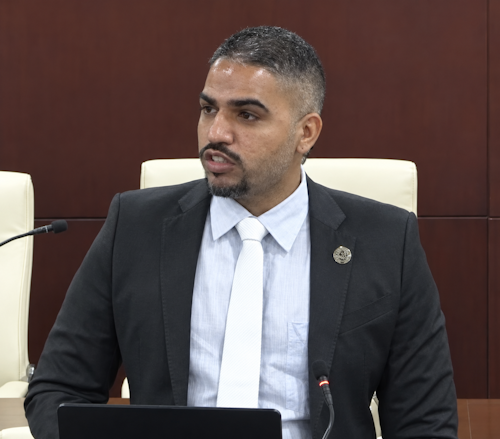 PHILIPSBURG — Democratic Party MP Viren Kotai has demanded a detailed explanation from VROMI Minister Patrice Gumbs Jr. about outstanding permits for the Setai development at Indigo Bay, asking whether delays have resulted in court proceedings and exposed the government to potential legal or financial liability.
During the 2027 budget debate, Kotai sought an application-by-application account of the development’s permitting position, including submission dates, decision-making deadlines, completed technical assessments and the reasons final decisions remained outstanding.
His questions challenged the minister to explain the administrative and legal basis for the handling of a major development rather than offer a general statement about the project.
Kotai asked whether government had provided formal written decisions and what specific steps it intended to take to bring the outstanding matters to a lawful conclusion.
His statement did not establish that government had acted unlawfully or that a court had imposed liability. It sought confirmation of the proceedings and the facts needed for Parliament to assess the ministry’s handling of the applications.
Has the dispute reached court?
Kotai first asked Gumbs to confirm whether the developers had initiated legal proceedings against the government over how it handled the permit applications.
If proceedings had begun, he wanted the minister to identify the administrative matters at the center of the dispute and explain how the situation had reached that point.
He then requested a complete overview of the outstanding applications.
For each, Kotai asked when it was submitted, what legal decision-making deadline applied, and why the ministry had not issued a final decision.
He also asked whether any applications had exceeded their prescribed decision periods and, if so, by how long.
Those questions placed the ministry’s processing record under scrutiny without assuming that every outstanding application should necessarily be approved.
The issue Kotai raised was whether government had assessed the applications, reached decisions within the applicable framework and properly communicated its grounds.
What did the technical departments recommend?
Kotai asked whether VROMI’s technical departments and the relevant advisory bodies had completed their assessments.
He wanted to know what recommendations had been submitted and whether any were positive.
Where assessments were complete, he asked what specific legal or technical considerations still prevented the minister from issuing final decisions.
He also questioned whether those reasons had been formally communicated to the developer.
The distinction between technical advice and a final ministerial decision was central to his intervention. Kotai sought to establish where the process stood and which outstanding considerations were preventing it from moving forward.
Can one permit issue hold up another application?
Kotai also asked whether decisions on some applications had been delayed because of concerns relating to other permits associated with the same development.
If that was the case, he requested the legal provisions allowing the government to withhold a decision on one application because of matters arising under another.
He further asked whether each application had been assessed independently according to its own legal requirements.
That line of questioning called for a precise explanation of the relationship between the applications, rather than treating the development as a single unresolved file.
Kotai concluded by asking whether delays had exposed government to potential legal or financial liability.
He referred to the scale of the investment and its anticipated economic contribution, but his request remained focused on lawful administration: written grounds, identifiable decisions and concrete steps toward resolving the matters.
An import-registration recommendation still awaiting answers
Kotai’s wider economic contribution also challenged government over the implementation of a longstanding recommendation on commercial imports and exports.
He referred to March 2016 advice from the Social Economic Council calling for a registration system linking commercial trade through the harbor and airport to businesses’ CRIB numbers.
The objective, he explained, was to strengthen tax compliance, improve revenue collection, support information-sharing and create a more level playing field.
“Nearly 11 years later, my question is, what have we actually implemented?” he asked.
Kotai wanted to know whether all commercial imports and exports were registered against verified CRIB numbers.
He also asked whether Customs and the Tax Administration were sharing and reconciling the information and using it to identify unregistered economic activity and strengthen turnover-tax compliance.
His challenge concerned whether an existing recommendation had become an operational system capable of producing results.
Transaction tax: Model the proposal before deciding
Kotai asked Finance Minister Marinka Gumbs for her position on the financial transaction tax concept presented by TEATT Minister Grisha Heyliger-Marten.
He did not call for immediate implementation.
Instead, he asked whether the minister considered the concept worthy of economic and fiscal modeling, even if she had reservations.
He specifically questioned whether a transaction tax could form part of a broader restructuring in which existing taxes might eventually be reduced, restructured or replaced.
Kotai referenced approximately 11.8 billion guilders in payment transactions examined for 2022 in the TEATT presentation.
He asked whether the scale of that recorded activity warranted further investigation of a broad transaction base as an alternative way to raise revenue.
That figure was presented as a reason to study the concept; it did not establish the size of a workable taxable base or the amount a new tax would collect.
Kotai proposed comparing a transaction-tax model with the present structure on revenue collection, compliance, administrative costs, and effects on economic activity.
His final question was whether the concept should be rejected in principle or examined through modeling before a decision.
Could the port and airport work under a unified structure?
Kotai also called for an assessment of closer cooperation between Port St. Maarten and Princess Juliana International Airport.
He described them as government-owned gateways central to the tourism economy and questioned whether their largely separate operations overlooked opportunities for shared services, coordinated investment and economies of scale.
He asked whether government had formally assessed a unified air and seaport authority.
If not, he wanted to know whether the TEATT minister would consider commissioning that assessment as part of the medium-term economic strategy.
Kotai requested an independent cost-benefit analysis to establish what savings could be achieved without compromising safety, service quality or operational efficiency.
He also asked whether coordinated financing and investment could improve profitability and strengthen the entities’ negotiating position.
Cooperation requires financial and legal groundwork
Kotai acknowledged that the port and airport had distinct assets, financing arrangements and obligations.
He therefore proposed financial and legal due diligence before pursuing any unified holding structure.
That work, he said, would need to protect existing assets, preserve financial stability and respect lender covenants and regulatory obligations.
He suggested beginning discussions with the supervisory boards and management toward a formal memorandum of understanding on strategic cooperation.
An independent feasibility study and a phased roadmap over approximately three years could then determine whether a unified authority served the country’s interests.
The proposal was for an assessment, rather than an immediate merger or an assertion that consolidation would automatically save money.
Across his contribution, Kotai demanded evidence on both existing problems and new proposals: the legal grounds for delayed permits, the actual implementation of import controls, the modeled effects of a transaction tax and the financial case for closer port-airport cooperation.
He left further questions for the second round of the debate.