






After challenging his own Democratic Party colleague over delayed reforms and missing results, Dimar Labega must decide whether accountability carries consequences or ends when the microphone switches off.
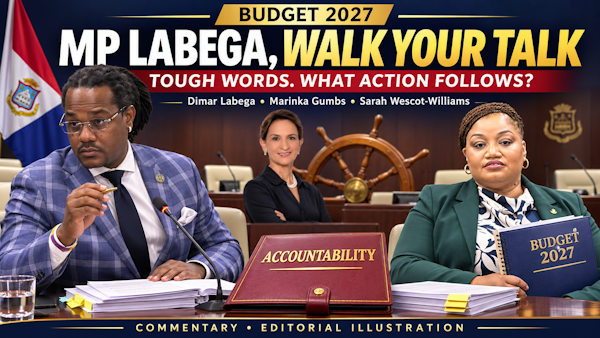 PHILIPSBURG:--- MP Dimar Labega has publicly questioned whether Finance Minister Marinka Gumbs has a solid strategy beyond upgrading the Tax Administration. He has challenged her urgency, criticized vague answers and demanded that she take command of the government’s revenue agenda.
Those are serious criticisms. Coming from a Democratic Party colleague who ran on the same slate, they cannot reasonably be treated as routine opposition rhetoric.
But MP Labega, the next question belongs to you: what are you prepared to do about the failures you have identified?
A parliamentary speech can expose a problem. It cannot, by itself, correct a defective budget, secure credible investment planning or force delivery of overdue legislation. If your assessment is as serious as your words suggest, your parliamentary conduct must now reflect it.
Otherwise, taxpayers will have witnessed another forceful performance followed by business as usual.
The record must be correct before the criticism can be effective
The budget that required a second parliamentary vote was 2025, rather than 2024.
The distinction matters. In October 2024, the government announced a 2024 budget amendment that reduced both projected revenue and expenditure by about 25 million guiders. The same announcement said it would present the 2025 budget to Parliament by early November, leaving enough time for approval before December 15, 2024. That was a public commitment to timely budgeting.
What followed was a different story.
Parliament approved the 2025 budget in January, but technical and legal problems with incorporating government and parliamentary amendments prevented ratification. Gumbs returned with a new draft, explaining that the previously approved changes had now been properly incorporated. Parliament voted again on June 24, 2025.
An ordinary budget amendment and a budget that cannot be ratified are different matters. The latter represents a breakdown between parliamentary approval and an executable financial instrument.
Labega cannot place himself outside that history. Reporting on the June vote lists him among the MPs who supported the replacement 2025 budget, alongside DP colleagues Sarah Wescot-Williams and Viren Kotai.
That vote does not make him responsible for every technical error. It does mean he helped sustain the minister’s budget program and now owes the public an explanation of what will change.
The Minister has already acknowledged the standard
When the 2026 budget was submitted to Parliament in June, Gumbs acknowledged it was late.
“First and foremost, I must acknowledge that Budget 2026 was submitted later than it should have been,” she said in government’s announcement. She also argued that government must apply to itself the standards it expects taxpayers to meet.
That principle is difficult to dispute.
Government expects businesses and residents to file, pay and comply. It must therefore accept scrutiny when its own financial planning arrives late or lacks the information needed for assessment.
In February 2026, the ministry had already acknowledged that the timetable for the 2026 budget was missing because of technical delays connected to the 2025 budget. It also abandoned the outstanding 2025 amendment, explaining that pursuing it after the year had ended would compound delays.
The problem was no longer confined to one unsuccessful budget exercise. Its consequences had carried into the following cycle.
What the CFT actually found
It would be inaccurate to say simply that the CFT “has not approved the 2026 budget.” Its latest assessment concerns a budget already adopted.
The CFT received it on September 24, 2026, against a December 15, 2025 deadline. Its published advice found that earlier recommendations had been insufficiently addressed, leaving it unable to determine whether the central budgetary standard was met. Consequently, it could not issue positive advice on the approximately 42.1-million-guilder investment borrowing request.
The deficiencies were substantive: inadequate multi-year investment planning, missing project-fund information and inconsistencies in supporting figures. One example placed free liquidity at 41 million guilders in the explanatory text but 5 million in the table. The CFT acknowledged progress toward a timely 2027 budget while stressing that quality still required considerable improvement.
That is the accountability issue Labega must pursue. Earlier submission is welcome; it does not settle questions about reliability.
MP Labega, turn your questions into conditions
During his November 3 contribution, Labega said:
“I believe there is no solid strategic plan past tax administration upgrades. I hope that I’m wrong.”
He also said:
“But we can’t approve or deliberate what hasn’t reached us.”
Those statements should now become a concrete parliamentary agenda.
Demand a written schedule for each major revenue proposal, identifying its present stage, outstanding advice, responsible ministry, and intended submission date.
Require government to reconcile its investment plans with its borrowing requests and explain which projects can realistically be executed.
Insist on a written response to the CFT’s findings, with deadlines for correcting deficiencies and scheduled parliamentary follow-up.
Use motions, amendments and subsequent votes to test whether the minister has delivered.
These are practical steps toward accountability. Their significance depends on what happens when a deadline is missed. A motion followed by silence is another form of postponement.
Political consequences cannot be permanently excluded
Accountability does not require an MP to begin with the most severe measure available. A clear, closely monitored corrective program may produce results.
But if Labega concludes that the minister lacks the strategy, urgency or capacity required—and government then fails to meet explicit corrective conditions—he must be prepared to reconsider his political support.
A censure motion, or ultimately a motion of no confidence, should be judged on demonstrated performance and the seriousness of unresolved failures. Party membership cannot provide permanent immunity from that judgment.
Labega cannot credibly tell the public that the minister is failing while treating continued support as automatic.
He must either explain why the answers restore his confidence or identify the action he will take because they do not.
Will the DP Captain repair the ship—or merely contain the damage?
Sarah Wescot-Williams faces a related political test as Democratic Party leader.
The question is not whether colleagues should resolve disagreements. They should. The question is what their reconciliation produces.
If the DP’s captain helps secure accurate budgets, credible deadlines and enforceable follow-through, that would serve taxpayers.
If the outcome is simply to calm Labega, protect Gumbs and carry on without measurable correction, the hole in the ship will have been concealed rather than repaired.
This exchange alone provides no basis to claim that such an intervention has occurred. The party now faces that choice.
Taxpayers should not be railroaded into accepting another declaration of progress while the same weaknesses remain unresolved.
The next vote will Say more than the speech
Labega’s criticism has created an expectation.
He has identified the minister’s leadership as a problem, challenged explanations that place responsibility on Parliament and demanded a clearer revenue strategy. He cannot now reduce those concerns to talking points that disappear after the debate.
MP Labega, put your conditions on the record. Publish your deadlines. Follow up publicly. If the minister meets the standard, acknowledge it. If she fails, act accordingly.
The public has heard your dissatisfaction.
Now show taxpayers what your dissatisfaction changes.