






DP MP presses VROMI on implementation, questions delays in support for local talent and renews his call for dedicated sports funding.
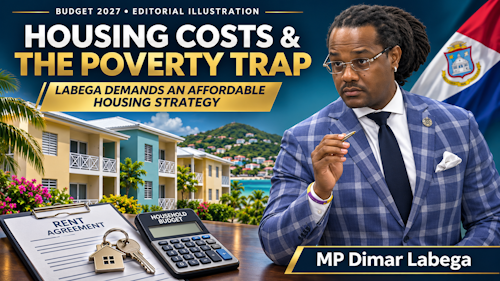 PHILIPSBURG:--- Democratic Party MP Dimar Labega has challenged the government to explain how its poverty reduction ambitions will translate into affordable housing, sustainable funding and practical opportunities for residents.
During the 2027 budget debate, Labega identified housing costs as a central pressure on household finances and asked VROMI Minister Patrice Gumbs Jr. for a concrete strategy to expand affordable accommodation.
“Skyrocketing housing and rental costs are the single largest driver of the poverty trap in St. Martin,” he argued.
He claimed that low- to middle-income families frequently spend between 50% and 70% of monthly income on housing. He did not cite a supporting study for the figure, so that range remains his stated assessment rather than an independently established national statistic.
His broader argument was that poverty reduction cannot be separated from the expenses consuming residents’ earnings.
Housing Policy Must Become an Implementation Plan
Labega acknowledged that Parliament had received a housing policy earlier in the year but asked what would happen next.
He recognized that government lacked the resources to develop all the required housing itself.
His questions therefore focused on execution: whether public-private partnerships were being pursued, how partners would be identified and what strategy would move the policy into actual development.
“What is the strategy moving forward?” he asked.
The distinction matters for households awaiting relief. A policy can establish objectives, but delivery requires financing, suitable sites, participating developers and arrangements that keep the resulting homes within reach of the intended residents.
Labega’s contribution sought clarity on the route from the government’s housing ambitions to practical results.
Poverty Reduction Requires Resources Across Ministries
Labega spoke positively about discussions with VSA Minister Claret Connor and his staff.
He said the productive meeting addressed financial assistance, community development, and a previously approved motion calling for a national poverty reduction plan.
He welcomed the ministry’s interministerial approach and work toward a task force.
However, he returned to a recurring theme throughout his contribution: implementation requires money.
“The key factor in poverty reduction is having the necessary resources to do that,” he said.
His remarks linked the social agenda to his broader criticism of delays in new revenue measures. Government, he argued, cannot indefinitely expand its commitments without explaining how it will fund them.
Sports Levy Proposal Returns to the Debate
Addressing ECYS Minister Melissa Gumbs, Labega requested an update on his proposal for a levy on gasoline and diesel sales to support sports.
He acknowledged objections that residents already face high living costs.
Nevertheless, he argued that athletes continue to develop and travel, creating an ongoing need for government support.
He also asked about the minister’s lottery-related funding idea.
His contribution did not announce an approved levy, a rate or an implementation date. It renewed the debate over whether sports should receive a dedicated revenue stream and how any additional charge would affect consumers.
The issue now requires government to explain the potential yield, administration and intended use of such funding before a proposal becomes a commitment.
Local Ambassador Program Faces Questions Over Delay
Labega also pressed TEATT Minister Grisha Heyliger-Marten about the local ambassador program, which he said had received unanimous approval during the 2025 budget process.
He asked why implementation was taking so long.
Local personalities, he argued, are advancing in their careers while missing opportunities to increase their exposure and promote St. Maarten.
He questioned whether local public relations firms and local talent would participate in the ministry’s wider marketing strategy, including expansion into additional overseas markets.
Where support was necessary, he asked how local participants could be helped to meet international standards.
The questions place local participation alongside destination promotion: residents and businesses should be able to contribute to, and benefit from, the country’s marketing expenditure.
Airport Should Reflect More of St. Maarten
Labega further suggested that the airport could better showcase the island’s culture.
He proposed stronger representation of local heritage, personalities and events, including interactive information for departing travelers.
Drawing on an example he had seen in Newark, he suggested trivia displays that could introduce visitors to St. Maarten’s history and identity while they wait.
Unlike major housing developments or national funding reforms, this proposal offers a comparatively focused discussion about how an existing public-facing space can promote local culture.
A Demand for Practical Benefits
Across housing, poverty reduction, sports and tourism promotion, Labega’s questions shared a common concern: how government plans will produce benefits that residents can identify.
He welcomed coordination where he had seen it, particularly in his discussions with VSA, while demanding greater clarity about implementation elsewhere.
The ministerial responses must now explain how affordable housing will be pursued, how poverty reduction will be financed, and when promised support for athletes and local ambassadors will become operational.