






Minister identifies an estimated 11.8 million guilder funding gap, warns of mounting student support costs, and challenges a sports spending model centered on travel rather than development.
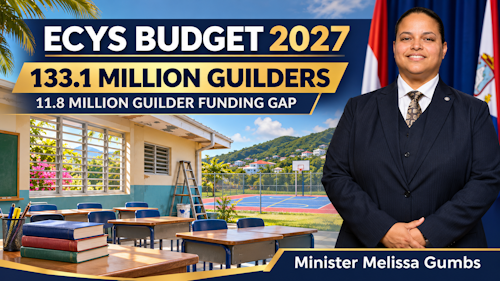 PHILIPSBURG:--- Minister of Education, Culture, Youth and Sport Melissa Gumbs has told Parliament that her ministry’s proposed 133.1 million guilder budget for 2027 will sustain essential services but will not provide the investment necessary to resolve longstanding problems in education, school maintenance, cultural preservation, youth development and sport.
Presenting the ECYS budget, Gumbs identified an estimated 11.8 million guilder strategic funding gap, including approximately 6.1 million guilders in education alone. She cautioned that the actual requirement could be higher as the ministry assesses and costs its outstanding needs more thoroughly.
The proposed allocation represents an increase of approximately 7.1 million guilders, or 5.64%, over the 2026 budget of 126 million guilders. Gumbs said the ministry’s actual expenditure in 2025 was about 117.8 million guilders.
Despite that growth, her central message was that a larger budget does not automatically translate into greater capacity to improve services. Existing commitments, salary adjustments, subsidies and rising operating costs consume much of the available funding before new initiatives can begin.
Asked whether the increase would adequately finance the improvements expected by Parliament, the public and the ministry itself, Gumbs answered plainly: “The answer, to be quite blunt, is no.”
Most of the Budget Already Has a Job
The proposed expenditure comprises approximately 34.3 million guilders in personnel costs, accounting for 26% of the budget, and 98.8 million guilders in material costs, accounting for 74%.
Within the material allocation, education subsidies account for approximately 74.2 million guilders, projects and activities for 11.8 million guilders, and operational costs for 12.8 million guilders.
Those commitments leave limited flexibility to address deferred maintenance, expand specialized services or undertake broader reforms.
Gumbs emphasized that the estimated funding gap represents planning assumptions based on ministry-reported needs, staffing shortages, maintenance backlogs and reform requirements. It is not a collection of audited project costs.
That distinction matters: the ministry has identified substantial pressure, but Parliament still needs sufficiently detailed costing, priorities and delivery schedules to determine how additional funding should be allocated.
The minister argued that shifting money between existing obligations would not resolve the underlying problem. A lasting solution, she said, requires a government-wide approach to both revenue and expenditure.
Student Assessments Reveal the Cost of Unmet Needs
Gumbs used the Student Support Services Division, SSSD, to demonstrate how expanding access to essential services creates recurring financial obligations.
The division assesses students referred by schools and parents and contributes to school safety initiatives. Its work requires specialized assessment materials purchased through authorized suppliers, and certain purchases require professional credentials.
These materials cannot simply be photocopied to stretch the budget, she explained.
One speech assessment kit costs approximately US$325 and includes only 25 record forms. An additional 75 forms cost approximately US$255.
A separate assessment tool used to examine learning processes associated with reading, writing and mathematics costs approximately US$1,271, with limited materials included. Purchasing that kit with additional replenishment packs can cost approximately US$6,294, according to the minister.
The expenditure grows as more children require assessment and support.
Gumbs also relayed concerns from the daycare sector about speech development delays and other developmental needs among young children. She presented those concerns as a warning of additional pressure on services as these children enter school.
The policy challenge is significant: identifying more children who need assistance is a necessary improvement, but identification must be followed by funding for assessment, intervention, and continuing support.
New Care Center Will Address Only Part of the Need
The public education budget is expected to increase by approximately 2.2 million guilders, largely associated with introducing and staffing the Educational Care Center.
The center will provide targeted support for students with significant behavioral challenges and is intended to operate at the Charles Leopold Bell School in Cole Bay once reconstruction is completed.
Gumbs described it as an important step while acknowledging that substantial needs remain across special and inclusive education.
The center therefore represents one element of a wider response. Its establishment will not, by itself, resolve shortages in assessment services, specialized support or inclusive learning opportunities across the school system.
School Repairs Advance, but Wider Assessment Is Still Pending
Gumbs outlined ongoing efforts to address public school infrastructure, including roof problems, waterproofing, drainage and structural repairs.
At one primary school, engineers have conducted assessments to guide emergency works. She said immediate safety repairs to damaged staircase surfaces and an unstable railing have already been completed, while pest control and further corrective measures continue.
The minister reported that cleaning and security service tenders had been evaluated, with award recommendations submitted or being finalized before the required approvals and contracting.
A separate tender for a Structural Condition Assessment and Prioritized Repair Plan covering all seven public schools remains open until November 6, 2026.
That assessment is intended to guide repair priorities, budgeting, and preventive maintenance.
The ministry has also begun discussions with VROMI about using existing government resources to support routine public school maintenance.
These measures indicate progress, but the wider repair program will depend on translating assessments into funded work with clear completion dates.
Gumbs Challenges Sports Spending Priorities
The minister also questioned a longstanding expectation that government should finance travel to every sporting event.
She argued that this approach has often come at the expense of facilities, grassroots programs, coaching development and comprehensive athlete support.
Her presentation pointed to gaps in nutritional guidance, targeted physical training and clear development pathways for athletes.
The implication is that international participation must form part of a broader development strategy, supported by investment in the conditions that allow athletes to prepare and compete effectively.
Gumbs said similar concerns apply to culture and the creative industries, where historical spending practices have contributed to current weaknesses.
Work continues on a proposed gas levy fund for local sports development. A legal adviser is also examining an Aruban lottery-related legislative model to assess whether a similar mechanism could be adapted for St. Maarten in collaboration with TEATT.
These remain potential funding arrangements under examination.
Temporary Project Funding Cannot Carry Permanent Services
Alongside its regular budget, ECYS expects approximately 4.8 million guilders in country package reform support and 3.18 million guilders for the culture portfolio’s Future Roots initiative in 2027.
The reform support is intended to advance work on curriculum, staffing and salary structures, vocational pathways, early childhood development, education data and legal frameworks.
Gumbs repeatedly stressed that project funding cannot replace permanent financing.
Cultural preservation responsibilities continue after individual projects end. Educational reforms also generate ongoing needs for staffing, materials, maintenance and monitoring.
The ministry is developing a 2027–2037 strategic plan, with 2027 treated as a transition year and the new framework expected to become fully operational through Budget 2028.
For Parliament, the immediate issue is whether the 2027 allocation provides a credible bridge to that next phase.
Gumbs’ presentation drew a clear distinction between keeping services operating and improving them. Her ministry’s proposed budget supports continuity, but the estimated funding gap raises a harder question: how long can St. Maarten defer essential investment while expecting better outcomes from the same strained systems?
Answering that question will require both sustained financing and measurable accountability for what the additional investment delivers.