






Minister raises ambition for a billion-guilder national budget but explicitly rejects treating a five-percent illustration as a proposed rate
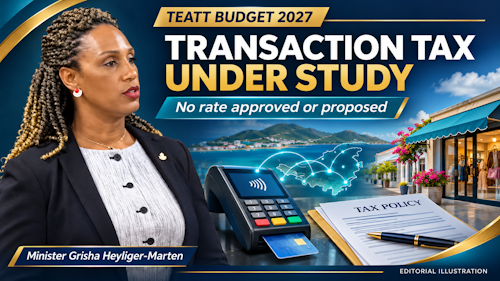 PHILIPSBURG:--- TEATT Minister Grisha Heyliger-Marten has called for research into a financial transaction tax as part of a broader overhaul that could reduce, restructure or potentially replace existing taxes.
Speaking during the draft 2027 budget debate, the minister said St. Maarten should examine whether a simpler revenue system could let workers keep more income, reduce administrative burdens on businesses, and support a stronger national budget.
However, she explicitly warned against interpreting an illustrative calculation using five percent as a government proposal.
“Five percent is not an approved or proposed rate,” she told Parliament.
Her presentation did not announce an enacted transaction tax, an implementation date, or the approved abolition of income, turnover, or profit taxes.
A replacement concept, rather than simply another charge
Heyliger-Marten described a possible mechanism under which a percentage charge would be collected automatically on clearly defined electronic transactions through the payment system.
The central question, she said, is whether such a mechanism could generate sufficiently predictable revenue to permit reductions in other taxes.
“It is not a proposal simply to add another tax on top of everything else people and businesses already pay,” she said.
The minister expressed interest in examining the possibility of eliminating income tax and turnover tax while significantly reducing or potentially abolishing profit tax.
Those ambitions would depend on a wider revenue strategy and supporting financial and economic assessments.
No existing tax obligations change as a result of the presentation.
Payment volumes are not automatically a taxable base
Heyliger-Marten referred to a model drawing on Central Bank payment-system statistics for 2022.
She stressed that the calculation illustrated the scale of payment activity rather than establishing a revenue forecast.
A proper study would first have to determine which transactions could responsibly be covered, which should be exempt, and how frequently the same money moves through the system.
The minister acknowledged that repeated charges could accumulate through supply chains, increase consumer prices or encourage a shift toward cash and other payment arrangements.
“A large volume of transactions is not automatically the same as a taxable base,” she said.
That qualification is central to assessing the concept: the total value of payments cannot simply be multiplied by a selected percentage and treated as dependable government income.
Would households actually be better off?
Heyliger-Marten said a reform would have to demonstrate a genuine improvement after all costs are considered.
“Reducing one tax achieves little if another charge makes grocery supplies and every service more expensive by the same amount or more,” she said.
The assessment would therefore need to examine household purchasing power, business costs, investment incentives, collection efficiency and the risk of repeated taxation of funds as they circulate.
The minister also questioned whether a transaction-based system could reduce the time taxpayers spend on filings, assessments, objections and uncertainty over amounts owed.
Those potential benefits remain questions for research, rather than established outcomes.
Billion-guilder ambition depends on broader reform
Against the draft national revenue projection of approximately 670 million guilders for 2027, Heyliger-Marten suggested examining what would be required to sustainably support a billion-guilder national budget.
She said that ambition would require credible projections, sound financial management and a phased strategy.
Other revenue options identified include a moderate tourism entry fee, modernized accommodation taxation covering short-term rentals and online platforms, maritime charges and carefully targeted excise or “sin” taxes.
She acknowledged that affordability, competitiveness, enforcement costs and the effect on lower-income households must inform their design.
They would need to assess the combined impact, rather than judge each measure in isolation.
Finance coordination remains essential
Heyliger-Marten placed TEATT’s role within economic policy, investment promotion and business development, working with the Ministry of Finance and other partners.
She said the TEATT management team members who attended the preliminary presentation supported pursuing the approach further. One manager was absent, and she said she could not speak for that person.
That internal support does not amount to Cabinet approval, parliamentary authorization or proof that the model is financially workable.
The proposal now requires the evidence the minister herself identified: a clearly defined base, credible revenue estimates, workable collection arrangements and a demonstration that replacing existing taxes would leave households and businesses better off.