






Finance minister outlines 94 million guilders in new borrowing while warning that staffing shortages, refinancing costs and government-company liabilities threaten fiscal stability
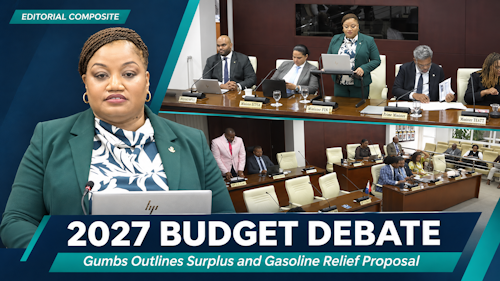 PHILIPSBURG:--- Finance Minister Marinka Gumbs has presented Parliament with a revised draft 2027 national budget projecting revenues of approximately 670 million guilders, expenditures of 660 million guilders and a surplus of 10 million guilders, while identifying a possible source of funding for temporary relief at the gasoline pump.
Addressing the public debate following Central Committee deliberations, Gumbs said the additional 2 million guilders in the revised surplus could be earmarked for gasoline relief, provided subsequent budget amendments do not consume those funds.
The minister said her ministry has already assessed a possible temporary reduction in the special import duty on gasoline from 0.29 guilders to 0.145 guilders per liter—a proposed 50 percent cut.
Her remarks offered a potential response to rising living costs, but did not announce an implemented reduction, a starting date, or how long the measure would remain in effect.
“I did and still do recognize that the impact on the consumer is real, particularly when higher fuel prices also contribute to the broader cost of living and doing business,” Gumbs told Parliament.
The proposed relief comes within a broader financial plan that combines an operating surplus with substantial additional borrowing for capital investments. Gumbs also acknowledged significant weaknesses in government’s capacity to collect revenue, implement reforms and monitor future financial obligations.
Budget corrections increase the projected surplus
The draft initially provided for approximately 662 million guilders in expenditures and an 8 million guilder surplus.
According to Gumbs, questions raised during the Central Committee debate about the treatment of the ENNIA arrangement prompted a correction that reduced projected expenditure by 3 million guilders.
A separate review identified about 1 million guilders in General Affairs building rent and maintenance expenses that had been inadvertently omitted from the original submission.
Together, the adjustments reduced projected spending by a net 2 million guilders, bringing expenditure to approximately 660 million guilders and increasing the anticipated surplus to 10 million guilders.
The revised result therefore reflects changes in the accounting and expenditure estimates. It does not represent an additional 2 million guilders in newly projected revenue.
Gumbs described the budget as grounded in existing revenue sources and reasonable expectations, stressing that government had excluded income from proposed measures that still require legislation or implementation.
Revenue forecast depends heavily on economic growth
Tax revenue is projected at approximately 497 million guilders, accounting for roughly three-quarters of anticipated government income and representing an increase of approximately 19 million guilders over the 2026 budget.
Gumbs linked that growth to economic activity, explaining that higher business profits, wages and consumer spending generally support stronger profit tax, wage tax and turnover tax collections.
Other revenue was presented at approximately 84 million guilders, fees and concessions at 65 million guilders, and licenses and permits at 25 million guilders. These rounded category figures slightly exceed the stated overall revenue total.
The minister attributed the projected increase in license and permit income largely to historical information, including business-license amounts invoiced during the current year. Higher bank-license fees are expected to support growth in fees and concessions.
Other revenue is expected to decline by approximately 4 million guilders, mainly because of lower project funding and grants.
The reliance on economic growth also leaves the forecast exposed to weaker performance. Gumbs acknowledged that external shocks, a narrow tax base, the informal economy and collection difficulties could undermine revenue expectations.
Tourist tax and gaming-tax proposals excluded from estimates
Gumbs said the revenue forecast does not include anticipated proceeds from a proposed tourist tax, revisions to government fees requiring legislative amendments, or a possible gaming-tax framework.
These initiatives remain part of government’s fiscal agenda, alongside efforts to strengthen tax assessment, collection and compliance.
However, she argued that including uncertain proceeds before legislation is approved and implementation arrangements are established would risk overstating government’s financial position.
The minister said those revenues would be incorporated into future estimates once implementation schedules and expected yields become sufficiently certain.
Their exclusion gives Parliament a clearer distinction between the income government expects under the existing framework and additional revenue it hopes future reforms will generate.
Personnel remains government’s largest expense
Personnel expenditure is projected at approximately 288 million guilders, the largest spending category.
Gumbs said staffing increases are intended to address longstanding vacancies, particularly in management and other critical areas where insufficient capacity affects the government’s ability to perform its duties.
She also acknowledged that most ministries’ organizational structures and function books have not been comprehensively reviewed since 2010.
Goods and services account for approximately 180 million guilders. Other major expenditure categories include subsidies of 106 million guilders, social provisions of 36 million guilders, interest of 30 million guilders, depreciation of 16 million guilders, and scholarships and allowances of 4 million guilders.
The figures illustrate the scale of government’s recurring obligations before additional policy initiatives can be financed.
New borrowing rises as 2026 investments move into 2027
Gumbs said government now anticipates approximately 94 million guilders in new borrowing during 2027, incorporating investments previously expected to be financed through a 2026 loan that will not materialize.
Outstanding loans are projected at approximately 1.004 billion guilders at the beginning of 2027. With new borrowing and scheduled repayments of approximately 22 million guilders, that balance is expected to reach approximately 1.076 billion guilders by year-end.
The projected operating surplus and the increase in debt concern different parts of the budget: the ordinary service covers recurring revenues and expenditure, while the capital service finances longer-term investments.
Gumbs placed the projected debt-to-GDP ratio at approximately 34.4 percent for 2027, citing IMF estimates, and maintained that the debt position remains manageable.
Nevertheless, she warned that additional debt carries interest costs that reduce the resources available for other priorities.
Two existing loans are expected to require refinancing in 2029 and 2030. Gumbs cautioned that replacement financing could carry higher interest rates, placing further pressure on liquidity and future budgets.
The ministry has initiated discussions on support from the Caribbean Regional Technical Assistance Center, CARTAC, for debt management and cash forecasting.
Buildings dominate major capital priorities
Among the major capital allocations outlined by Gumbs, approximately 59.2 million guilders is designated for nonresidential buildings.
Projects include 27.3 million guilders for Tax Administration accommodation, 10.5 million guilders for a new Meteorological Office building and 10 million guilders for a new Parliament building.
Approximately 9 million guilders is reserved for other government buildings, including acquiring properties currently rented, while a further 2.4 million guilders is allocated for repairs and maintenance of critical public facilities.
Gumbs said purchasing rented properties would increase the government’s assets while reducing recurring rental expenses.
Other allocations include 6.2 million guilders for land for a future multipurpose Education, Culture, Youth and Sport facility.
Infrastructure spending includes 9 million guilders for roads and 5.1 million guilders for other works, including cemetery and sewage infrastructure. A separate 2 million guilder ICT allocation includes a building-permit system.
ENNIA commitments draw on government’s liquidity
Gumbs also detailed the treatment of commitments connected to the ENNIA resolution.
She said St. Maarten provides an annual loan of approximately 2.082 million guilders to the Resolution Fund under a 30-year, zero-interest arrangement totaling approximately 62.4 million guilders. Full repayment is reflected in the government’s liquidity planning for September 2074.
The annual contribution is financed from the government’s available liquidity rather than additional borrowing.
Gumbs emphasized that the corresponding capital financing entry should not be confused with ordinary revenue.
She also identified a peak-facility guarantee of approximately 32.45 million guilders and a capital-injection guarantee of approximately 3.57 million guilders.
These guarantees do not immediately require expenditure, she explained, but could create payment obligations if called upon.
The minister said the headline agreement is expected to generate about 3 million guilders in annual Central Bank income, while the budget currently includes 5 million guilders in anticipated Central Bank dividends based on information received from the bank.
Tax modernization faces a serious staffing constraint
The Ministry of Finance’s revised expenditure budget stands at approximately 95 million guilders, around 4.5 million guilders above the 2026 budget.
Its capital budget is approximately 39.8 million guilders, including the proposed Tax Administration accommodation, 11 million guilders for tax ICT renewal and a taxpayer portal, and 1.5 million guilders for the final phase of the government-wide financial-management system.
Gumbs said the tax ICT investment is financed through the Temporary Work Organization, TWO, rather than a capital-service loan.
Planned improvements include a business-taxpayer portal, cleaner registration records, standardized payment references and closer monitoring of wage-tax and turnover-tax filing and payment.
The ministry also intends to reduce unnecessary filing requirements for qualifying AOV pensioners whose sole income is their pension, using available third-party information.
Management dashboards and published quarterly progress reports are intended to make performance more visible.
However, Gumbs was direct about the obstacle to implementation.
“Staff capacity remains the main constraint,” she said.
The ministry expects approximately 134 full-time-equivalent staff at the beginning of 2027, compared with a formal establishment of 214 positions. The budget provides for 163 positions, including 29 vacancies.
Only two management positions are officially filled, with another occupied on an acting basis. Shortages also affect tax assessment, collection, policy analysis and international tax compliance.
Gumbs said only two full-time staff within Fiscal Affairs are currently dedicated to the tax-reform program.
Government-company oversight remains a fiscal risk
Among the most consequential admissions in the presentation was Gumbs’ warning that transparency, reporting and oversight at government-owned companies remain insufficient.
Financial difficulties or growing liabilities could become apparent only later, creating unexpected pressure on government finances, she said.
Hidden or implicit liabilities and delayed structural reforms received the highest potential-impact rating in the ministry’s risk assessment: five out of five.
Gumbs identified pensions, healthcare and taxation as areas where delayed reform could allow obligations to increase without adequate structural funding.
She also warned that staffing shortages place additional pressure on existing personnel, increasing the risk of burnout and loss of institutional knowledge.
Timely submission must now lead to implementation
Gumbs said the draft was submitted on time in September, describing it as the first such timely submission since October 10, 2010.
She credited earlier preparation, clearer deadlines and cooperation across ministries, but said the process would only reach its intended milestone once the budget is approved, adopted and published before the December 15 deadline she identified.
“I will reserve my applause until we have crossed that finish line,” she said.
For residents, the immediate question is whether the proposed gasoline-duty reduction will move from assessment to implementation. For Parliament, the broader challenge is to scrutinize the revenue assumptions, borrowing plans and contingent obligations while ensuring that government has the staff and systems needed to execute the budget.
Gumbs herself framed 2027 as a test of delivery.
“Our focus will not be on developing more plans, but on delivering results,” she told Parliament.