






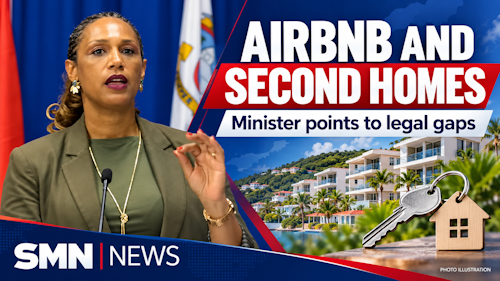
 Draft tax amendment awaits Finance input; no implementation date announced
PHILIPSBURG:--- Minister of Tourism, Economic Affairs, Transport and Telecommunication Grisha Heyliger-Marten says shortcomings in the legal framework are complicating efforts to regulate and collect revenue from homes used as short-term tourist accommodation, with a draft amendment awaiting input from the Finance Department.
Responding to questions at Wednesday’s Council of Ministers press briefing, Heyliger-Marten said her ministry had prepared a legislative amendment and sent it to Legal Affairs. Because the proposal concerns taxation, Finance must also weigh in before it proceeds through the remaining stages.
“The main complication is our law,” the minister said.
Heyliger-Marten was the only minister present at the briefing. She did not announce a new tax rate, a date for parliamentary consideration or an implementation deadline.
The issue arose during questions about foreign-owned second homes and properties advertised on Airbnb. When asked why the government could not simply identify operators through their listings and pursue compliance, the minister said the legislation needed to clarify how homes are taxed.
“It’s not even clear in our laws,” she said.
According to Heyliger-Marten, the proposal would still have to follow the legislative process, including consideration by the Council of Advice and eventual parliamentary treatment. She said she might take it to Parliament with the Minister of Finance.
The minister also referred to owners who, she said, approached the tax office wanting to pay but were uncertain how their rental activity should be treated. She contrasted those accounts with rentals whose proceeds pass through a company, referring to turnover-tax payments in that context.
Her remarks did not provide a comprehensive explanation of the tax obligations applicable to each category of owner or rental arrangement. They also did not establish a blanket exemption for Airbnb operators or foreign homeowners.
Heyliger-Marten said the government was examining related issues involving condominiums, foreign homeownership and real-estate legislation. She argued that the different areas of regulation needed to complement one another, including where investment and residence intersect.
She accused the government of having turned a blind eye to the sector and losing revenue as a result. However, she did not provide an estimate of the uncollected amount, the number of affected properties, or the share of operators outside the applicable requirements.
Wednesday’s exchange highlighted uncertainty over the framework for a growing segment of tourist accommodation, but it produced no announced enforcement programme or immediate change for property owners.
The minister identified the next step as Finance’s contribution to the draft proposal, followed by the required legal and parliamentary process. Until those details are presented, the scope of the intended changes—and their effect on individual rental operators—remains unclear.