






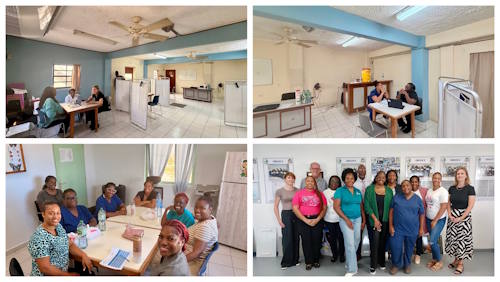
 PHILIPSBURG:--- Pointe Blanche Prison and the Miss Lalie Center (MLC) recently completed a Prison Health Sprint focused on preventive health screening and establishing a clearer baseline of inmates' and staff's health needs across both facilities.
During the initiative, which ran from September 16 to October 8, a team of eight volunteer nurses and other health professionals carried out structured physical and mental health screenings. At Point Blanche Prison, the team screened 57 prisoners and 17 staff members, while all residents of the Miss Lalie Center participated. The screenings identified potential health concerns and, where necessary, determined appropriate follow-up.
A central feature of the Health Sprint was the close collaboration between correctional, physical health, mental health, and education partners. The Mental Health Foundation (MHF), the National Institute of Professional Advancement (NIPA), the Trimbos Institute, the National Recovery Program Bureau (NRPB), and the American University of the Caribbean School of Medicine (AUC) supported the initiative. This collaboration brought together operational knowledge from the detention sector with specialized physical and mental health expertise, along with targeted donations and other support, strengthening the quality and comprehensiveness of the screening process.
MHF played a particularly important role in the Sprint's mental health component. In addition to supporting the mental health screening approach, MHF provided three staff members throughout the Health Sprint to help ensure mental health screenings were conducted appropriately and sensitively. MHF also contributed expertise on confidentiality, informed consent, non-stigmatizing communication, and trauma-informed approaches to facilitate a responsive delivery of the mental health component.
Beyond the individual screenings, the Health Sprint helped test and strengthen practical systems for preventive healthcare in detention, including screening procedures, documentation, and possible referral arrangements and coordination between detention services and external health partners. The initiative also generated practical experience that can inform the further development of sustainable health screening procedures and future prison-health services.
The Health Sprint demonstrated the added value of bringing together different areas of expertise around a shared objective: ensuring that health needs in detention settings can be identified more systematically. At the same time, it strengthened collaboration among government institutions, health professionals, and community-based partners, building relationships and practical experience that can support continued cooperation beyond the Sprint.
The Detention Sector Reform Program (DSRP) implemented this initiative, with joint funding from the Ministry of Justice of Sint Maarten and the Government of the Netherlands. It was delivered through a partnership with the United Nations Office on Drugs and Crime (UNODC).