






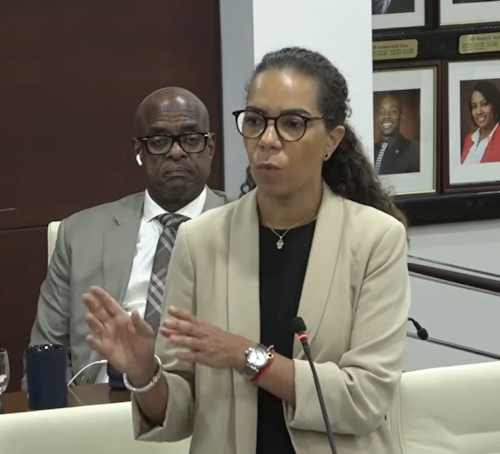
 PHILIPSBURG:--- Member of Parliament Ludmilla de Weever called on Minister of VROMI Patrice Gumbs to clarify whether the wastewater overflow shown in a circulating video resulted from the expiry of a management contract or from an operational problem that could have occurred under any management arrangement.
Speaking during Parliament’s discussion on waste, wastewater and related developments, De Weever said that distinction was essential to explaining the incident to the public.
She asked whether the overflow was linked to the end of the previous contract and the management transition, or to routine operational difficulties.
Her questions followed Gumbs’ earlier statement that the previous wastewater treatment plant management agreement ended in August 2026 and was not renewed. The ministry is carrying out daily operations while preparations for a new management tender continue.
De Weever also challenged the government to explain how the enforcement measures discussed under the Nature Policy Plan would address wastewater entering roads, drains, ponds and other waterways.
She argued that nature protection must connect directly with the sewage problems affecting residential and commercial areas.
To illustrate the concern, De Weever recounted residents' complaints about wastewater runoff from a business in their neighborhood. She said the operator had sought to justify the discharge by alleging that another institution also released water into a pond.
The account was presented as an example of the responses residents encounter when raising complaints. It did not establish the allegation against that institution as fact.
De Weever asked how the government would ensure households, apartment buildings, hotels, and businesses face meaningful consequences for improper wastewater disposal.
She highlighted the environmental and public health implications, noting that pollution entering ponds can ultimately reach the sea.
For an island dependent on tourism, she argued, damage to waterways and coastal waters also threatens the natural assets supporting livelihoods.
“We have to be real with what we’re doing to destroy the things that are making us actually have money,” she said.
De Weever linked those concerns to the island’s increasing building density, questioning whether sewage infrastructure and development requirements adequately accommodate taller buildings.
She asked what conditions apply to a development containing, for example, 60 apartments: whether it must provide its own wastewater facilities, connect to the public sewage network, or meet other requirements.
Her intervention reinforced earlier questions from MPs Veronica Jansen-Webster and Ardwell Irion about how government distinguishes residential apartment properties from commercial premises when determining waste collection responsibilities.
De Weever said Sint Maarten’s limited land area has produced a mix of residential, commercial, and industrial activity, making clear rules and adequate infrastructure especially important.
She also requested an update on previous discussions about financing waste management through a collection fee linked to utility bills.
However, De Weever explicitly stated that she was not calling for an additional charge on GEBE bills, given the high utility costs residents already face.
She cited arrangements elsewhere in the Dutch Caribbean as background to her question, asking what happened to earlier discussions in Sint Maarten and whether the proposal remained under consideration.
“I am not asking to add on additional fees,” she emphasized.
De Weever said she wanted an explanation of the proposal’s status, not to have her request portrayed as support for imposing a new charge.
Another focus was the discharge of pond water into Great Bay following rainfall.
De Weever described occasions when an excavator opens the drainage channel, and the bay then turns brown for several days, depending on sea and weather conditions.
She asked whether future development at the former Great Bay Hotel site could create an opportunity for a public-private partnership to treat water before discharge.
Her question asked whether the government was discussing treatment, cleaning, or reuse of the water as part of planning for the area.
She argued that the issue affects both beach users and any future tourism development beside the discharge point.
De Weever’s contribution brought together four central demands: an explanation of the treatment plant overflow, effective enforcement against wastewater pollution, clarity on waste management financing discussions, and infrastructure requirements capable of supporting further development.
The supplied proceedings did not include the minister’s responses to her questions.