






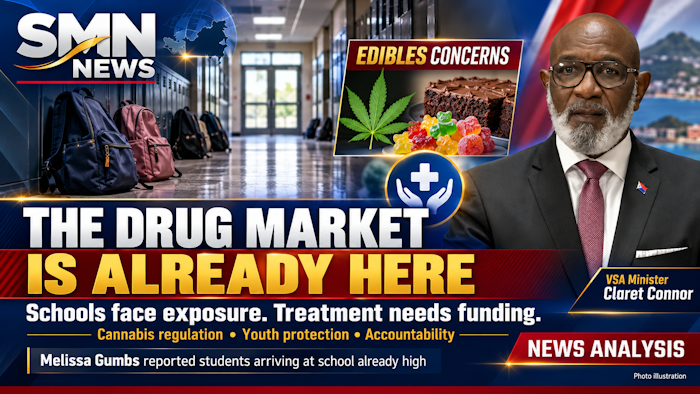
 PHILIPSBURG: --- Students hiding in containers to smoke during school breaks. Children as young as 14 arriving for lessons already high—and, according to Education Minister Melissa Gumbs, not always on marijuana. Addiction services are struggling for resources while an underground industry continues operating outside a licensed cannabis framework.
These are not hypothetical consequences awaiting a future legalization decision. Gumbs described these conditions during Parliament’s 2026 draft budget debate.
Her August 26 intervention, alongside VSA Minister Claret Connor’s October 14 call for a thorough health assessment, forces the government to answer a question: what is St Maarten doing about the drug market that already exists while politicians debate the conditions for a legal one?
Connor’s public health caution deserves attention. So does Gumbs’s warning that refusing to confront an existing market leaves the country living with its consequences.
Gumbs: Students arriving at school already high
Responding to MP Raeyhon Peterson during the second round of budget questions, Gumbs said she regularly received messages from teachers at Milton Peters College about students using containers at school and farther down the road to hide and smoke during breaks.
She also described reports from the management of the St. Maarten Vocational Training School about students arriving intoxicated before classes began.
“Students, some as young as 14 years old, are coming to school at 7.30 in the morning, already high, and it’s not always on marijuana,” she told Parliament.
That final qualification matters. The Education Minister’s account extended beyond cannabis, although she did not identify the other substances or present laboratory results or prevalence figures.
Gumbs rejected the suggestion that the country could keep treating cannabis as a problem that had not yet arrived.
“We’re having a chicken-and-the-egg conversation while not admitting that the egg has hatched,” she said.
She explained that ECYS had joined the cannabis workgroup after she raised concerns about the Ministry’s earlier exclusion, allowing educators’ concerns to enter the process. WhatsApp Ptt 2026-08-26 at 7.23…
Gummies and cakes require investigation, not silence
SMN News has previously reported receiving information about cannabis-infused candies and cakes being accessible to school-age youngsters, including allegations involving primary-school children. That reporting explicitly identified the accounts as requiring investigation rather than presenting them as confirmed enforcement findings. The material examined for this article does not establish the scale of student sales. smn-news.com
That evidence gap demands action.
Authorities should establish what products are circulating, where they originate, whether students are distributing them, and what substances they contain. A sweet described as a “cannabis gummy” is not a laboratory identification.
The European Union Drugs Agency documents edibles resembling branded sweets, counterfeit products with variable THC content, and sweets containing synthetic cannabinoids. It also explains that delayed effects can lead people to consume additional servings before the first has taken effect.
Those findings establish an international risk requiring local investigation; they do not prove that synthetic cannabinoids have been found in Sint Maarten schools. The European Union Drugs Agency (EUDA)
Without testing and consistent incident reporting, officials cannot reliably distinguish ordinary cannabis exposure from other intoxicants marketed under the same label.
Schools cannot wait for the legalization debate
A new cannabis framework could set specific rules for licensed sellers, product presentation, youth access, and prevention funding.
It would not automatically eliminate substances from school grounds.
Nor should schools have to wait for recreational legalization before government establishes clear procedures for suspected intoxication, emergency medical assistance, safeguarding, parent notification and referrals for treatment.
The immediate policy questions are practical: Are incidents recorded consistently? Who coordinates the response? What happens when the same student repeatedly arrives intoxicated? Where can a family obtain help?
A child being sent away from class is not, by itself, a treatment intervention. Schools need a functioning pathway to professional support.
Turning Point’s funding problem is documented
The treatment shortage is officially documented.
In a March 4, 2025 government statement, Turning Point’s Director and Senior Counselor, Dr. Tasheena Thomas-Maccow, reported that direct VSA funding for voluntary admissions had been discontinued in 2016.
At that time, the facility had 37 people on its waiting list and only 15 treatment spaces. Those are dated figures, not a verified October 2026 count, but they show capacity concerns predate the current debate.
Thomas-Maccow also warned that cannabis-policy changes could increase pressure on already limited resources.
The provider’s website, under Stichting Co-operation, separately describes how the loss of the voluntary-care subsidy affected admissions and prevention work. Some explanations refer to the pandemic period and need updating before they can be treated as current operational figures. They nevertheless document the connection between funding decisions and access to care. stcosxm.org
Gumbs’s budget remarks brought that problem directly into the cannabis discussion.
Describing the resources available for youth programs at Turning Point, she said: “We are sweeping at cobwebs.”
Gumbs identified a proposed $750,000 annual fund
Gumbs argued that industries generating social risks should contribute toward addressing them.
She told Parliament that, according to information shared with the Council of Ministers, the cannabis package included a proposed $750,000 annual fund—$7.5 million over ten years —with most of it intended for programs addressing cannabis abuse and misuse.
She also referred to a phased outreach plan involving families, religious organizations, educational institutions, and other stakeholders.
That proposal warrants scrutiny rather than either automatic acceptance or dismissal.
Her statement does not establish that the money has been received, that payments have begun, or that Turning Point and the Mental Health Foundation have secured allocations.
Government should publish the currency, payment conditions, legal enforceability, beneficiaries and arrangements for independent oversight. A promised fund has little public-health value unless it produces dependable services.
Any revenue model must also account for the cost of regulation, testing, inspections, and enforcement. Gross receipts are not the same as money available for treatment.
Mental healthcare investment exists—but operating support still matters
It would be inaccurate to suggest that no investment is being made in mental healthcare.
In June 2025, the NRPB announced US$14 million in financing for the development of a new mental health facility, including construction, equipment and related project expenses. National Recovery Program Bureau
More recently, an October 2, 2026, update described work with the Trimbos Institute on screening and referral protocols, professional training, prevention and child and adolescent mental health. National Recovery Program Bureau
Those developments are significant. They do not, on their own, establish that every recurring staffing, outreach, rehabilitation or aftercare need is financed.
The budget question is therefore sharper than whether government supports mental health in principle: what services can residents access now, what remain unfunded, and who pays for continuing care?
The drug discussion must extend beyond cannabis
Gumbs’s statement that students were not always intoxicated on marijuana demands follow-up concerning other substances.
Cocaine trafficking is also documented. SMN News reported that Customs intercepted 20 kilograms of cocaine aboard an in-transit container vessel at Port St. Maarten on April 18, 2026, in an operation that subsequently led to arrests in the Netherlands. That seizure establishes a trafficking case; it does not measure local consumption or identify users' occupations. smn-news.com
Scrutiny should extend across society, including people with money, influence and senior responsibilities. However, the evidence examined here does not substantiate a blanket allegation that senior officeholders or an identifiable “elite” use cocaine.
A credible national assessment must examine substance use across age groups and social settings without reducing the problem to schoolchildren or people living on the streets.
Likewise, homelessness and psychiatric illness cannot responsibly be attributed wholesale to cannabis or other drugs. Individual circumstances require assessment; street visibility is not a diagnosis.
Regional governments have moved beyond debate
Nearby jurisdictions demonstrate that reform can take different forms.
St. Kitts and Nevis officially launched its Medicinal Cannabis Authority on April 25, 2025, to manage lawful medicinal access for eligible adult patients while addressing misuse and protecting vulnerable people. SKNIS
Antigua and Barbuda’s Medicinal Cannabis Authority operates under its 2018 framework, while St. Vincent and the Grenadines publishes legislation covering its medicinal cannabis industry, patient access and compliance. These medicinal arrangements should not be confused with unrestricted recreational sales. Safety ...
The U.S. Virgin Islands authorized adult recreational and sacramental use in 2023. Its legislation also directed cannabis-tax revenue to support behavioral health, homelessness, and youth programs. That offers a regional example of linking reform to social funding, rather than proof of what Sint Maarten would collect. apnews.com
Regulation can displace illegal sales, but it requires enforcement
Canada provides evidence of both progress and continuing problems.
Its 2024 expert review reported that an estimated 73 percent of household spending on non-medical cannabis came from legal sources in the third quarter of 2023. The panel described substantial displacement of the illicit market while cautioning about measurement limitations.
The same review found youth use relatively stable after legalization, rather than eliminated, and raised concerns about childhood poisonings and insufficient prevention support. Canada.ca
The lesson is that a regulated market can redirect purchases toward accountable suppliers, but legislation must be backed by enforcement and sustained public health work.
Connor’s review needs an outcome
Connor’s October 14 commitment to seek PAHO assistance can contribute to that work. His insistence on evaluating health consequences aligns with Gumbs’s demand to confront what already exists.
Government should now turn those positions into a published timetable: establish school-incident data, investigate reported edibles, assess treatment capacity, disclose the proposed prevention fund and explain the options for medicinal access and adult regulation.
The evidence does not establish that prohibition alone caused Sint Maarten’s drug problems, or that legalization would solve them.
It does establish something politically uncomfortable: students were already arriving high while treatment services were struggling for resources.
How much longer will government debate readiness without delivering the controls, information, and care the existing situation demands?