






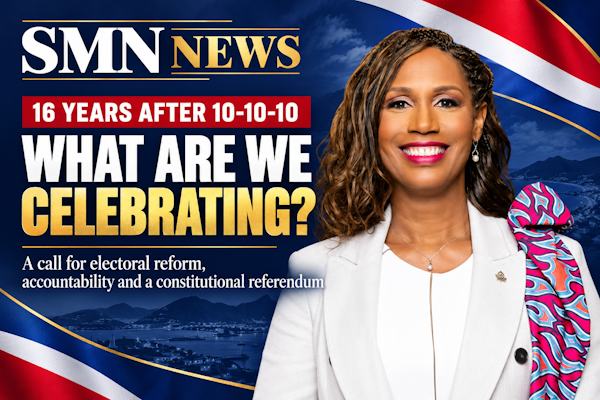
 POND ISLAND:--- As Sint Maarten marks sixteen years of country status within the Kingdom of the Netherlands, I spent this weekend reflecting on my journey as a citizen, a Member of Parliament, a Minister, and someone who has worked in both the private sector and government.
Let me be clear: in the referendum approximately twenty-six years ago, I voted for independence, not the constitutional status we have today.
As we look at countries in our region, including St. Kitts and Nevis, we must ask ourselves some serious questions.
What have we achieved in shaping a future based on our own needs, capabilities and aspirations? What exactly are we celebrating? And where do we go from here, in a world that keeps changing around us?
Having served this country for six of its sixteen years under the present constitutional arrangement, I have experienced government from different positions. Those experiences have led me to question whether the system we established truly serves our people's best interests.
A System That Needs Honest Examination
Before 10-10-10, Sint Maarten operated within the Netherlands Antilles under a different governing structure. The Island Council served as the legislative branch, while the Executive Council carried out executive responsibilities. Under that monistic arrangement, elected representatives could also serve in the executive branch, as occurs elsewhere in the English-speaking Caribbean.
During the constitutional transition, the Dutch Government required a move to a dualistic system, presented as a way to improve democracy. Elected representatives would have to choose between serving in Parliament and serving as ministers.
Warnings were raised that this separation could contribute to political instability rather than improve government. Former Saba Commissioner Will Johnson repeatedly raised these concerns with Dutch negotiators.
Sixteen years later, I believe our experience demands a serious reassessment of that decision. Frequent government changes have disrupted continuity and made it harder to sustain policies, complete reforms, and deliver results.
The transition also brought the expense of building and maintaining a larger government apparatus. We must examine whether that structure is proportionate to Sint Maarten’s size, resources and needs.
More offices, more administrative responsibilities and greater public expenditure do not automatically produce better governance.
Nor should we romanticize the former Netherlands Antilles arrangement. We should compare the systems honestly, considering their costs, efficiency, accountability and ability to deliver for the people.
The purpose is to learn from our experience and build a better future.
In my view, dualism has contributed significantly to political instability. We must examine whether our present political structure helps us progress or holds us back.
Reform Work Must Be Resumed
These concerns are not new. During my time in Parliament, I worked to address them.
As chair of Parliament’s electoral reform committee, I advanced discussions on the electoral system, political parties, parliamentary membership and the screening of ministers.
I believed then, as I do now, that electoral reform must go beyond addressing so-called “ship-jumping.” It must confront the structural weaknesses that contribute to instability and consider whether our system of government is appropriate for a country of our size.
I also supported a serious examination of our constitutional future within the wider Caribbean context.
In November 2020, together with MP Solange Duncan, I helped establish the Permanent Committee for Constitutional Affairs and Decolonization. Our aim was to place the unfinished process of decolonization firmly on Parliament’s agenda and encourage meaningful discussion about self-determination and our relationship within the Kingdom.
These initiatives addressed fundamental questions: Who are we as a nation? How should we govern ourselves? And what arrangements will best serve future generations?
Unfortunately, electoral reform lost momentum. My tenure as chair of the electoral reform committee was not renewed, and the work stagnated. Constitutional affairs and decolonization also require sustained political commitment to produce meaningful results.
The groundwork has been laid. Now we need the political will to complete the work.
Parliament Must Confront the Constitutional Questions
I call on the current Members of Parliament to revisit these initiatives, resume electoral reform and seriously examine our constitutional and governmental structure, including the possibility of a constitutional referendum.
We must assess the financial and practical costs of political instability, the consequences of frequent government changes, and whether our institutions provide the continuity, accountability, and efficiency our people deserve.
If we are serious about our future and closer integration with the region, we cannot allow this work to disappear whenever political priorities change.
We owe the next generation a system that functions better than the one we have today.
Autonomy Must Improve Everyday Life
What is the value of having our own government if we cannot honestly assess whether our decisions, institutions and spending improve people’s lives?
We must take responsibility for addressing inefficiencies, protecting consumers, and urgently pursuing practical solutions.
When families struggle to pay for electricity, food, fuel and other essentials, constitutional discussions cannot remain abstract. People need to see how self-government translates into better living conditions, reliable services and greater opportunity.
Autonomy is a responsibility. It demands stable institutions, effective leadership, accountability and the courage to reform systems that fail to deliver.
Why I Chose Not to Attend
For the first time since Sint Maarten attained its current status, I decided not to attend the celebrations.
That decision was neither easy nor taken lightly. It reflects my concern about our direction and my commitment to seeing this country do better.
My absence should not be interpreted as disrespect for our nation, our flag, our people, or those who worked and sacrificed for greater self-government.
I also recognize that progress has been made since 10-10-10. Our people's resilience, particularly after Hurricane Irma, remains a source of pride.
I look forward to the day when we can celebrate with confidence that our institutions function efficiently, public resources are spent wisely, political stability supports development, and our people experience the benefits of the country we have built.
Sixteen years of autonomy should be a moment to demand accountability, confront difficult questions, and renew our commitment to reform.
Our people deserve a government and a constitutional system that deliver lasting progress.