





NRPB promised Trust Fund financing for preventive maintenance in 2021. A 2024 report outlined a transition to government maintenance. With equipment reportedly out of service, VROMI and NRPB must explain what happened to those commitments—and World Bank immunity does not automatically shield local officials from accountability.
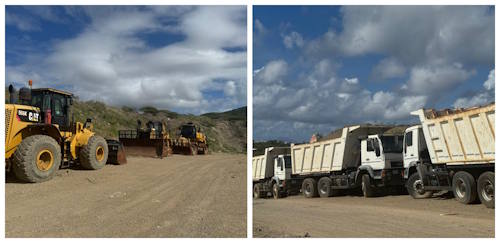 PHILIPSBURG:--- Millions of dollars were spent on landfill equipment to improve waste management and reduce the government’s dependence on rented machinery. Preventive maintenance was publicly promised. A maintenance plan and operational budget were later identified as essential to handing responsibility to government.
Yet SMN News’ visit to the landfill has brought reports of idle government machinery, unresolved repairs, unpaid services, and a new garbage scale that is reportedly not operational.
The documents now place a direct question before the Ministry of VROMI and the National Recovery Program Bureau: what happened between the promise to maintain these public assets and their reported failure?
The Maintenance Commitment Was Explicit
In a press release dated July 27, 2021, NRPB announced that VROMI had received a front-end loader, bulldozer, alternative daily cover equipment, and a solid waste compactor.
NRPB valued the machinery and alternative daily cover equipment at approximately US$2.1 million. It explained that the purchases would save government money by replacing equipment previously rented from third parties.
The release also made an unequivocal commitment:
“The Trust Fund will also fund preventative maintenance for all the purchased and delivered heavy machinery until the end of the EDMP project.”
That statement requires an accounting of the maintenance support delivered. It does not establish that every breakdown repair was covered, but it leaves no doubt that preventive-maintenance financing formed part of the publicly announced arrangement.
VROMI and NRPB should now identify the servicing funded under that commitment, the companies engaged, the inspection schedules followed, and the records showing whether each machine received the required attention.
A Later Report Promised a Government Maintenance Plan
NRPB’s monitoring report for January–March 2024 adds another important piece of evidence.
The report described the project as being in its final phase of supporting VROMI’s landfill operations through equipment functionality. It stated that, once the loader was repaired, a maintenance plan including an operational budget would be provided to the government for further maintenance.
That was a proposed transition with specific requirements: repair the loader, prepare the plan, and provide the budget framework.
The public record SMN News examined does not establish whether those steps were completed.
Was the loader repaired? Was the maintenance plan delivered? Which department accepted it? Was money allocated? Who was instructed to carry out servicing?
The relationship between that proposed transition and NRPB’s earlier commitment to Trust Fund financing until the project ended also needs explanation.
A planned handover cannot be treated as a completed transfer of responsibility without the documents showing when and how it occurred.
Procurement Records Reveal a Canceled Maintenance Activity
World Bank-hosted procurement records identify a proposed US$100,000 heavy-equipment maintenance activity naming RIMCO, under reference SX-NRPB-169182-NC-DIR.
The latter plan marks that activity as canceled.
A separate activity named JMP Hydraulique, reference SX-NRPB-225232-NC-DIR, is recorded as completed, with an actual amount of US$8,269.19. The recorded contract dates relate to 2021.
These entries do not establish who currently holds responsibility for repairs. They do, however, show that maintenance was specifically contemplated within project procurement.
Why was the RIMCO activity canceled? What replaced it? What machinery and services did the completed JMP activity cover? What arrangements followed?
Those questions require contracts and service records, not assumptions based on a company having provided training.
Equipment Purchases Used Different Procurement Methods
The equipment procurement records also show that the purchases were not all conducted through open competitive bidding.
The D8T waste-handling bulldozer was recorded as a direct selection, with an actual amount of US$600,000. The final landfill compactor procurement was also recorded as direct selection, with an actual amount of US$738,000. The wheel loader used a limited request-for-quotations procedure.
Direct selection does not, by itself, establish an improper purchase. To assess the decisions, the relevant justification and approval documents are necessary.
But responsibility for maintaining purchased equipment continues regardless of the selection method. The public deserves the full record of acquisition, servicing, repairs and operational use.
Workers Report Unresolved Repairs and Lost Employment
SMN News went to the landfill and spoke with several persons who described concerns about a local contractor’s removal from the work schedule, outstanding payments, and the consequences for workers.
Those interviewed alleged that a loader required a sensor replacement costing approximately Cg. 3,000, including associated work, but that a purchase order was withdrawn while government brought in another contractor.
VROMI has not independently verified that repair estimate or the circumstances surrounding the purchase order. They remain allegations requiring a response and supporting documentation.
If government-owned machinery remains idle while replacement services are purchased, VROMI must explain the financial and operational calculation behind that decision.
The purchases were originally promoted as a way to reduce reliance on rented machinery. Returning to third-party equipment or services while public assets await repairs requires a clear cost account.
The Garbage Scale Has Its Own Accountability Questions
The newly installed weighbridge represents a separate investment.
NRPB’s contract award notice records US$355,712 for its supply, delivery and installation, awarded on July 31, 2024, to JV AVTO ENGINEERING and Elicom ELECTRONIC through an open international request for bids. The notice records one timely evaluated bid and another submission excluded for arriving late.
Persons who spoke with SMN News now report that the scale is not operational and is not being maintained.
That report must be checked against inspection, commissioning and repair records. The heavy-machinery maintenance commitment made in 2021 does not establish the terms governing this later purchase.
VROMI and NRPB must identify the weighbridge’s warranty, maintenance obligations, acceptance date and current technical condition.
A scale purchased to improve waste measurement cannot fulfill that purpose while out of service.
World Bank Immunity Does Not Automatically Protect Local Officials
The accountability questions also intersect with the 2022 agreement governing the World Bank organizations’ office in Sint Maarten.
Article VII provides broad institutional immunity for IBRD and IFC. Article IV protects qualifying staff for official acts and separately safeguards the organizations’ archives. Article III restricts official entry into protected Bank premises without the required consent.
Those protections may complicate compulsory access to Bank-held evidence. They do not automatically make every government project record a protected Bank archive.
Nor does this agreement grant immunity to an ordinary Sint Maarten civil servant, a local implementing body or a contractor merely because their work concerns a World Bank-funded project.
The legal status of a particular person, record or location must be established. A World Bank funding connection is insufficient on its own.
Government’s own decisions, payment records, instructions and maintenance arrangements therefore require examination on their actual legal footing.
Produce the Records and Explain the Failures
The available evidence establishes a maintenance funding commitment, documented maintenance procurement and a later proposed transition to government responsibility.
It does not yet establish who failed to meet a particular contractual obligation. That determination requires the records VROMI and NRPB should be able to produce.
The immediate questions are concrete: who scheduled maintenance, who authorized repairs, who paid for the work, who accepted the handover, and what servicing occurred before the equipment became unusable?
The public also needs to know what restoring the machinery will cost and what the government is paying for replacement services in the meantime.
The US$2.1 million investment was announced to improve landfill operations and save public money. VROMI and NRPB must now show how they maintained that investment—and explain why essential equipment is reportedly standing idle while the country continues paying to manage its waste.