






VROMI Minister outlines road paving, landfill rehabilitation and digital permitting plans, but faces pointed questions over housing delivery, garbage collection, government land records and a backlog of 631 building permits.
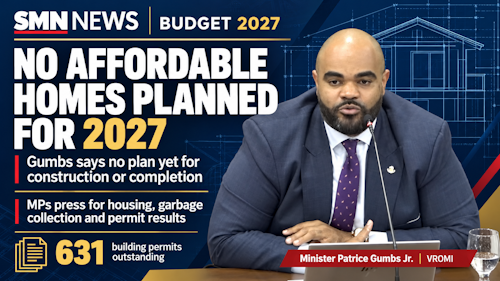 PHILIPSBURG:--- Minister of Public Housing, Spatial Planning, Environment and Infrastructure (VROMI) Patrice Gumbs Jr. told Parliament that there is currently no plan to construct or complete affordable homes in 2027, prompting sharp questions about when government’s housing ambitions will translate into actual homes for residents.
Responding to Members of Parliament during the Central Committee’s examination of the draft 2027 National Budget, Gumbs outlined a broad agenda covering housing policy, road improvements, waste management, building permits and parking.
His presentation identified several milestones, including a target to pave 35 side roads in 2027, the expected start of landfill rehabilitation works that year and the introduction of a new building code targeted for July 2027. However, key elements of the housing and permitting programs still depend on staffing, financing, legal changes, and further planning.
For residents facing housing shortages, overflowing garbage bins and lengthy permit delays, the central question emerging from the debate was when those preparations would produce measurable improvements.
Housing target still lacks a delivery timetable
Asked by MP Lyndon Lewis how many affordable homes would reach construction or completion in 2027, where they would be located and who would qualify, Gumbs gave a direct answer.
“There is no plan yet to construct or complete affordable homes in 2027,” the Minister said.
He explained that the housing policy sets out approaches intended to support future delivery, including reusing existing housing stock, increasing density, apartment development and semi-detached homes.
The policy defines affordability in relation to residents earning a median income, with housing costs not exceeding approximately 30 percent of median net income. Gumbs also identified teachers, healthcare workers and civil servants as categories of workers who should be able to purchase homes within the affordable housing segment.
However, specific locations, construction schedules, and detailed eligibility arrangements still need to be developed during implementation.
Responding to questions from MP Egbert J. Doran about the previously announced objective of 1,200 homes over ten years, Gumbs emphasized that the housing policy is a strategic document rather than a construction plan.
The Ministry must still translate that objective into a multi-year implementation program that identifies projects, responsible parties, financing requirements, and activities that can be budgeted.
Gumbs said the Ministry is recruiting a policy advisor dedicated to implementing the housing policy. He could not provide a completion date for the multi-year housing strategy, citing capacity constraints.
At least 70 percent of the housing program is intended to come through approaches such as reuse of existing properties, densification, apartments, semi-detached homes and townhouses, he explained.
Lewis and Doran press for tangible housing progress
Lewis challenged the gap between repeated budget discussions and actual housing delivery, asking in which budget residents could expect an affordable housing program to materialize.
He pointed to successive budgets considered during his time in public office and questioned how much could realistically be accomplished within the remaining parliamentary term.
Doran similarly argued that the Minister’s responses lacked concrete starting dates and project milestones despite the housing crisis.
He sought clarification on Vineyard Heights, asking whether a new legal dispute affected the development, whether an existing plan would change, and when work could begin.
Gumbs said development would require a concrete housing action plan supported by available resources and resolution of relevant land issues. He indicated that the new land issuance policy was expected to be finalized in October 2026.
The Minister also referred to discussions on a public-private partnership involving land associated with the housing foundation in the Foga area.
He stressed that the government was pursuing opportunities with potential partners while preparing the broader implementation framework.
Landfill works expected in 2027, closure targeted for 2032
On waste management, Gumbs outlined national targets of 75 percent waste diversion and fully professional waste collection by 2030.
The proposed transition includes an independent waste authority to manage the sector, while government focuses increasingly on legislation, regulation, enforcement and oversight.
The Minister said government and the National Recovery Program Bureau are pursuing landfill works involving reshaping and stabilization, protective infrastructure, and eventual capping and vegetation.
Construction is expected to begin in 2027 and continue for approximately three years, with closure of the landfill targeted for 2032.
The closure works have already been tendered, he said. Bids are undergoing technical evaluation, to be followed by financial evaluation before a contractor is selected. A firmer implementation cost will become available after procurement is completed.
Gumbs also acknowledged that closing the landfill requires a workable alternative for the country’s waste. Options under consideration include waste-to-energy, waste export and cooperation with surrounding islands.
A proposed allocation of approximately 2.7 million is intended to relocate businesses operating on the landfill site. According to the Minister, those relocation costs are not eligible under the applicable World Bank project financing procedures.
MPs demand improvements before next year
Gumbs said residents should see clearer collection responsibilities, better bin management, maintained collection points, removal of stray garbage and improved communication about collection schedules in 2027.
He also identified a weighbridge and electronic recording system as essential for measuring incoming waste, supporting future planning, and enabling a weight-based tipping system.
Lewis argued that improvements should begin before 2027, saying he had not seen significant changes in garbage collection this year.
MP Ardwell Irion raised the practical problem of insufficient bins, citing an apartment building with 16 units served by only two small green bins.
He asked how residents could obtain bins, how many were needed nationally, whether the budget reflected purchases, and whether waste haulers were expected to buy them.
Irion also requested clarification about bins previously discussed by the TEATT Ministry and whether they had been distributed.
Chair of Parliament Sarah Wescot-Williams asked Gumbs to address the five items contained in the unanimously adopted garbage motion of January 16, 2025, in his written responses. She also recalled the garbage motion adopted during the 2026 budget deliberations.
The supplied proceedings do not include the Minister’s answers to these follow-up questions.
Cleaning contracts expired; interim spending questioned
Doran questioned arrangements after district cleaning contracts expired on March 31.
Gumbs said the tender for district cleaning and public-area maintenance services for 2026–2031 had been launched, with bids due on October 9, 2026.
He reported interim expenditure of 255,310 for a one-time pre-hurricane cleanup and temporary beach cleaning services.
According to the Minister, contractors were selected through an invitational bidding process. The Minister approached previous contractors first because of their familiarity with the assigned areas. Where they could not undertake the work, the Ministry invited another contractor with relevant experience and capacity.
Doran requested the names of the companies receiving the work and further clarification on the authorization requirements for those arrangements.
Gumbs said the Ministry intends to introduce a contract-management dashboard providing updates where necessary.
“There should not be a gap between the conclusion of one contract and the commencement of another,” he stated.
631 building permits remain outstanding
The Minister reported that 631 building permits remained outstanding as of the day before the meeting, down from 661 in his response.
He cautioned that the figures reflect both applications processed and new applications received. The reduction of approximately 30 therefore does not establish how many permits were issued during the period.
The draft budget provides for digitizing and automating the permitting process, including electronic document management, applicant access, workflow tracking, security, audit trails, and training.
The intended system would allow applicants to submit documents online, receive a reference number, respond electronically to correction requests and track their applications.
However, Gumbs could not commit to a date for full online access. Additional legal provisions may be required to support electronic documents, signatures, decisions and records.
He also said the Ministry could not establish one fixed processing-time target for every application at the beginning of 2027.
35 side roads targeted, subject to approval
Gumbs said approximately 25 roads had been identified for consideration in the second phase of the side-road paving program, with a target of 35 roads in 2027.
Selection criteria include an unpaved surface, access to at least five residential properties, a width exceeding three meters, an officially recognized name and the absence of family or ownership disputes. Priority would be given to low-income areas.
Assessments are expected to finish in November 2026, followed by publication of the proposed program in December. Final selection and execution remain subject to budget approval.
Doran and Irion asked how low-income areas or roads would be defined and whether an established policy supported that prioritization.
Paid parking considered; land inventory remains incomplete
Gumbs said paid parking is being considered for Philipsburg and Simpson Bay, potentially through a tiered system charging more near commercial centers while allowing consideration of free parking farther away.
Final pricing and measures to reduce costs for regular users would depend on the business cases for proposed public-private partnerships.
The Minister also acknowledged that government cannot yet provide a complete, sufficiently verified inventory of government land free of leasehold, rental or third-party obligations.
Doran challenged that explanation and renewed his request for a list of available government land.
Gumbs said record verification and cooperation with the Cadastre were intended to improve the Ministry’s land administration.
The debate left VROMI with a clear accountability challenge: turn policy objectives into funded projects, publish credible delivery schedules and answer the outstanding questions about services residents need now.