






Cell broadcast has passed a controlled test, but final payments remain pending; firefighter placement and compensation issues also lack firm settlement dates.
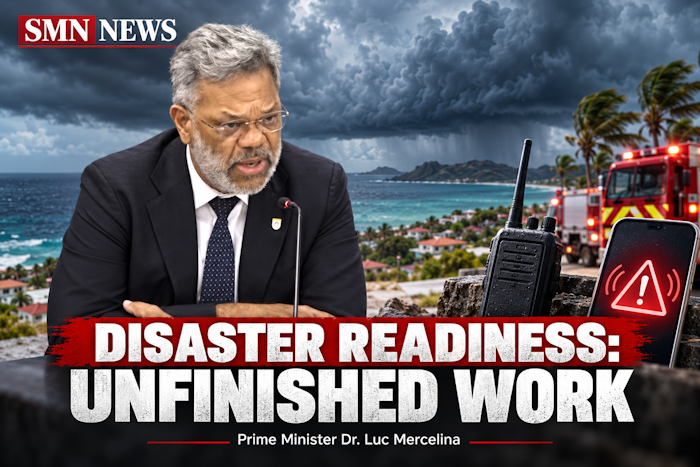 PHILIPSBURG — Sint Maarten’s cell broadcast public warning system still awaits final payments to TELEM, Prime Minister and Minister of General Affairs Dr. Luc Mercelina told Parliament on October 1, creating an administrative and financial hurdle for an emergency communication tool.
Responding during the Central Committee’s consideration of the draft 2027 Budget, Mercelina said the system had already been successfully tested in a controlled environment. The related advice had been drafted and was moving through the approval process.
He did not provide a public activation date.
For a system intended to warn people during emergencies, the difference between successful testing and operational availability matters. Parliament still needs to know when that final step will be completed.
Several Disaster Planning Measures Target Late 2027
Mercelina identified the fourth quarter of 2027 as the target for completing tsunami and earthquake plans and standard operating procedures, a host nation support plan and procedures, and exploring micro-insurance possibilities.
He said some products could be delivered earlier, but the government had selected the later target because of possible unforeseen bottlenecks.
Those dates do not mean Sint Maarten has no existing emergency arrangements. They do mean several planned improvements remain unfinished, with completion targets set late in the coming budget year.
The Office of Disaster Management’s broader five-year development program also remains ongoing.
Government Promises Readiness Testing Before Hurricane Season
In response to MP Lyndon Lewis, Mercelina committed to a comprehensive readiness assessment and hurricane preparedness exercise before the 2027 hurricane season.
The assessment is intended to verify plans, personnel, communications equipment and coordination arrangements. He said readiness would be tested through tabletop exercises, communications tests, Emergency Operations Center activation exercises and field exercises where appropriate.
This is a substantive commitment. Its value will depend on whether the exercises identify weaknesses and whether those weaknesses are corrected before an emergency.
Parliament could assess delivery through the exercise dates, findings, assigned corrective actions, and completion status.
Backup Communications Exist, but Public Warning Remains Unfinished
Mercelina said several satellite phones are available for emergency communication. Extra handheld radios and vehicles equipped with built-in repeaters can provide backup if antennas are damaged.
He also referred to previous discussions about requesting assistance from the Marines if necessary.
Those arrangements support emergency coordination. They do not settle when the cell broadcast system will be available to issue warnings to the public.
An update on shelters was deferred to a later response in his capacity as acting Minister of VSA, leaving that component outside the answers delivered in this part of the meeting.
Firefighters Still Await Personnel Resolutions
The Prime Minister’s disaster preparedness answers also exposed continuing delays affecting Fire Department personnel.
Responding to MP Darryl York, he said the placement process had commenced, and draft letters had been prepared. The first batch remained under review following consultations with management, WICSU-PSU and negotiation teams.
Staff shortages in Personnel and Organization, together with medical leave affecting key personnel, had delayed the process.
Mercelina described practical capacity constraints and said the parties were working to complete placement carefully and promptly. He did not give a completion date.
Responding to MP Francisco Lacroes, he also identified unresolved matters involving placement, ranks, promotions, retroactive salary or compensation adjustments, higher-level duties and historical acting arrangements.
No overall settlement date was offered.
Response Ambitions Need Performance Evidence
Mercelina said the Fire Department works toward an approximately eight-to-ten-minute response standard, depending on incident location, traffic, time of day and operational circumstances.
For 2027, government intends to maintain and improve its ability to achieve that standard through staffing, vehicles, equipment, training, station readiness and communications.
However, the response did not provide actual response-time figures showing how consistently the department currently meets its target.
Planned investments include equipment renewal, breathing apparatus, professional training, fire prevention, and stronger emergency coordination.
These improvements are necessary. The unanswered questions are operational: when will the public warning system go live, when will firefighter personnel matters be resolved, and what measurable readiness gains will be in place before the next hurricane season?
Emergency preparedness cannot be assessed solely
by promises in a budget. It requires functioning systems, equipped personnel, and verified readiness before those capabilities are needed.