





MP demands a complete financial picture, warning that inconsistent figures and undisclosed obligations undermine Parliament’s decisions.
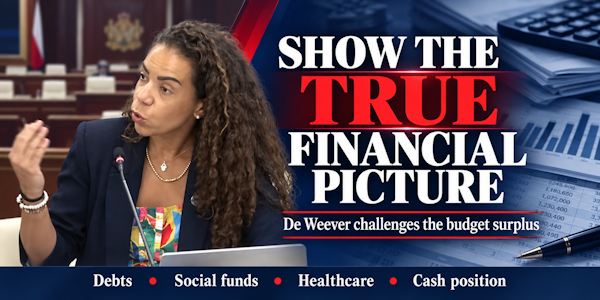 PHILIPSBURG:--- MP Ludmilla de Weever has challenged the government to demonstrate that the surplus presented in the draft 2027 budget reflects the country’s actual financial position, rather than a calculation that leaves major risks and outstanding obligations unexplained.
During the Central Committee debate, De Weever demanded clearer disclosure of social insurance fund shortfalls, government arrears, healthcare financing pressures and risks involving government-owned companies.
She also questioned inconsistent figures across the budget documents, arguing that MPs should not have to piece together the country’s financial position from amounts that do not reconcile.
Her central warning was that incomplete information can produce poor decisions, regardless of which government or parliamentary majority is in office.
Which risks are included in the surplus?
De Weever referred to Cft’s advice on the draft 2027 budget, dated August 4, and said it identified material risks involving government entities and social funds that required further explanation.
She asked which of those risks had been incorporated into the projected ordinary-service surplus and which remained outside it.
She requested a reconciliation showing the result before and after accounting for ENNIA, social fund risks, healthcare deficits and government-owned company exposure.
“If these known risks have not been quantified in the ordinary service, on what basis does government consider the presented surplus a realistic indication of the country’s financial position?” she asked.
De Weever also referred to a Cg. 75 million loan for generators, which she said the finance minister had identified, while asking for a fuller explanation of government-owned company risks.
She demanded that the government show how those risks affect the country’s finances and whether they could create additional calls on public money.
Conflicting figures need correction
De Weever questioned differences between the budget and its explanatory documents concerning borrowing and liquidity.
She referred to amounts of Cg. 17 million and Cg. 22 million, asking which loan figure was correct. She also cited references to a positive Cg. 2 million and negative Cg. 8 million year-end liquidity position.
She said she would provide page references so the finance minister could address the discrepancies directly.
For De Weever, those differences require a corrected and consistent set of documents. Parliament needs a clear borrowing figure and an understandable cash position before it can assess what government can realistically afford.
Social insurance funds need individual forecasts
De Weever pressed for detailed projections for each fund administered by SZV, rather than a combined presentation that obscures the condition of individual funds.
She asked for each fund's projected financial result in 2027 and its expected reserves at the end of 2027, 2028, 2029 and 2030.
She also asked when the government expects any fund to exhaust its reserves.
The MP recalled earlier warnings to Parliament about the seriousness of the social insurance position. She argued that those risks must remain visible in the budget so that new and returning decision-makers understand the obligations they face.
De Weever explicitly said her concern was broader than an accusation against an individual minister. She questioned whether Parliament, government and SZV collectively were providing enough information to make sound decisions.
Government debt affects healthcare
De Weever highlighted the relationship between government’s payments to SZV and SZV’s ability to finance healthcare, including payments to St Maarten Medical Center.
She said the budget did not present a sufficiently clear picture of those connected obligations.
She requested the total amounts owed between government and SZV, broken down by type and year, together with a plan to settle the arrears.
She also asked what portion of the healthcare shortfall ultimately becomes an obligation of the country and where that exposure is reflected in the budget.
Without that explanation, she argued, Parliament is left examining separate pieces of a financial relationship whose consequences reach the hospital and the wider healthcare system.
Outstanding bills cannot be ignored
De Weever cited more than Cg. 150 million in outstanding obligations to suppliers, alongside the separate concerns involving SZV and ENNIA.
She acknowledged that a budget is forward-looking, but argued that outstanding commitments still shape the country’s liquidity and room to make new spending decisions.
She criticized the failure to keep those obligations visible, which creates an unrealistic picture of what government can afford.
She warned that ministers, MPs and civil servants must be reminded consistently of the country’s exposure. Otherwise, she argued, successive administrations risk making decisions without understanding the financial commitments already attached to public revenue.
De Weever’s questions placed the burden on government to produce a reconciled account of its finances: the projected surplus, the actual cash position, the outstanding bills, the condition of each social insurance fund and the risks that could become government obligations.
For her, a credible budget must show the pressures behind the headline balance as clearly as it shows the balance itself.