






~MP Ardwell Irion calls for protection of Caribbean identity, wider public access and human oversight as artificial intelligence expands.~
 PHILIPSBURG — Parliament has ratified a regional outcome statement on responsible artificial intelligence, committing Sint Maarten to continued work on ethical governance, data privacy, information integrity and the responsible use of rapidly developing technology.
The outcome statement emerged from a three-day workshop hosted in Anguilla from June 21 to 23, 2026, by the Commonwealth Parliamentary Association UK and UNESCO.
Sint Maarten was represented at the workshop by Member of Parliament Ardwell Irion and the Chairperson of Parliament, both members of Parliament’s Digital Transformation and Artificial Intelligence Work Group.
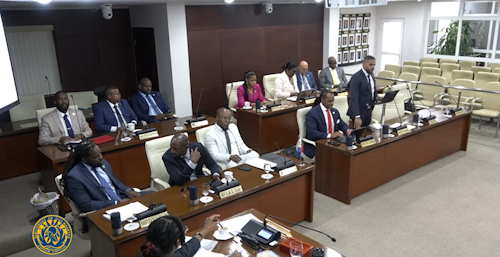
The document, registered as IS/1327/2025-2026 and dated August 11, 2026, was presented during a public meeting of Parliament on Monday, September 7. Members approved it without a formal vote after indicating their agreement with its ratification.
The regional workshop brought together parliamentarians from the Caribbean and the United Kingdom to discuss AI readiness, legislation, ethical governance, data privacy, information integrity and the growing influence of digital platforms.
Sint Maarten Must Prepare for the Future
Addressing Parliament, MP Irion said the pace of artificial intelligence development makes it essential for Sint Maarten to prepare now rather than risk being left behind.
He said Sint Maarten was among the few participating countries whose Parliament had already taken the initiative to establish a working group dedicated to digital transformation and artificial intelligence.
According to Irion, the regional statement sets out goals that participating parliaments will be expected to pursue. He stressed that cooperation among Caribbean territories will be essential because small island developing states lack the economies of scale of larger countries.
However, he argued that the Caribbean’s size should not excuse inaction.
Together, he said, Caribbean countries can strengthen their position, share knowledge and ensure that their people are not excluded from the opportunities created by AI.
Protecting Caribbean Culture and Intellectual Property
One of Irion's strongest concerns was the risk of Caribbean countries losing their cultural identities and intellectual property as AI systems continue to expand.
He said Sint Maarten and the wider Caribbean must ensure that artificial intelligence reflects the people, language, history and culture of the region.
“How do we as Caribbean people ensure that, going forward, AI represents us, that AI sounds like us, and that we don’t just lose our intellectual property?” Irion asked.
The MP said this issue must be addressed not only locally, but also within the wider Kingdom of the Netherlands. He emphasized that Sint Maarten must be able to identify, preserve and protect the information and cultural material that belong to its people.
The warning comes as powerful AI systems are increasingly trained on enormous amounts of information gathered worldwide. Without adequate safeguards, smaller societies risk having their culture and intellectual property absorbed into global systems without recognition, control or compensation.
Humans Must Remain in Control
Irion also cautioned that while Parliament may use artificial intelligence to improve efficiency and support better decision-making, it cannot replace elected representatives or human judgment.
“The people elected us and not technology to represent them,” he told Parliament.
AI, he said, should function as a tool to assist Parliament and improve public service. Final decisions affecting the country and its people must remain in human hands and subject to democratic accountability.
The statement is particularly important as governments worldwide examine how AI could be used to draft documents, analyze policies, process public information, and improve service delivery.
However, the same technology raises serious questions about privacy, misinformation, bias, surveillance, employment and the protection of confidential government information.
Benefits Must Reach the Average Citizen
Irion made clear that Sint Maarten’s AI strategy cannot be limited to Parliament, government departments, wealthy businesses or people who already possess advanced technical knowledge.
He said the average resident must understand how artificial intelligence can improve everyday life.
“It can’t just be that we have artificial intelligence and that some benefit, but the average person on the island does not see a benefit from it,” Irion said.
He questioned how Sint Maarten could make AI more accessible and use it to confront some of the country’s most persistent challenges.
He identified healthcare, tourism, economic development, business, and the fight against sargassum.
His remarks placed the focus beyond simply acquiring new technology. The greater challenge, he suggested, is determining how AI can be transformed into practical solutions that improve the lives of the people of Sint Maarten.
Work Group Expected to Present Recommendations
Following Parliament’s ratification of the regional statement, the Digital Transformation and Artificial Intelligence Work Group is expected to continue examining its recommendations.
The work group will identify the steps Parliament should take and present its recommendations to the full legislature for further discussion and decision-making.
Parliament’s endorsement represents an initial commitment, but the real test will be whether the principles contained in the statement are converted into legislation, policies, safeguards and measurable benefits for the public.
Sint Maarten now faces the same challenge confronting governments around the world: embracing the potential of artificial intelligence without surrendering privacy, culture, intellectual property or human control.
For a small country, the risks are significant—but so are the opportunities. Parliament’s message is that Sint Maarten must prepare, participate, and protect its people before decisions about the future of AI are made without them.