






Cg. 310,000 allocations unchanged for approximately five years, while urgent school repairs face standard payment procedures
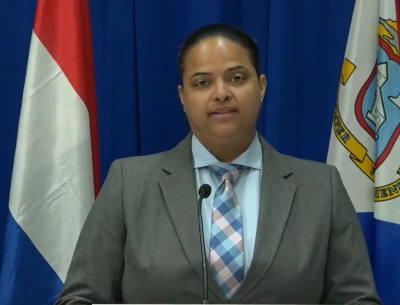 PHILIPSBURG:--- Education Minister Melissa Gumbs has acknowledged that the annual allocation for maintaining Sint Maarten’s seven public schools is inadequate, frequently runs out before year-end, and was not based on a recent comprehensive assessment of the schools’ needs.
Yet the government still cannot provide a verified total for the outstanding emergency works. A structural assessment intended to establish the condition of the schools, prioritize repairs and determine their costs is projected for completion in early 2027.
The admissions emerged during Gumbs’ responses to MPs in the 2026 budget debate, revealing both a funding problem and an administrative system that can delay urgent intervention.
“The annual allocation of 310,000 guilders for the maintenance of the seven public schools is a historical budget provision that has remained unchanged for approximately five years,” Gumbs told Parliament on August 25.
“It was not determined through a recent comprehensive assessment of the present structural and preventive maintenance needs of all seven schools.”
Budget repeatedly depleted before year-end
Responding to MP Darryl York’s concerns, Gumbs said the allocation had originally been informed by previous expenditure on routine and on-call maintenance.
Actual spending patterns, she acknowledged, showed that the amount was insufficient.
“The maintenance budget is frequently depleted before the end of the financial year, requiring budget transfers from other available budget lines to address urgent and unavoidable works,” she said.
That means the annual provision has not been sufficient to meet the maintenance demands arising during the year, leaving the ministry to move money from other allocations when urgent repairs become unavoidable.
“The ministry can nevertheless confirm, based on actual expenditure patterns, that the current allocation is inadequate to sustainably maintain all seven public schools,” Gumbs stated.
No verified total for emergency repairs
The following evening, MP Egbert Doran pressed for the actual amount required to address outstanding emergency issues at public schools.
Gumbs said the ministry could not yet provide a definitive figure.
“The current allocation of 310,000 guilders is being directed toward the most urgent health, safety, and operational needs identified by the division of public education,” she said.
“However, the ministry does not yet have a consolidated verified cost estimate covering all outstanding emergency works.”
The minister said a public tender had been issued for a structural condition assessment and prioritized repair plan.
The exercise is intended to produce a school-by-school overview, rank work according to urgency and risk, and establish corresponding cost estimates.
“The current projection for the completion of the assessment is early Q1 of 2027,” she said.
That is a projected date for completing the assessment—not a commitment to complete all identified repairs by then.
Gumbs said the results would support decisions on funding through the ordinary and capital budgets and, where appropriate, external financing.
Repairs follow problems rather than prevent them
The minister also acknowledged that public education operates under a reactive maintenance system.
“I mentioned time and time again, Mr. Chairman, that public education currently operates under a reactive maintenance system, where repairs are generally undertaken after defects are reported or identified, rather than through a structured preventive maintenance program,” she said.
Gumbs identified that approach as a weakness the ministry intends to correct.
The proposed assessment would underpin a multi-year preventive and corrective maintenance plan, rather than continuing to rely primarily on interventions after defects appear.
Her explanation does not mean that all maintenance has stopped pending the assessment. She said urgent work was being prioritized and ongoing repair and reconstruction projects would continue to be monitored and supported.
It does mean that the comprehensive plan and verified costing were still outstanding as Parliament considered the 2026 budget.
Urgent sanitation repairs face ordinary procedures
Beyond insufficient funding, Gumbs identified another obstacle: government lacks a dedicated emergency procurement and payment procedure for public-school operations.
“Consequently, even urgent purchases of sanitary fixtures or replacement components must pass through the standard procurement-to-pay process, which can delay immediate intervention,” she said.
Plumbing and sanitation failures are treated as urgent because of their potential impact on students and staff, the minister explained. But recognizing urgency does not automatically accelerate the purchasing and payment process.
To address that problem, the Division of Public Education prepared an emergency and fast-track payment framework and submitted it to the head of the Finance Department for discussion.
Gumbs described this as a preliminary step. Finalization would require the involvement and signatures of both herself and the Finance Minister.
The proposal would accelerate qualifying expenditure involving health, safety and infrastructure failures while retaining documentation, approval and audit controls.
The debate did not establish that the framework had already been approved or implemented.
Oranje School repairs illustrate the difference in speed
Responding to concerns about Oranje School, Gumbs said the ministry had welcomed assistance coordinated through community police, Kooyman and other contractors.
She explained that the collaboration allowed repairs to move faster than the government’s procurement-to-payment process.
Other proposed work was not authorized because the ministry was already at an advanced stage of procurement for those activities, she said.
Gumbs also rejected the suggestion that private citizens or MPs were prohibited from donating to public schools.
“What I have said is that donations and contributions to public schools must follow a procedure,” she stated.
She said assistance should be coordinated, not that contributions were unwelcome.
The next test is implementation
The minister’s responses establish three separate problems: a maintenance allocation she considers inadequate, the absence of a comprehensive verified repair bill, and procedures that can slow emergency intervention.
They also identify proposed remedies: technical assessments, a prioritized maintenance plan, and an accelerated procedure for qualifying emergency expenditure.
The immediate accountability questions are therefore specific. When will the emergency framework be approved? Which urgent works will be completed while the assessment is underway? And how will the eventual cost estimates translate into funded repairs?
For students and staff, a completed assessment will be an important step. It will not, by itself, fix a bathroom, replace a damaged fixture or prevent the next maintenance emergency.