





~Finance Minister owns late delivery, acknowledges critics and warns that passing the budget is not the achievement.~
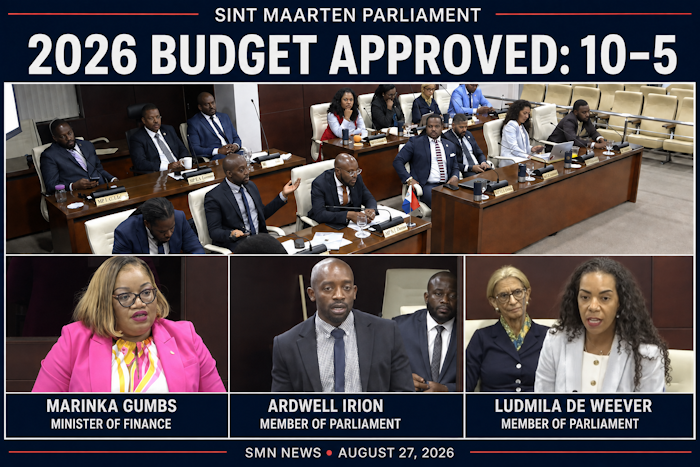 PHILIPSBURG: --- Parliament approved St Maarten’s draft 2026 national budget with 10 votes in favor and five against on Thursday, August 27, following a debate that exposed continuing concerns about government spending controls, household relief and the execution of public commitments.
MP Ludmila de Weever voted against the budget, despite acknowledging significant improvements in the presentation of financial information.
“Against, this time,” she said when her vote was called.
The draft passed with nine adopted amendments. Its approval brought the parliamentary debate to a close, but Finance Minister Marinka Gumbs used her closing remarks to acknowledge the budget’s lateness and insist that government must now turn the financial framework into results.
“That is why the adoption of this budget cannot be the achievement. What we do with it must be the achievement,” Gumbs said.
De Weever acknowledges progress but demands control of outstanding bills
De Weever’s opposition was not a rejection of every aspect of the budget.
She explicitly recognized improvements in how information was prepared and presented to Parliament.
“From the time I started speaking in the first round, I said that there's been a significant improvement in how the information is produced and presented to us,” she said.
Her central concern was whether ministries could reliably account for their outstanding obligations.
She described inconsistent responses, with some information available immediately while other information required a lengthy wait.
“But what it says is that we don't have a handle on our expenses, on our costs, even in providing all that information,” de Weever said.
She also referred to discussions with the Prime Minister about the reliability of information on properties government rents and owns.
“Now, have I seen a significant improvement from the previous year? Absolutely, I have,” she said.
Nevertheless, she challenged ministers to resolve the outstanding questions before the 2027 budget and implement the Finance Minister’s “no purchase order, no pay” approach, ensuring that vendors understand it.
“Once that is done and in action, I can definitely see myself supporting a future budget,” she said.
Her remarks distinguished between better financial presentation and the underlying spending controls she considered necessary before supporting the budget.
Doran condemns lack of household relief
MP Egbert Doran opposed the budget, arguing that the debate had been dominated by cannabis and garbage while leaving major concerns about revenue and household costs unresolved.
“Cannabis and garbage,” he said. “That was the theme of this year's budget debate, Mr. Chairman.”
Doran criticized the number of amendments and questioned why allocations needing substantial revision had reached Parliament in that condition.
He also challenged the government over road funding and the absence of a clear approach to relief from electricity bills and fuel costs.
In his assessment, repeated promises had not produced sufficient results to justify his support.
Ottley: no support without relief
MP Omar Ottley likewise said he could not support the budget without relief for residents.
He questioned why so many adjustments were needed so late in the financial year and warned about the time needed to process and implement them.
Ottley emphasized his repeated calls for GEBE relief and criticized the lack of a firm timeline.
“I cannot support this budget if there is no relief for the people,” he said.
His argument was not that MPs should refrain from bringing amendments. Rather, he questioned why so much revision was necessary at the end of August and whether residents would see the benefits before the year ended.
Irion holds Finance Minister accountable for budget preparation
MP Ardwell Irion acknowledged the work of Finance Ministry personnel but maintained that the finance minister remained responsible for the budget presented to Parliament.
“The budget is yours,” he said.
He questioned why allocations for activities that would not proceed remained in the draft, including the flagpole project, and why MPs were being asked to redirect funds so late.
Irion also raised concerns about accountability for spending and the absence of promised relief.
His criticisms included assertions about issues raised by the Council of Advice. Those remarks were his characterization of the advice and should not be confused with an independently established finding in this report.
When voting, Irion said: “With a heavy heart, against.”
Lewis voices reservations but votes in favor
MP Lyndon Lewis described a difficult decision between his objections to the budget and concern about the financial consequences for civil servants.
He questioned whether government was sufficiently addressing the high cost of living and revenue generation.
Lewis also discussed civil servants seeking promised compensation and the pressure surrounding the anticipated 2.5 percent indexation.
He warned that the budget required scrutiny beyond any single payment.
“We have to know what we're voting for. We have to understand the system that we're in,” he said.
Despite his reservations, Lewis ultimately voted in favor.
Roseburg defends using amendments to improve the budget
MP Sjamira Roseburg supported the budget and emphasized Parliament’s responsibility as co-legislator.
She said MPs could ask questions, bring legislation, propose motions and amend allocations instead of limiting their role to criticism.
Roseburg pointed to her work on legislative proposals and the amendment providing additional resources for legislative lawyers.
She questioned the consistency of helping secure changes to the budget and then rejecting it, while acknowledging every MP’s right to decide.
“But again, that's your conscience, and I will have my conscience, and I will therefore support this budget,” she said.
Wescot-Williams says course correction means adjustment, not starting over
MP Sarah A. Wescot-Williams explained that her call for a course correction was not a demand to abandon the government’s work and begin again.
Rather, she said, it meant adjusting areas where improvements were necessary.
She identified commitments that encouraged her, including follow-up on motions, progress toward the 2027 budget, tax reform discussions, pension-related measures, traffic legislation, district empowerment and further work on GEBE relief.
She also said the Council of Ministers would revisit cannabis legislation and report to Parliament.
Wescot-Williams asked the government to prioritize those commitments in its statement for the opening of the parliamentary year.
She voted in favor.
Lacroes puts household survival at the center
MP Francisco Lacroes also supported the budget while emphasizing the financial pressures facing residents.
He described the choices households face between rent, electricity, school expenses, transportation and food, and urged government to make people’s well-being central to its work.
Lacroes expressed optimism about cooperation with ministers, but said Parliament must follow up on previously adopted motions.
“Mr. Chairman, I hate the fact to hear anyone say, a motion is just a wish,” he said.
“If it's a wish, it is a wish of Parliament, whom the people have placed here to represent them. So they should be taken seriously.”
Finance Minister acknowledges votes against
After the budget passed, Finance Minister Gumbs thanked supporters while expressly recognizing those who opposed it.
“I sincerely thank those who voted in favor, and I equally acknowledge those who voted against,” she said.
“Because the vote against does not diminish the value of the questions that were raised, the constructive criticism that was offered, or the recommendations that were put forward.”
Gumbs said suggestions not incorporated into the 2026 budget had not necessarily been dismissed. She said she hoped relevant recommendations would be reflected in the next budget.
She also thanked civil servants, her cabinet and Finance Ministry personnel for their work.
“The budget was late”
Gumbs said the government had continued meeting salaries and other recurring obligations despite the late budget.
However, she explicitly rejected using that continuity as a justification for the delay.
“But I will not use that as an excuse for lateness of the budget. The budget was late,” she said.
“That is a fact and we must own it.”
She added: “I sincerely hope that this will be the last late budget that comes before this parliament.”
The minister said preparation of the 2027 budget was already underway, that the Council of Advice had provided its advice, and that the government was moving toward the next stage before Parliament.
Minister calls for collective responsibility
Reflecting on the debate, Gumbs acknowledged that government had areas requiring improvement.
“Everything is not going right,” she said.
She stressed that acknowledging shortcomings did not erase progress or diminish civil servants' work.
“We have to get it together, not individually, but collectively,” she said.
Gumbs called for better communication, collaboration and coordination across government, Parliament and public institutions.
She argued that problems involving several ministries must not become disputes about territory, personalities or credit.
Residents waiting for services, businesses meeting payroll, young people seeking opportunities and elderly people expecting dignity need institutions to function together, she said.
“The debate is over, but the work is not”
The finance minister closed by shifting attention from the vote to implementation.
“Budget 2026 has now passed. The debate is over, but the work is not,” she said.
Gumbs emphasized that holding office was not an accomplishment in itself and that residents should judge the government by their experience of its decisions.
“The budget 2026 has been adopted. Now the responsibility is ours to deliver,” she said.
“And to the people of St. Martin, continue to hold us accountable.”
The 10–5 vote secured parliamentary approval. It did not resolve the concerns raised about outstanding bills, household relief or delivery. Those issues now form part of the accountability test facing government as it implements the 2026 budget and prepares the next one.