





~Six coalition MPs protect Minister Patrice Gumbs despite complaints about garbage, roads failing and dysfunction at VROMI; Sjamira Roseburg, Ludmila de Weever and Viren Kotai break ranks~
 PHILIPSBURG:--- Parliament President Sarah A. Wescot-Williams has spent considerable time warning about Sint Maarten's deteriorating condition, questioning the island’s cleanliness and speaking about the urgent need for course correction.
However, when Parliament was given the opportunity to formally demand that correction from Minister of Public Housing, Spatial Planning, Environment and Infrastructure Patrice Gumbs Jr., Wescot-Williams voted against it.
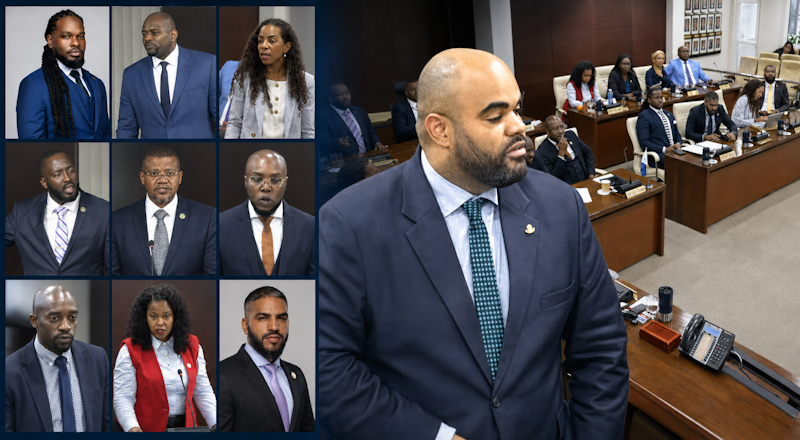
The Motion of Disapproval nevertheless passed Parliament on Wednesday with nine votes in favor and six against. The motion was presented by MP Darryl York.
All six votes against the motion came from coalition members. Three other coalition MPs—Sjamira Roseburg, Ludmila de Weever and Viren Kotai—broke ranks and supported the motion, joining the opposition in placing the country’s condition above coalition protection.
The result exposed a glaring contradiction within the governing majority.
Coalition MPs spent the budget debate describing garbage, deteriorating roads, abandoned vehicles, permit backlogs and other failures affecting VROMI. Yet when the moment came to translate those complaints into parliamentary action, six coalition members voted to shield the minister from even a formal expression of disapproval.
This was not a motion to dismiss Gumbs.
It was not a Motion of No Confidence.
It was Parliament’s mildest meaningful warning: acknowledge the failure, demand improvement and give the minister another opportunity to correct course.
Even that was apparently too much accountability for six coalition MPs.
Wescot-Williams’ Words Collide With Her Vote
Wescot-Williams’ vote is particularly difficult to reconcile with her own interventions during the budget debate.
She was among the loudest voices raising concerns about the island's dirty state. She spoke about residents being challenged to clean their communities and pressed the government on issues affecting the country’s physical appearance.
She also described herself as an advocate for “course correction.”
Yet the motion placed before Parliament was precisely a course-correction measure.
It outlined the deterioration, documented the lack of execution, formally expressed Parliament’s disapproval and gave the minister another warning before the situation escalated to another Motion of No Confidence.
If Wescot-Williams truly believed course correction was necessary, Parliament presented her with the instrument to demand it.
She voted against it.
Her vote suggests that “course correction” is easy to promote as a political slogan but much harder to support when it requires holding a coalition minister publicly accountable.
Wescot-Williams even acknowledged concerns raised in the motion about alleged bullying, intimidation and the treatment of female employees within VROMI. She encouraged the minister to conduct an independent assessment or survey among staff to determine whether there was a problem.
But after recognizing that the allegations warranted independent examination, she still voted against the motion containing those concerns.
The contradiction could not be more obvious: acknowledge the problem, request an investigation, complain about the state of the country—and then oppose the parliamentary action demanding accountability.
Parliament had already given Gumbs more time
The motion did not emerge from nowhere.
A Motion of No Confidence was previously tabled against Gumbs on April 1. When it came to a vote on May 26, it was defeated by the narrowest possible margin: seven votes against and six in favor.
The minister was therefore given additional time to demonstrate measurable improvement.
At that time, MPs who refused to remove him publicly demanded change. Some warned that their position could be different if the situation remained the same. Parliament was told it had to see improvement.
Several months later, the Motion of Disapproval documented that many of the same problems remained.
The island continues to struggle with garbage, litter, illegal dumping, overgrown areas, abandoned vehicles and deteriorating infrastructure. According to the motion, no road tender has been published or executed under the current administration.
The initial 2026–2029 waste-collection tender failed and had to be restarted.
The building-permit figures were equally alarming: 662 of 1,111 applications remained pending, including 150 of the 155 applications submitted thus far in 2026.
Those are not abstract administrative numbers. They represent homes that cannot be built, businesses that cannot expand, investments that cannot proceed, and employment opportunities that remain trapped inside a dysfunctional permit system.
The motion also raised serious allegations about bullying, intimidation and the treatment of staff, particularly female employees. These allegations have not been independently established, but even MPs who ultimately voted against the motion recognized their seriousness.
What more did the six coalition MPs require before supporting a formal warning?
Roseburg, De Weever and Kotai put country before coalition
MP Sjamira Roseburg did not pretend that everything was fine.
She told Gumbs that responsibility for the ministry falls on him—not the Secretary General or previous administrations.
Roseburg said she could not ignore the allegations involving intimidation of women and called for an independent and confidential investigation. She also acknowledged what residents can see with their own eyes: the island is in a mess.
Her vote in favor of the motion gave those words meaning.
MP Ludmila de Weever similarly described the motion as a warning and compared it to a private-sector performance evaluation. She made the simple but essential point that government cannot continue repeating that nothing was done in the past. The current administration was elected to improve the situation.
De Weever understood what six of her coalition colleagues refused to accept: a Motion of Disapproval is not political execution. It warns that performance is unacceptable and improvement is required.
MP Viren Kotai also voted in favor of the motion, becoming the third coalition member prepared to support formal parliamentary disapproval of Gumbs’ performance.
Kotai’s vote matters because it further shows that supporting the motion was not simply a coalition-versus-opposition exercise. Three members of the governing coalition examined the conditions confronting the country and concluded that Parliament had sufficient reason to issue a formal warning.
Roseburg, De Weever and Kotai demonstrated that coalition membership does not require surrendering independent judgment.
The other six coalition MPs demonstrated the opposite.
Minister blames years of neglect
Gumbs defended himself by arguing that the problems affecting roads, garbage, sewage and drainage developed over many years. He said the island is experiencing a snowballing effect caused by repeated failures to make the necessary structural investments.
There is truth in the argument that Sint Maarten’s infrastructure problems did not begin under one minister.
But inherited problems do not erase present responsibility.
Every minister inherits unresolved issues. That is the nature of government. Ministers are not appointed merely to explain how problems developed; they are appointed to produce solutions, communicate progress and demonstrate measurable execution.
Gumbs acknowledged that the island is at a tipping point. He said his ministry is working hard and argued that many structural problems cannot be solved within one four-year term.
However, the motion did not demand that every decades-old problem be solved immediately. It demanded measurable progress, urgency, responsiveness and leadership.
After Parliament spared the minister in May, the minister was given time to show that progress.
The 9–6 vote shows that a majority of Parliament is no longer satisfied with excuses.
Coalition complaints mean nothing without accountability
The six coalition MPs who voted against the motion must now explain what their complaints during the budget debate were intended to accomplish.
If the island is dirty, if roads continue to deteriorate, if building permits remain trapped in a massive backlog, if abandoned vehicles remain a public nuisance, if waste management is failing and if serious concerns exist within the ministry, then what exactly does a minister have to do—or fail to do—before those MPs will support even a Motion of Disapproval?
Parliament cannot spend hours condemning conditions and then recoil when asked to attach consequences to its own words.
That is not oversight.
That is political theatre.
The motion passed because nine MPs were prepared to say publicly that VROMI’s performance is unacceptable. Roseburg, De Weever and Kotai deserve credit for refusing to allow coalition discipline to silence that conclusion.
Wescot-Williams and the other five coalition MPs who voted against the motion chose a different path. They complained about the symptoms but voted against formally disapproving of the performance responsible for addressing them.
Sint Maarten does not need more speeches about course correction.
It needs elected representatives prepared to vote for it.