





~MPs say several questions remained unanswered; Doran demands yes-or-no answers on tenders and challenges minister over Over the Bank and Alegría, while York disputes Gumbs’ characterization of criticism as coming from the opposition.~
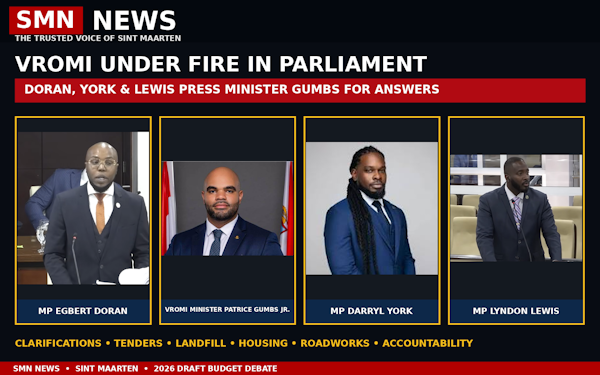 PHILIPSBURG:--- The pressure on VROMI Minister Patrice Gumbs Jr. intensified during the clarification round of the 2026 draft budget debate Thursday, as Members of Parliament challenged several of his earlier responses and demanded more precise answers on procurement, roadworks, landfill operations, wastewater, housing, building permits and government land.
The clarification round became particularly pointed when MPs argued that some of their original questions had not been answered directly or that the minister's answers did not match the information they had requested.
MP Egbert Jurendy Doran repeatedly reduced his questions to a simple demand: was there a public tender — yes or no?
MP Darryl York, meanwhile, returned to unanswered questions concerning the landfill, challenged the minister's account of a parliamentary housing meeting and questioned how the Cole Bay Drainage Project could be presented as a success when, according to Gumbs' own subsequent explanation, aspects of the project remain in the study and funding stages.
The exchanges came as Gumbs faces heightened parliamentary scrutiny over his management of VROMI.
Doran: Stop running around the answers — Was there a tender?
Doran challenged Gumbs directly over works carried out during his tenure.
He first questioned figures the minister provided on the estimated construction value of approved projects, saying VROMI should be able to retrieve historical totals because approved building permits are registered.
Doran disputed figures he understood the minister to have cited for previous years, stating that he was certain the estimated construction value for 2022 was Cg. 249 million.
He then turned to roadworks.
According to figures discussed during the debate, the road budget stood at approximately Cg. 2.5 million in 2022 and 2023 before dropping substantially in later years.
But Doran said his clarification was much simpler:
“Did you publish any road tender, yes or no?”
He then broadened the same question to other works.
Doran referred to ongoing cleaning activities and roadworks and asked whether those jobs had gone through tender procedures.
“Was a tender done, yes or no?” Doran asked.
He said he was deliberately reducing the questions to yes-or-no answers because, in his view, Gumbs had been “running around with the answers.”
That exchange places procurement squarely back at the center of the VROMI debate.
Audit Chamber Confidentiality Challenged
Another MP also challenged Gumbs' characterization of correspondence from the General Audit Chamber as confidential.
The minister had previously acknowledged that VROMI received correspondence from the Audit Chamber concerning procurement.
During clarification, the MP asked what national or Kingdom interest could be threatened by disclosing a document dealing entirely with government matters.
“What makes this document confidential?” the MP asked, arguing that the matter does not concern an external third party.
That question takes on additional significance because confidentiality has become a recurring issue during the budget debate.
If government maintains that the Audit Chamber correspondence cannot be released, Parliament is effectively asking government to identify the legal basis and public interest requiring secrecy rather than merely applying the word “confidential.”
Doran Questions Wastewater Contract Timing: “Clear as Day Negligence”
Doran also zeroed in on wastewater operations.
According to his understanding of Gumbs' earlier answer, contracts connected to the wastewater plant would expire on August 31 — only four days after Thursday's sitting — and would not be renewed, while government was still working on terms of reference.
Doran called that situation “clear, clear, clear as day negligence.”
He also pushed back against Gumbs' earlier argument concerning savings and maintenance.
Doran said that during his own tenure, he achieved significant savings by reducing payments to a company that, according to him, had been receiving more than US$240,000 monthly.
He challenged the implication that those savings necessarily resulted in reduced wastewater services.
The competing arguments expose an important issue Parliament will have to resolve: whether previous reductions represented genuine efficiencies or merely deferred costs that later administrations inherited.
Long-Lease Collection Committee: Doran says there were results
Doran also rejected Gumbs' earlier assessment of the committee established to collect outstanding long-lease payments.
According to Doran, the minister had suggested there was no proof of results.
Doran disagreed.
He argued that collections increased and that large companies were forced to pay outstanding amounts in order to become compliant.
“We all know that the numbers went up,” he told Parliament, saying that could be counted as a result.
He also sought clarification concerning VROMI's legal fees, saying payments during his tenure had been around Cg. 5,000 monthly, while current figures appeared to exceed Cg. 10,000 monthly.
Doran asked Gumbs to clarify whether the Cg. 10,000 figure he referenced applied monthly or to the entire year and requested clearer information for 2025.
Over the Bank Debate Explodes Again
The longstanding Over the Bank land controversy also resurfaced.
Doran challenged Gumbs' reference to the court judgment and read from what he described as published portions of the August 22, 2023 ruling.
According to the passage cited by Doran, the Court of First Instance determined that Country Sint Maarten was not bound by draft decrees issued by a former minister and that the Over the Bank group could not derive legally justified expectations from those documents because of violations involving public order and principles of good governance, including transparency.
Doran argued that the government could not selectively rely on portions of the ruling while ignoring other findings.
MP Raeyhon Peterson then intervened, pointing out that the Ombudsman had also begun an investigation into the property matter involving an earlier administration.
The exchange quickly widened into an argument about previous government actions and responsibility for the Over the Bank saga.
Doran accuses government of risking a “Sellout” in Alegría Matter
Doran then turned to the Alegría land dispute.
He referred to previous court cases involving the government and questioned why the current VROMI Minister was now meeting with the other party while litigation remained ongoing.
Doran said Gumbs had not denied meeting with the party but had declined to discuss any potential agreement because of the litigation.
He then posed one of his strongest questions:
After government fought through the courts to reach its current position, would attempting to reach an agreement now amount to “selling out”?
The transcript does not establish the terms of any proposed agreement, and Gumbs had not yet answered the clarification when this portion of the meeting adjourned.
Therefore, Doran's “selling out” characterization remains his political challenge to the minister — not an established fact.
York: Several Landfill Questions were still not answered
York then took the floor and immediately returned to the landfill.
He asked why several questions remained unanswered, including whether VROMI has alternative qualified or certified operators capable of repairing the government's landfill machinery.
York also wanted the names of companies currently performing work at the landfill and how much they are being paid.
He also requested the physical execution date for the Simpson Bay Lagoon, or “swamp,” project, saying he did not recall receiving that answer.
York initially avoided accusing Gumbs outright of deliberately skipping the questions.
“I don't want to say the minister skipped it, but I didn't hear it,” he said.
Those questions are particularly important because Gumbs had already confirmed that the government's three pieces of landfill equipment were out of service and that private equipment was being used to maintain operations.
York Produces Documents to Challenge Minister on Housing Meeting
The exchange sharpened when York addressed Gumbs' characterization of an earlier parliamentary meeting on housing.
York said he had personally requested the meeting and produced what he described as both the meeting request and Parliament's convocation.
According to York, neither document stated that the meeting concerned housing policy.
He said the meeting concerned immediate housing problems affecting the country at the time.
York further claimed that when Gumbs initially resisted attending because he was working on a housing policy, York specifically told him that the requested meeting “has nothing to do with your housing policy.”
York then accused the minister's subsequent characterization of the meeting as being about housing policy of being false.
The transcript records York saying:
“So that again was a lie.”
That is York's accusation. The transcript segment ends before Gumbs responds to the clarification, so it does not establish whether the minister accepted or disputed York's account.
York Challenges Cole Bay Drainage “Success”
York also challenged one of the accomplishments Gumbs had reportedly highlighted during his presentation.
According to York, Gumbs had identified the Cole Bay Drainage System Project among his successes.
But York said the minister subsequently acknowledged that the project remained in the study phase, that money still needed to be allocated, and that portions of the work remained to be determined.
His question was straightforward:
If the project is still being studied, still requires funding, and still has work to be defined, how can it already be categorized as a completed success?
That clarification strikes at how governments report accomplishments.
There is a major distinction between a project being conceived, studied, funded, tendered, contracted, under construction, and completed.
York wants Gumbs to establish precisely where the Cole Bay project sits on that timeline.
Who Can Order the Landfill Machine Parts?
York then returned to the broken landfill machinery.
Gumbs said repairs would be financed through World Bank-related resources.
But York questioned how VROMI intends to obtain the required parts.
According to York, ordering certain parts requires involvement from a certified individual.
He therefore asked the minister to explain how the parts will actually be ordered even if financing is available.
It is a practical question that goes beyond whether money exists.
Funding a repair and having the technical capacity, authorized suppliers, and qualified personnel needed to execute it are not necessarily the same thing.
York: Don't Blame the Opposition — Your Coalition Criticized VROMI Too
York saved one of his strongest political clarifications for last.
He challenged Gumbs' apparent characterization of negative descriptions of VROMI as coming from the opposition.
York rejected that.
He told Parliament that, before the previous day's debate, major public criticisms of VROMI had also come from members of the minister's own coalition.
“So it's not the opposition's characterization of the ministry,” York said.
“We didn't characterize anything.”
That distinction is politically significant while Gumbs faces parliamentary pressure.
If criticism of VROMI were confined entirely to opposition benches, government could more easily dismiss some of it as conventional opposition politics.
York argues that dissatisfaction has extended beyond the opposition.
Minister Requests 15 Minutes Before Answering
By the end of the clarification round, the minister was facing a concentrated set of questions demanding specific answers:
Were roadworks publicly tendered? What companies are working at the landfill and what are they being paid? Who is qualified to obtain the parts for the broken landfill machines? When will the relevant project physically begin? Why was a housing meeting characterized differently from the documents York presented? How can the Cole Bay Drainage Project already be called a success if elements remain under study? And what precisely is confidential about the Audit Chamber correspondence?
After York completed his intervention, Parliament returned the floor to Gumbs.
The Chair asked whether the minister was prepared to respond immediately or required time to gather the answers.
Gumbs requested 15 minutes.
The meeting was consequently adjourned until 12:30 p.m.
That short adjournment left the minister with a much bigger political task.
The clarification round was no longer about broad policy explanations. MPs had narrowed several issues to names, figures, dates, contracts and yes-or-no questions.
For a minister already defending his record under the shadow of parliamentary disapproval, the next answers could prove considerably more important than the explanations that came before them.
Gumbs Confirms No Public Tender Was Published
The clarification round produced one particularly direct admission from VROMI Minister Patrice Gumbs Jr. After MP Egbert Doran repeatedly pressed him to state plainly whether a public tender had been published for the works under discussion, Gumbs responded that “no public tender was published.” The minister explained that the works were instead handled through invited groups, confirming the very distinction Doran had been attempting to establish with his repeated yes-or-no questioning. This clarification is significant because it moves the issue beyond political argument over whether the minister had adequately answered Parliament: Gumbs ultimately confirmed on the floor that there was no published public tender, leaving Parliament to scrutinize the procurement method used, the legal basis for using invited parties, and whether the circumstances properly justified that approach.