





~Prime Minister says some government building arrangements are only verbal and documents cannot be traced; backs review of student-loan policy, promises unified cannabis position and warns Sint Maarten has little fiscal room for sweeping relief.~
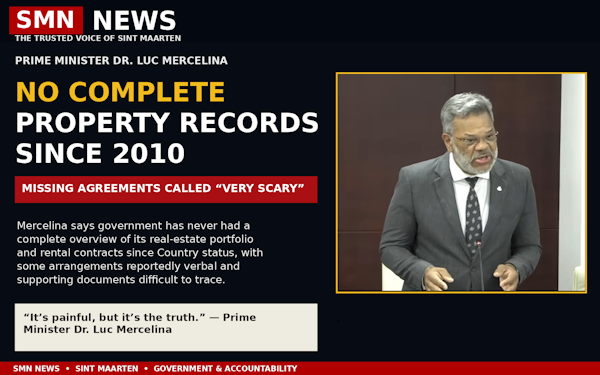 PHILIPSBURG:--- Prime Minister Dr. Luc Mercelina made a series of significant admissions during his second-round responses on the 2026 budget, including that the Government of Sint Maarten has never had a complete overview of its real-estate portfolio and rental contracts since becoming a country in 2010.
The Prime Minister went even further during clarification, telling Parliament that his government has discovered arrangements involving buildings for which officials cannot locate written agreements — and, in some cases, arrangements that appear to have been made verbally.
“We have been so surprised in the past one and a half years in government with agreements that we have,” Mercelina said, explaining that there are agreements officials cannot trace back to supporting documentation.
“There are some agreements that are verbal agreements that nobody can trace back to documents for these agreements, and that is something very scary,” the Prime Minister told Parliament.
For a government spending public money on rental properties and managing public assets, the disclosure raises serious questions about financial controls, institutional recordkeeping, and how agreements involving government property could exist without a centralized, verifiable paper trail.
“It’s Painful, But It’s the Truth”
The issue arose after MP Egbert Doran requested an overview of all government real estate and rental contracts.
Mercelina did not attempt to disguise the condition of the administration's records.
“It's painful, but it's the truth,” he said.
According to Mercelina, since 2010 the government has never possessed a complete overview of its real estate portfolio and rental contracts. He stressed that the problem therefore predates his administration.
The government is now trying to establish a comprehensive inventory covering government-owned properties, leased facilities, rental obligations and contractual commitments.
The existing overview contained in the budget documentation is being used as a baseline while historical records and actual property holdings are reconciled.
The Prime Minister said the situation has even contributed to litigation involving buildings and past agreements where the government struggles to retrieve the documentation needed to establish precisely what was agreed.
“It is unfortunate. It is a reality that I have to deal with now because it falls under General Affairs,” Mercelina said.
Government Still Monitoring Fuel and Telephone Usage
Mercelina also confirmed that the government continues to monitor and verify fuel consumption for government vehicles monthly following the introduction of a digital system.
Project managers assigned under country-package measure B10 began work last week, according to the Prime Minister, with cost monitoring and reduction—including government vehicle fleet and fuel expenses—among their areas of focus.
Mercelina promised Parliament a six-month breakdown of government fuel consumption by ministry.
He similarly confirmed that information concerning telephone and fuel usage can be provided to Parliament in writing.
Council of Ministers Says it has not Received Audit Chamber Letter
Asked about two letters reportedly originating from the General Audit Chamber concerning a procurement procedure, Mercelina said the Council of Ministers had not received a letter and therefore had not deliberated on the matter.
He said the Council would discuss the matter once it was received.
50% Student-Loan Forgiveness is not Automatic
Mercelina also clarified earlier statements concerning student-loan forgiveness for civil servants.
The Prime Minister said the 50% figure should not be interpreted as an automatic entitlement for every civil servant.
According to his explanation, the existing recruitment and retention incentive can allow qualifying employees with student debt to receive forgiveness or reimbursement of up to 10% annually, to a maximum of 50%, subject to conditions including satisfactory performance, applicable procedures and available financial resources.
Mercelina said his April 2025 remarks were meant to highlight incentives to attract graduates and professionals back to Sint Maarten, not to promise an automatic 50% reduction for every government employee.
That distinction could prove significant for civil servants who understood the earlier public statements differently.
Prime Minister Acknowledges Ambiguity Over Who Qualifies
More importantly, Mercelina acknowledged that the policy itself contains ambiguity that may have led to different interpretations.
He said the term used to establish who qualifies is not expressly defined in the policy, and different interpretations have therefore arisen over time.
P&O has applied an administrative interpretation, but Mercelina said the issue is currently under discussion and has also become the subject of legal proceedings. He consequently declined to comment on individual cases.
However, the Prime Minister agreed that eligibility requirements must be clear, transparent and consistently applied.
He said he supports reviewing the policy with P&O to determine whether it needs additional clarification.
That review could be particularly important where Dutch citizens are excluded or treated differently because of differing interpretations of eligibility.
P&O Understaffed — Applicants are Being Left Waiting
Mercelina also acknowledged complaints from Sint Maarteners abroad who send applications to the government but receive no timely response.
He described the concern as valid.
According to the Prime Minister, the problem is not the government's unwillingness to respond but a serious shortage of personnel at P&O.
P&O is “significantly understaffed,” he said, and is struggling to support recruitment across the entire government apparatus.
Government is therefore attempting to recruit additional P&O personnel, implement its strategic recruitment plan and potentially engage an external recruitment agency.
“No qualified candidate, whether residing abroad or in Sint Maarten, should feel that their interest in serving their country is being ignored,” Mercelina said.
Paternity Leave Could Increase from Two Days to Ten
Another concrete announcement concerned paternity leave for civil servants.
Mercelina confirmed that the issue is being discussed with the CCSU as part of negotiations concerning public-service employment conditions.
Currently, according to Mercelina, there is a mismatch: the Civil Code provides seven days, while the regulation applicable to civil servants provides only two days.
The proposal under discussion with the unions would increase paternity leave for civil servants to 10 days.
Mercelina said he fully supports the proposed increase.
Mercelina: Government must return to cannabis table
The Prime Minister also intervened in the increasingly fractured debate surrounding cannabis policy.
After Chairlady of Parliament Sarah Wescot-Williams asked the Council of Ministers to return to the table after ministers made differing statements, Mercelina agreed that the government cannot keep presenting conflicting positions on an issue of such importance.
“The government must speak with one voice on a matter of this importance,” Mercelina said.
“I agree completely with that.”
He committed to bringing the issue back before the Council of Ministers to consider the concerns raised and the work already completed, and promised to update Parliament after those discussions.
That commitment places responsibility squarely on Mercelina, as Prime Minister, to reconcile the differing positions expressed by members of his own Council of Ministers and establish precisely what government's cannabis policy is.
Confidentiality Cannot Simply Be a Label
Mercelina also provided an extensive response to Doran's concerns about government repeatedly declaring information confidential.
The legal advice provided to the Prime Minister stated that confidentiality is not determined merely by labeling a document. It depends upon the nature of the information and the legal interests requiring protection.
Article 62 of the Constitution gives MPs the right to information from ministers, although information may be withheld where disclosure conflicts with the interests of the country or Kingdom. Sensitive information can also be provided through closed-door meetings, confidential inspection or other restricted arrangements that preserve Parliament's oversight function.
The conclusion provided to Parliament was particularly important:
Transparency is the general rule; confidentiality is the exception.
During clarification, Mercelina reinforced that MPs have an oversight, corrective and supervisory function and should have access to information, while arguing that sensitive commercial or third-party information must sometimes be handled through confidential channels.
Mercelina Pushes Back on GEBE Fuel Promise
The Prime Minister also responded to recordings Doran played concerning earlier statements about GEBE absorbing higher fuel costs rather than passing them to consumers.
Mercelina argued that the statements had been taken out of context.
According to him, those remarks specifically concerned the temporary 10 MW container generators, which required more expensive diesel fuel. At that time, he said, GEBE had agreed to absorb the additional cost associated with that diesel.
Doran challenged Mercelina's characterization of raising the issue as politics, saying residents continue to struggle with the GEBE crisis and that asking the Prime Minister to clarify a promise he made was part of his responsibility as an elected MP.
Mercelina subsequently softened his response, acknowledging that both he and Doran want relief for residents.
“The People Are Struggling”
Perhaps the Prime Minister's clearest acknowledgment of the country's economic pressure came at the end of that exchange.
“We realize that the people are struggling,” Mercelina told Parliament.
But he said sitting on the executive side forces government to confront the financial consequences of every relief measure it considers.
According to Mercelina, government must repeatedly weigh immediate assistance against whether a measure could threaten the country's financial sustainability.
Earlier, he had acknowledged that the fiscal space for broad relief measures is “extremely limited.”
He pointed to targeted utility relief for vulnerable households, support for pensioners and vulnerable groups, education assistance, efforts to improve public services without increasing costs, and initiatives intended to create jobs and economic opportunities.
The Prime Minister nevertheless invited MPs to submit workable proposals for additional relief within the available fiscal space.
Fifteen Motions and Ten Budget Amendments Await Parliament
The budget debate itself is now moving toward a decisive stage.
At adjournment, Parliament announced that 15 motions and 10 amendments to the draft 2026 budget had been submitted and would be handled when the meeting resumes.
Mercelina warned that many motions require extensive information, legal reviews, policy proposals, implementation plans, reports and timelines at a time when ministries are already dealing with staffing and legislative-capacity shortages.
Still, he welcomed a dedicated meeting between government and Parliament to review the implementation status of adopted motions, their feasibility, financial consequences and legislative requirements.
Mercelina’s Biggest Admission is about Government itself
Across Mercelina's answers, one theme repeatedly surfaced: St Maarten's government machinery remains institutionally weak in areas that should have been brought under control years ago.
P&O is understaffed.
Government is still trying to clarify employee incentives.
Corporate-governance reforms remain under assessment.
Administrative enforcement is constrained.
Cannabis policy has produced conflicting messages from ministers.
And sixteen years after 10-10-10, government still cannot say with complete certainty what properties it owns, what buildings it rents and where all the agreements supporting those arrangements are located.
Mercelina did not attempt to hide that reality.
He called it “painful.”
He called the discovery of undocumented and verbal agreements “very scary.”
Government says it is now working to establish a centralized, verified inventory.
That work cannot come soon enough.
Because the issue goes beyond missing paperwork. A country cannot properly protect public assets, control rental expenditure or hold anyone accountable for government agreements if the government itself cannot produce a complete record of what it owns, what it rents and what it agreed to.