






~Minister says students as young as 14 are arriving at school already high; teachers report students hiding smoking during breaks; argues unregulated industries must help finance prevention, treatment and social programmes.~
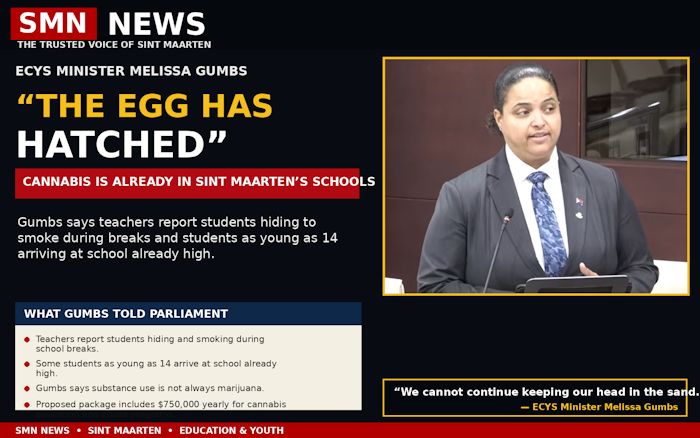 PHILIPSBURG:--- Minister of Education, Culture, Youth and Sport (ECYS) Melissa Gumbs has delivered a stark assessment of cannabis and substance use among Sint Maarten’s youth, telling Parliament that the country is debating whether it is “ready” to confront cannabis while teachers and school managers are already dealing with its consequences.
Responding to questions during the second round of the 2026 budget debate, Gumbs said the cannabis initiative originated under the former administration. When she was still an MP, she questioned why the Ministries of Justice and ECYS did not seem sufficiently involved in the process. After becoming minister, she said she would add ECYS to the workgroup so educators' concerns would be represented.
But Gumbs' strongest message was that the debate is occurring as though cannabis use is some future problem.
For her, that is disconnected from reality.
“We're having a chicken-and-the-egg conversation while not admitting that the egg has hatched,” Gumbs told Parliament.
“We are not Ready” is not good enough for Gumbs
The minister criticized what she described as St Maarten's tendency to avoid difficult subjects until they become impossible to ignore.
“We have a very head-in-sand approach to difficult topics,” she said, arguing that society can become comfortable operating in grey areas where legislation and regulation are absent.
Gumbs said she understands concerns about cannabis legislation, but remains surprised by arguments that St Maarten is simply “not ready.”
She compared the reaction to earlier controversy surrounding comprehensive sex education in primary schools.
Gumbs recalled that when she previously raised that subject, critics argued that children were too young and accused the ministry of wanting to teach children how to have sex.
But she said the AIDS Foundation told Parliament in 2022 that its programmes had identified children as young as 11 engaging in sexual activity and warned that the age could decline further.
Her argument was not that cannabis and sex education are identical issues. Rather, she used the example to make a broader point: refusing to discuss a difficult reality does not prevent children from encountering it.
“Cannabis and the pros and cons associated with it are already here,” Gumbs said.
Teachers Reporting Students Hiding and Smoking at School
Gumbs then moved the cannabis debate directly into Sint Maarten’s schools.
Her statements should command the attention of parents.
The ECYS Minister said that almost every other week she receives messages from teachers at Milton Peters College (MPC) complaining about students using a container at the school and containers down the road as places to hide and smoke during breaks.
The problem, according to Gumbs, goes beyond marijuana.
She said she also hears directly from the school manager at the vocational training school about students arriving at school at 7:30 in the morning already high.
Some, she said, are only 14 years old.
“And it's not always on marijuana,” Gumbs told Parliament.
That statement changes the complexion of the cannabis debate.
Parliament is not simply considering an abstract question about whether adults should legally be allowed to purchase and consume cannabis.
The Minister responsible for education is telling the legislature that educators are already encountering intoxicated teenagers in the school environment.
The immediate question, then, is: what is being done for those children now?
Gumbs says prevention programmes need money
Gumbs linked the school situation to another problem — funding.
She pointed to programmes such as Turning Point and Ujima, saying organizations dealing with addiction and other social problems have struggled for decades to obtain adequate resources.
“When I look at what is available to allocate to a program for young people at, for example, Turning Point, we are sweeping at cobwebs,” Gumbs said.
Her argument is that Sint Maarten has allowed an unregulated cannabis economy to operate for decades, generating significant private financial activity while contributing nothing to government revenue or the social programmes dealing with its consequences.
Gumbs said there has simultaneously been a government desperately searching for diversified revenue and community programmes desperately searching for funding.
According to the minister, those realities should be connected.
“The Sin must pay for the sinner”
Gumbs' philosophy goes beyond cannabis.
She told Parliament that controversial industries should be required to contribute financially toward addressing the social risks and damage associated with them.
“The sin, so to speak, must pay for the sinner,” she said.
She pointed to gambling as another example.
Gumbs said casinos, lotteries and unregulated gaming machines have operated within Sint Maarten society for years while insufficient resources have been directed toward preventing and treating gambling addiction.
She said prominent members of the community have seen their lives severely damaged by gambling addiction and argued that regulation should ensure these industries contribute toward addressing the problems they can create.
Her cannabis position follows the same reasoning: if an industry creates risks that government, schools, families and social organizations must ultimately manage, that industry should contribute toward the cost.
$750,000 Annually for Cannabis Education and Abuse Programmes
Gumbs also disclosed a significant financial component of the cannabis proposal discussed with the Council of Ministers.
According to information shared with the Council, the current package includes establishing a fund of $750,000 annually for ten years — $ 7.5 million in total.
Gumbs said the intention is for the majority of those funds to be allocated toward new programmes dealing with cannabis education, abuse and misuse.
For ECYS, that money appears to be a central argument for participating in the regulatory discussion.
If young people are already using cannabis and other substances, and treatment and prevention organizations are struggling for resources, Gumbs' position is that the economic activity surrounding cannabis cannot remain completely outside the system while taxpayers alone finance the consequences.
Gumbs Says Local Farmers Have Been Involved
The minister also challenged claims that local farmers have been excluded from discussions.
Based on updates provided by ECYS's liaison to the cannabis workgroup, Gumbs said local farmers have attended meetings, raised concerns and made suggestions that were incorporated into planning for the framework.
She also said the workgroup has a phased community-outreach plan involving families, religious organizations, educational institutions, private businesses and ECYS divisions, including Student Support Services Division (SSSD).
Her conclusion remained consistent:
Sint Maarten cannot continue putting its “head in the sand” when dealing with controversial industries.
Public Schools: Cg. 310,000 for urgent repairs, but total cost still unknown
Cannabis was not the only major education issue Gumbs addressed.
The minister acknowledged that ECYS still cannot tell Parliament how much money is required to address all outstanding emergency maintenance problems at public schools.
For now, Cg. 310,000 has been allocated toward the most urgent health, safety and operational needs identified by the Division of Public Education.
However, there is still no consolidated, verified estimate of the total cost.
ECYS is therefore advancing a structural condition assessment and prioritized repair plan through public tender. That exercise is supposed to examine schools individually, identify outstanding work, rank repairs according to urgency and risk, and establish corresponding cost estimates.
Gumbs said completion is projected for early Q1 2027.
Only then, according to the minister, will government have a reliable picture of how much is actually needed to repair the public-school infrastructure.
Breakfast Assistance Available at Every Public School
Gumbs also clarified the status of the school breakfast programme.
She said all public schools have access to breakfast assistance, although support is needs-based rather than automatically provided to every student.
Schools identify children requiring assistance, and the Division of Public Education provides support within available operational resources, supplemented where possible by organizations such as Rotary and other private and community partners.
Gumbs said no public school is intentionally excluded.
New Enrollment Arrangement for Children Turning Four
The minister also addressed a longstanding concern affecting children whose fourth birthday falls after the beginning of the school year.
Under the revised arrangement agreed with primary-school boards, children turning four between August and December may enroll at the start of the school year.
Children turning four between January and July may enroll from January 1, subject to classroom capacity.
The purpose, Gumbs said, is to prevent children from unnecessarily losing an entire school year simply because of their date of birth.
However, the arrangement is not yet uniformly enforceable by law.
Amendments to the Education Supervision Ordinance are still required. Until then, school boards are being encouraged to implement the arrangement voluntarily.
Lottery Booths Around Schools Under Scrutiny
Gumbs also confirmed that government is examining concerns about lottery booths near schools.
She said she has discussed the issue with the relevant ministers and was informed that no request for government land or building permits had been submitted for the booths in question.
That potentially creates an enforcement gap when booths are established on private property.
Gumbs said she intends to strengthen coordination with the inspectorate so the appropriate government departments can be alerted when potentially unauthorized structures are identified.
The applicable lottery regulation governs permission, registration, eligibility, oversight and fees for sales points, she said, but does not establish geographic criteria governing where lottery booths may be located.
That leaves government confronting another uncomfortable question: even if a lottery sales point is legally authorized, should gambling activity be allowed immediately around children and schools?
“We Approached the Tipping Point Many Moons Ago”
Gumbs also warned about Sint Maarten's wider economic model.
Responding to questions about Curaçao's carrying-capacity study, she said she had reviewed it and found little surprising.
Even with her experience in the tourism sector, Gumbs said she believes Sint Maarten reached or approached its tourism “tipping point many moons ago.”
She called for genuine economic diversification through industries that are not dependent upon continued mass tourism.
The minister also said she had read economist Jason Lista's paper concerning Sint Maarten's economy and low foreign direct investment, describing it as a warning sign that deserves serious public discussion.
Gumbs’ Message: Stop Pretending Difficult Problems Aren’t Already Here
Across her parliamentary answers, Melissa Gumbs returned repeatedly to one theme.
Sint Maarten has spent years confronting difficult social and economic realities after they became entrenched.
Cannabis exists.
Teenagers are using substances.
Gambling addiction exists.
Lottery booths are appearing around communities and schools.
School infrastructure requires significant repairs.
Social programmes need money.
And the economy remains overwhelmingly dependent on tourism.
For Gumbs, saying the country is “not ready” does not make those realities disappear.
Her most consequential disclosure may therefore not have been about a future cannabis law at all.
It was what she said is already happening inside the education system: teachers reporting students hiding to smoke during school breaks and a school manager encountering children as young as 14 arriving for classes already high.
That is not a future policy debate.
It is a problem already sitting at the school gate.