





~MP also questions cannabis legislation’s impact on youths and says residents must share responsibility for Sint Maarten’s cleanliness~
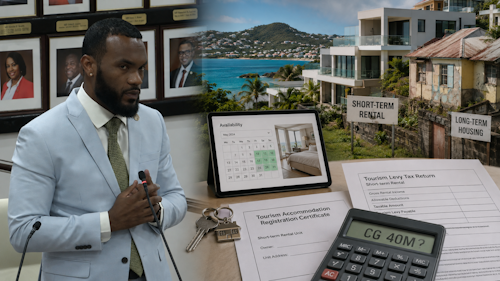 PHILIPSBURG, Sint Maarten — Member of Parliament Raeyhon Peterson has called on the government to fast-track legislation to tax short-term rentals, arguing that Sint Maarten could collect approximately Cg. 40 million in additional annual revenue from the rapidly expanding sector.
Peterson raised the issue during the continuation of the 2026 budget debate on Wednesday, where he also questioned the ECYS Minister about drug use among students, defended the need for public responsibility in combating illegal dumping and explained a budget-neutral proposal to redirect unused VROMI funds.
Short-term rentals are no longer ‘low-hanging fruit’
Peterson recalled that an Airbnb or short-term-rental tax had previously been described as relatively low-hanging fruit when the present TEATT Minister served in Parliament.
He asked what legislative obstacle now prevents the government from implementing the measure.
Based on examples from other cities and countries and after accounting for the size of Sint Maarten’s economy, Peterson estimated that the tax could potentially generate ‘a good maybe 40 million extra guilders a year.’
He urged government to move the legislation forward during the final quarter of 2026 and into 2027, citing the country’s urgent need for additional revenue.
Peterson’s figure was presented as an estimate during his parliamentary remarks. The transcript included no supporting calculation, tax rate, occupancy data, or collection model, and the government would have to produce a formal revenue projection before treating the amount as expected income.
Housing units moving into the visitor market
Peterson said new buildings are appearing throughout Simpson Bay, Cupecoy, Middle Region and other communities under the assumption that they will provide housing.
In practice, he argued, many units are being offered as short-term accommodation through Airbnb, Booking.com, Vrbo and similar platforms.
He further questioned whether companies owning some of the units are registered offshore, potentially allowing rental proceeds to flow outside Sint Maarten rather than circulate through the local economy.
The concern links the short-term-rental debate to three national issues at once: government revenue, the availability of long-term housing and whether earnings generated from Sint Maarten properties remain in the country.
Peterson argued that taxing the sector is therefore not only about raising government revenue. It is also about fairness between traditional accommodation businesses, residents and companies earning income from unregulated or lightly regulated visitor rentals.
The budget crisis did not begin with this government
Peterson said he had relatively few questions about the late 2026 budget because Parliament is expected to return within weeks to begin addressing the 2027 budget.
He nevertheless criticized opposition politicians whom he accused of using the debate to create social-media content and presenting earlier COVID-19 support measures without acknowledging that they were financed with Dutch liquidity assistance.
Peterson said he was present during that period and remembered the funding source.
He rejected the suggestion that Sint Maarten moved cleanly from the COVID crisis into normal conditions, arguing that the country and much of the world have faced continuing crises and financial pressure since the pandemic.
That shortage of money, he said, makes the government’s delay in tapping identifiable revenue sources such as short-term rentals more difficult to understand.
Unused VROMI funds would be redirected
Peterson also explained an amendment that another MP was expected to present on his behalf at the request of the VROMI Minister.
He said approximately Cg. 1.5 million budgeted for district-cleaning contracts could not be used for that original purpose in 2026 because those contracts were no longer running while the ministry awaited a public tender.
Under the proposed budget-neutral amendment, approximately Cg. 800,000 would be redirected to solid-waste collection, Cg. 450,000 to expert advice and consultancy at the Staff Bureau, Cg. 150,000 to security and roughly Cg. 30,000 to calamity response.
Peterson stressed that the changes would not increase the overall budget, but would move existing funds to other VROMI expense categories.
What is happening with drug use in schools?
Turning to the cannabis debate, Peterson asked the ECYS Minister for an update on drug use among young people.
He recalled providing information during the 2025 budget debate indicating that 15-year-old students had tested positive for marijuana and cocaine in Sint Maarten schools.
Peterson asked what is happening now and how the proposed cannabis legislation could affect young people.
His questions add an education and youth-protection dimension to the wider political debate over cannabis regulation. The MP did not present new statistics during this intervention, but asked the minister to provide an updated assessment.
Residents must also answer for the island’s condition
Peterson agreed that Sint Maarten’s cleanliness has deteriorated and can affect the tourism product, but rejected the argument that the VROMI Minister alone should carry the blame.
He said responsibility also rests with residents who dump illegally or throw cups, paper and other waste from vehicles while simultaneously complaining about the country’s condition.
Peterson questioned whether more public education is needed and urged the country to confront the conduct of the people causing the damage instead of blaming every successive minister without examining individual responsibility.
He argued that repeatedly adding cleaning or collection companies has often divided work among entities that may not have the capacity to do it, while the behavior producing the litter continues.
For Peterson, criticism must be constructive and should address both government performance and public conduct.
Revenue, regulation and responsibility
Peterson’s intervention placed three demands before government: identify new revenue, protect young people and make both the state and the public responsible for the country’s condition.
His proposed short-term rental tax would require legislation, registration, reliable data, enforcement, and mechanisms ensuring that offshore owners cannot simply remain outside the tax net.
His questions on cannabis require current school and public-health evidence, not assumptions. His remarks on cleanliness require enforcement against illegal dumping alongside greater public discipline.
The common thread is implementation. Peterson argued that government cannot continue discussing identifiable problems—lost revenue, youth drug exposure and littering—without moving from debate to enforceable policy.