





MP elected with 54 personal votes enforced speaking limit after Wescot-Williams and SAM leader Franklin Meyers supported cutting debate time
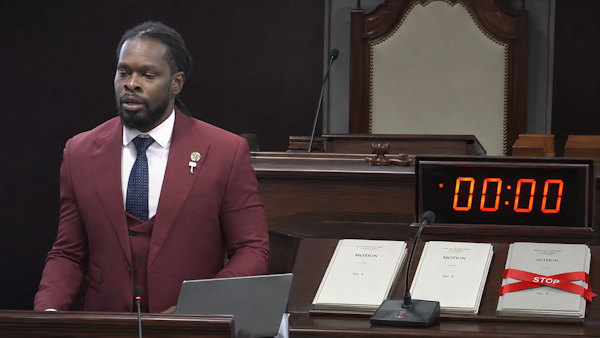 PHILIPSBURG:--- Democracy in St Maarten’s Parliament was placed on a stopwatch Tuesday when MP Chris Wever, who was presiding over the meeting, stopped Member of Parliament Darryl York from orally presenting his third motion because York’s allotted speaking time had expired.
Wever, who entered Parliament with 54 personal votes, invoked the Rules of Order after York requested two additional minutes to finish presenting his motions.
The ruling may have enforced the shortened speaking-time arrangement adopted for the 2026 budget debate, but the political circumstances behind that limitation cannot be ignored.
Wever did not create the reduced speaking time on his own.
The proposal to shorten the time available to MPs was presented and supported by Franklin Meyers, leader of the Soualiga Action Movement, and supported by the Chairlady of Parliament, Sarah A. Wescot-Williams, and coalition MPs.
The shortened clock was therefore not an unavoidable act of nature.
It was a political decision.
That decision was ultimately enforced against a duly elected representative who was attempting to perform one of Parliament’s most important functions: scrutinizing government and presenting motions intended for parliamentary consideration.
York did not lose his time because of disorderly conduct. He was not removed for using unparliamentary language. He was not refusing to obey the Chair.
He was attempting to complete the presentation of three motions.
Nevertheless, the clock was allowed to become more important than the substance.
York’s scrutiny of VROMI consumed his limited time
York used his second-round presentation to direct an extensive series of questions to Minister of Public Housing, Spatial Planning, Environment and Infrastructure Patrice Gumbs Jr.
He challenged the minister’s claim that the national housing policy had been presented to Parliament.
According to York, the policy was submitted to Parliament but was never formally presented and debated during the separate meeting that the minister had previously promised the public.
York also questioned whether the Cole Bay drainage project was being portrayed as a solution for Union Road when, according to the project’s terms of reference cited by the MP, its scope covers only a portion of the area.
He warned that the project may not extend completely to the Simpson Bay Lagoon and questioned whether unresolved obstructions between the proposed endpoint and the lagoon could expose nearby homes to additional flooding.
York then turned to the landfill.
He demanded clarity on Fleming Waste Services, including unpaid invoices, the absence of a finalized service-level agreement, the reported departure of the landfill operator and mechanic, the condition of government-owned heavy machinery, and information that another company may now be operating at the landfill.
York described several of these matters as reports requiring clarification. He did not present every allegation as an established fact.
The MP also challenged the government’s continued reliance on studies and international entities while basic traffic and infrastructure problems remain unresolved.
He asked why the government needs international consultants to identify issues that local professionals and residents have been raising for years.
York further demanded timelines for long-delayed projects in St. Peters and Dutch Quarter, structural attention for the aging Prince Bernhard Bridge, action concerning drainage outlets and concrete measures to address the condition of the Great Salt Pond.
These were not irrelevant diversions.
They were questions about housing, flooding, garbage, traffic, infrastructure, the environment, government spending and the basic living conditions of the people of Sint Maarten.
Government admits the island is dirty—then limits scrutiny
The decision to shorten MPs’ speaking time becomes even more troubling when placed against the government’s own admissions.
Coalition MPs have openly criticized the country's condition. The Prime Minister has spoken about the island’s cleanliness problem. Government-supporting MPs have called for “course correction,” while other MPs have described the deterioration in increasingly severe terms.
The country is dirty.
Roadside maintenance remains inadequate.
The landfill continues generating questions.
Traffic congestion is worsening.
Infrastructure projects remain delayed.
Housing remains beyond the reach of many residents.
Millions have been allocated to projects that still have not reached physical execution.
These are not small matters that can be responsibly addressed through rushed speeches and parliamentary speed-reading.
If the coalition and government recognize that the country faces serious problems, why did leading members support reducing the time available for MPs to interrogate the budget and present solutions?
A government accused of stagnating cannot respond by restricting the time available to expose that stagnation.
That is not course correction.
That is controlling the clock while the country continues waiting for results.
Wever enforced a limit created by others
When York asked for two additional minutes to present his third motion, Wever informed him that his time had expired.
York was allowed to conclude the motion he was already presenting. That motion was accepted for parliamentary consideration and is expected to be voted on.
However, York did not orally present the third motion before the clock stopped him. Wever stated that York could still submit it to Parliament in writing.
That procedural option does not eliminate democratic concern.
A submitted document is not the same as allowing an elected MP to explain a motion on the floor, place its purpose on the public record, and persuade fellow parliamentarians to support it.
The public must also distinguish between the person who enforced the limit and those who helped create it.
Whoever was presiding when York was stopped.
Wescot-Williams and SAM leader Franklin Meyers helped present and support the reduced speaking-time arrangement.
That political history cannot disappear simply because the person sitting in the Chair changed during the meeting.
It is insufficient for Parliament to say: “Your time is up.”
Who shortened that time?
Why was it shortened during one of the most consequential debates of the parliamentary year?
Whose interests are served when MPs are forced to rush through motions dealing with national development?
And what does it say about the state of democracy when a duly elected MP must plead for two additional minutes to finish presenting parliamentary business?
Fifty-four votes and the power to stop the clock
Wever’s 54 personal votes gave him a lawful seat in Parliament under St Maarten’s electoral system.
Once elected, he possesses the same constitutional status as every other member of the legislature.
But that reality also exposes the seriousness of what occurred.
A parliamentarian elected with 54 personal votes was placed in the position of stopping another duly elected representative from completing his oral presentation—not because York’s proposals were ruled unlawful or irrelevant, but because a politically shortened clock had reached zero.
That is the democratic contradiction.
The issue is not whether Wever had the procedural authority to enforce the time limit while presiding.
The issue is whether Parliament should have adopted such a restrictive limitation for the budget debate in the first place.
Procedure should facilitate democracy.
It should never become a convenient instrument for suffocating it.
York’s motions dealt with national development
York’s motions were not political theatrics detached from the budget.
One focused on formally identifying and developing Sint Maarten’s orange economy—the musicians, artists, designers, storytellers, cultural professionals and other creators whose work preserves the country’s identity while generating employment and economic activity.
Another called for developing a national maritime strategy.
York argued that Sint Maarten is a maritime country whose tourism, trade, transportation, regional connectivity and thousands of jobs depend on the sea.
He cited the maritime and yachting sector as contributing approximately 16.3 percent of gross domestic product and supporting close to 5,000 jobs.
The motion urged government to develop a long-term strategy covering yachting, marinas, ship repair, marine services, fisheries, ferry transportation, cargo, maritime education, vessel registration, environmental protection and Sint Maarten’s international responsibilities.
York proposed using resources already included in the 2026 budget, including the proposed NAf. 120,000 maritime study, without requiring an additional appropriation or duplicating research already commissioned.
The motion he was allowed to complete was accepted for parliamentary consideration and is expected to be voted on.
That exposes the absurdity of the cutoff.
If a motion is serious enough to be accepted and placed before Parliament for a vote, then its author should be given the minimal time necessary to explain it.
York had announced that he possessed three motions. Parliament knew that another motion remained.
Nevertheless, the clock prevailed.
Democracy can be stifled politely
Democracy is not always suppressed through dramatic confrontation.
Sometimes it is stifled politely.
A clock reaches zero.
A rule is cited.
A member is told his time has expired.
The Chair moves on.
Everything appears procedurally neat while a representative is prevented from completing the people’s business on the floor of Parliament.
Supporters of the restriction may argue that every MP was subject to the same shortened time.
That does not answer the deeper concern.
An unreasonable limitation does not become democratic merely because it is applied equally.
The budget determines how government collects and spends the people’s money. It gives Parliament its most important opportunity to examine ministerial performance, delayed projects, policy failures and national priorities.
Reducing that debate to a race against the clock benefits ministers who have failed to provide timely results. It weakens scrutiny and reduces the space available for solutions.
Government already controls the ministries, public administration and execution of the budget.
The coalition controls the parliamentary majority.
When members of that same political structure support restricting the time available for scrutiny, the democratic imbalance becomes impossible to ignore.
A stagnant government should answer questions—not shorten them
York’s presentation was uncomfortable for VROMI because he confronted the minister with dates, public statements, project scopes and alleged contradictions.
That is precisely what Parliament is supposed to do.
The answer to uncomfortable questions is not a shorter debate.
It is evidence.
If Fleming Waste Services was properly paid, government should provide the records.
If the company was not removed, the minister should say so.
If a new landfill operator was lawfully retained, disclose the contract, price, duration, and procurement process.
If the Cole Bay drainage project will safely connect to the lagoon, present the engineering evidence.
If the housing policy was formally presented and debated in Parliament, identify the meeting.
If millions allocated to St. Peters and Dutch Quarter projects are finally being spent, give the public firm execution dates.
The people do not need fewer questions.
They need more answers.
Sint Maarten cannot afford a Parliament in which ministers receive extensive opportunities to promote achievements while MPs are stopped before completing motions intended to address national problems.
The country is already struggling with stagnation.
Its democracy must not face the same restrictions.
The message delivered Tuesday was disturbing: government may delay projects for years, but an MP seeking answers and presenting solutions cannot receive two additional minutes.
That is not parliamentary efficiency.
That is democracy being timed, shortened and controlled by the same political forces that should be answering to it.
MOTION OF DISAPPROVAL
The Parliament of Sint Maarten, in its meeting of today, August 26, 2026,
Considering:
- That a Motion of No Confidence was previously tabled against the Minister of VROMI on April 1, 2026;
- That the previous Motion raised serious concerns regarding building permits, roads and infrastructure, abandoned vehicles, waste and landfill management, policy execution and the overall functioning of the Ministry;
- That when the previous Motion was voted on May 26, 2026, it was rejected by a narrow margin of seven votes against and six votes in favor, thereby affording the Minister additional time and opportunity to demonstrate measurable improvement;
- That Members of Parliament who did not support the previous Motion nevertheless publicly demanded improvement, including statements that if circumstances remained unchanged their position could be different in the future and that Parliament expected to “see change now”;
- That several months later, many of the same concerns remain unresolved and continue to negatively affect residents, businesses and the overall functioning of the country;
- That Sint Maarten is experiencing one of its worst periods of deterioration in cleanliness in years, with garbage, litter, illegal dumping, overgrown areas and abandoned vehicles contributing to an unacceptable state of the country and negatively affecting the image of Sint Maarten as a tourism destination;
- That despite repeated complaints from residents, businesses and Parliament, the Minister has failed to demonstrate that he fully grasps the urgency and realities of the matters falling under his Ministry and their daily impact on the people of Sint Maarten;
- That figures presented during the 2026 budget debate showed that 662 of 1,111 building permit applications received remained pending, including 150 of 155 applications submitted thus far in 2026;
- That these delays are not simply numbers on paper, but represent homes that cannot be built, businesses that cannot expand, developments that cannot move forward and investments and employment opportunities that are being unnecessarily delayed;
- That no road tender has been published or executed under the current administration, while the country's road infrastructure continues to deteriorate;
- That the continued failure to adequately address the deteriorating state of Sint Maarten's roads, despite the obvious and urgent need for intervention, amounts to serious negligence in the management of the country's public infrastructure;
- That the initial 2026–2029 waste collection tender failed and had to be restarted, while concerns regarding garbage, littering and the deteriorating cleanliness of the country persist;
- That significant road and infrastructure matters remain unresolved or still require further execution, while abandoned vehicles and environmental enforcement continue to be matters of serious public concern;
- That delays, backlogs and insufficient responsiveness within VROMI continue to negatively affect residents and businesses and contribute to frustration with public service delivery;
- That the continued lack of execution within VROMI is negatively affecting economic activity in Sint Maarten, as businesses, investors, homeowners and developers depend on timely permits, functioning infrastructure and an effective Ministry to move projects and investments forward;
- That serious allegations have been raised regarding bullying, intimidation and the treatment of staff within the Ministry, including allegations specifically concerning the treatment of female employees, as well as concerns regarding an unhealthy working environment and its effect on staff morale, productivity and progress within the Ministry;
- That allegations of this nature, particularly when involving the leadership and working environment of a Ministry, warrant serious concern and cannot be dismissed when assessing the Minister's overall management and functioning of the Ministry;
- That a Ministry responsible for the physical development, infrastructure, environment and cleanliness of Sint Maarten cannot function effectively when the public is confronted with persistent backlogs and deterioration while concerns are simultaneously being raised regarding the internal working environment;
- That Parliament already afforded the Minister additional time to correct course, and that additional time cannot become an indefinite excuse for continued delay, poor execution and lack of measurable progress;
- That despite being afforded this additional opportunity, the Minister has failed to demonstrate the measurable improvement, urgency, leadership and execution necessary to address the concerns raised by Parliament and restore confidence in the functioning of the Ministry;
Resolves:
That the Parliament of Sint Maarten formally expresses its disapproval of the performance and management
of the Minister of Public Housing, Spatial Planning, Environment and Infrastructure, Mr. Patrice Gumbs, in
relation to the continued lack of measurable progress, execution and responsiveness on the matters outlined
in this motion.
And goes over to the order of the day.
Copies of this motion to be sent to:
The Parliament of Sint Maarten
The Government of Sint Maarten
The Governor of Sint Maarten