






~Former VSA Minister presses on tackling overcrowding, punishment cells, loss of visits, prison leadership, and whether well-behaved inmates could qualify for greater early-release incentives.~
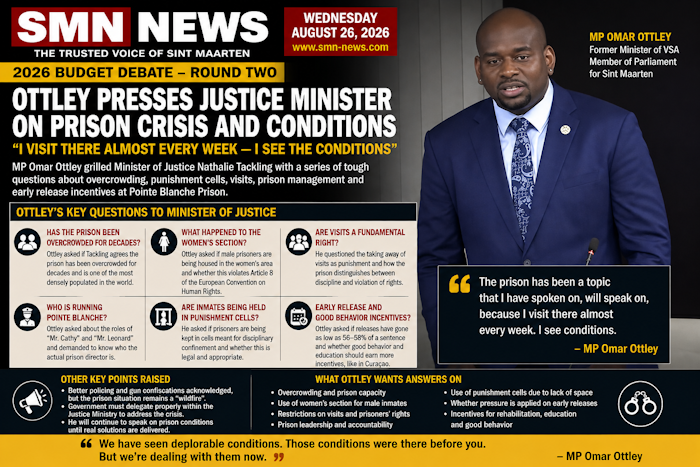 PHILIPSBURG:--- Member of Parliament and former Minister of Public Health, Social Development and Labor (VSA) Omar Ottley placed the continuing crisis at the Pointe Blanche Prison squarely before Minister of Justice Nathalie Tackling during the 2026 budget debate Wednesday, firing off a series of pointed questions about overcrowding, detention conditions, prisoners’ rights, management of the institution and the use of early or conditional release.
Ottley made clear that his questions were not based solely on reports reaching Parliament. He told the floor that he visits the prison “almost every week” and has personally seen the conditions inside.
“The prison has been a topic that I have spoken on, will speak on, because I visit there almost every week. I see conditions,” Ottley said.
While acknowledging what he described as improvements within the broader Justice Ministry — including greater police visibility, controls and the confiscation of illegal firearms — Ottley warned Tackling that the prison situation remains a “wildfire” requiring urgent attention and proper delegation within her ministry.
“We have seen deplorable conditions”
Ottley was careful not to suggest that the problems at Pointe Blanche began under Tackling.
He said Parliament had previously visited the institution and witnessed what he described as “deplorable conditions,” adding that those conditions existed before Tackling became Justice Minister.
His argument, however, was that inherited problems are now the current administration's responsibility to address.
“We have seen deplorable conditions. And those conditions were there before you. But we're dealing with them now,” Ottley told the minister.
That distinction became central to his questioning: government may not have created the prison crisis, but Ottley wants to know what it is doing now that it has responsibility for it.
Ottley demands answers on chronic overcrowding
Ottley asked Tackling directly whether she agrees that Sint Maarten's prison has been overcrowded for decades.
He also asked whether she was aware of claims that the Pointe Blanche facility ranks among the world's most densely populated and overcrowded prisons. Ottley posed that assertion as a question during the debate; the material provided to SMN News does not independently establish that ranking.
His questions go directly to one of the most difficult realities facing the Justice chain: what happens when the country arrests, prosecutes and sentences people but lacks sufficient detention capacity to hold them under proper conditions?
Ottley clearly wants the minister to address the issue not merely as a construction problem, but as a question of fundamental rights, public safety and the administration of justice.
What happened to the women's section?
One of Ottley's strongest lines of questioning concerned the use of space within Pointe Blanche.
He asked whether there is presently no functioning women's section at Pointe Blanche and whether male prisoners are consequently being housed in space designated for women.
“Is it true or is it not true?” Ottley demanded.
He then asked whether such a situation, if confirmed, could violate Article 8 of the European Convention on Human Rights and, if so, how Tackling intends to address it.
Again, these were questions and allegations raised by Ottley on the floor and should not be treated as established findings until the minister provides the requested answers.
But they underline the seriousness of the information reaching the MP about conditions inside the institution.
Are prison visits a fundamental right?
Ottley also challenged the use of restrictions on family and other visits as a disciplinary measure.
He asked whether prisoners have a fundamental right to receive visits and questioned how prison management distinguishes between legitimate disciplinary punishment and interference with a prisoner's fundamental rights.
Ottley said he has observed situations in which visits were taken away as punishment and referred to an earlier occasion when a committee criticized the minister over visits.
The question raises a broader issue that Tackling will have to confront: even when someone has been lawfully deprived of liberty, imprisonment does not automatically eliminate every other legal protection afforded to that person.
Ottley: Who is actually running Pointe Blanche?
The former VSA Minister then turned to management.
He specifically asked Tackling to explain the functions of two individuals whom the transcript identifies as “Mr. Cathy” and “Mr. Leonard.”
More importantly, Ottley demanded clarity about who actually holds the position and authority of prison director.
“I need to know who is the director. I need to know who is the director at the prison because it behooves me. And based on the answer, I'll go into why,” he said.
The repeated question suggests Ottley intends to pursue the issue further once Tackling identifies the institution's management structure and division of responsibility.
Are inmates being housed in punishment cells?
Ottley also raised potentially serious concerns about the use of punishment cells.
He asked whether prisoners are currently being held in cells intended for disciplinary confinement and whether those cells are legally and physically suitable for ordinary detention.
“Is it true that prisoners are being held in the punishment cells?” he asked.
He further demanded to know whether holding prisoners under such circumstances violates the law or whether the cells meet the required detention standards.
That question takes on added significance if ordinary accommodation is being substituted with disciplinary spaces because of a shortage of prison capacity.
If confirmed, the minister will have to explain whether this is temporary, how many inmates are affected, how long they remain there and under what legal authority.
Ottley turns to early release
The MP then moved directly into one of the most politically sensitive aspects of Sint Maarten's prison-capacity debate: early release.
Ottley asked Tackling whether she has ever received pressure or telephone calls from the Prosecutor's Office concerning whether a particular prisoner should be released.
“Have you ever been pressured, received a call from the prosecutor's office when it's time for a prisoner to be released?” Ottley asked.
He specifically questioned whether there had been pressure against allowing a prisoner to qualify for release after serving a particular percentage of a sentence.
This is significant because Ottley was not simply asking how the early-release system operates on paper. He was asking whether outside institutional pressure has ever been exerted on the minister in individual release considerations.
The Justice Minister's response to that question will therefore be important.
Could good behavior and education earn additional release incentives?
Ottley went further.
Referring to percentages discussed during earlier committee meetings, he asked Tackling to clarify whether releases had gone as low as approximately 56 or 58 percent of a sentence.
He then raised Curaçao as an example and asked whether Sint Maarten should consider a system in which inmates who demonstrate good behavior, pursue education, and make genuine rehabilitation progress can earn additional incentives toward release.
Ottley's argument was straightforward: prison policy should incentivize inmates to improve themselves.
He suggested that prisoners who remain out of trouble and seriously pursue education could potentially qualify for an additional reduction similar to what he described as a Curaçao model.
That is an important dimension of the debate because it moves the discussion beyond simply releasing inmates to create space.
Ottley is effectively asking whether early release can be linked more systematically to rehabilitation.
If the prison system expects inmates to educate themselves, improve their conduct, and prepare to return to society, then it must also provide meaningful incentives and measurable rehabilitation programs.
A prison-space problem has become a Justice-chain problem
Ottley's intervention exposes the difficult intersection confronting Tackling: St Maarten needs sufficient prison space, but it must also ensure that incarceration complies with the law and that early-release mechanisms are not reduced to an emergency pressure valve for overcrowding.
The MP's questions now require detailed answers.
Is Pointe Blanche chronically overcrowded? Are men being housed in areas intended for women? Are inmates being kept in punishment cells because ordinary cells are unavailable? Who is exercising day-to-day authority at the prison? Under what circumstances can visits be restricted? And how exactly are early-release decisions being made?
Perhaps most importantly, Ottley has raised another question: should prisoners who genuinely rehabilitate themselves receive greater consideration for early release?
For Tackling, the prison debate therefore goes far beyond constructing additional cells.
It concerns detention capacity, human rights, rehabilitation, management, public safety and the credibility of the entire criminal-justice system.
Ottley made clear that he intends to keep watching.
And with an MP telling Parliament that he visits Pointe Blanche almost weekly and personally sees the conditions behind the walls, the Justice Minister can expect the prison crisis to remain firmly on Parliament's agenda.