






~Politicians argue legalization while cannabis reaches youths, edibles raise new dangers, cocaine moves through the island, and an overcrowded justice system struggles with enforcement.~
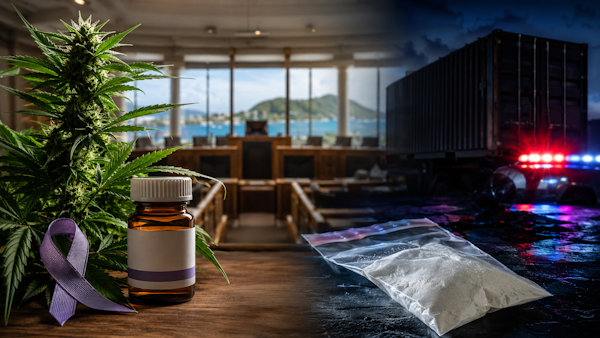 PHILIPSBURG: --- Parliament’s debate over whether St. Maarten should legalize and regulate cannabis risks becoming detached from the reality outside the walls of the legislature.
Cannabis is not waiting for Parliament.
It is already here. People consume it openly and privately across different sections of society. Claims have also been made that its use extends to professionals and people in political circles. But unless individual cases are supported by evidence, it would be irresponsible to identify elected officials as cannabis users simply on the basis of allegation.
The more important issue is that the country is debating whether cannabis should become available when the real policy problem is that cannabis is already readily available through an uncontrolled illegal market.
That distinction changes the entire debate.
Prime Minister Dr. Luc Mercelina told Parliament this week that St Maarten should not rush cannabis legislation merely so that the Mercelina II Cabinet can say it completed the process during its term. He warned that a fundamental change in cannabis policy has implications for public health, young people, society, the justice system and government's capacity to regulate and enforce a new regime.
Those concerns are legitimate.
But they leave an unavoidable question:
What is the government's solution for the cannabis market that already exists?
Cannabis is already on the streets — regulation or no regulation
The discussion cannot simply be divided between those who support cannabis and those who oppose it.
MP Ludmila de Weever has raised some of the strongest objections, questioning whether St Maarten possesses the healthcare, mental-health, regulatory and enforcement capacity required for legalization and commercialization. Her position has essentially been that St Maarten is not ready.
The Prime Minister has urged caution as well.
Yet the Mercelina II Cabinet, through the Ministry of Tourism, Economic Affairs, Transport and Telecommunication (TEATT), has continued work surrounding cannabis regulation, while TEATT Minister Grisha Heyliger-Marten has defended a broader discussion encompassing health, safety, agriculture, education, enforcement and economic development.
Government has also referred to an inter-ministerial process involving TEATT, Justice, VSA and Finance, while the controversial Native Nations arrangement predates the present administration.
That produces a peculiar political situation.
One section of Government is advancing the regulatory work. The Prime Minister is warning against rushing it. Members of the governing coalition are raising questions themselves. Opposition MPs are demanding answers about the structure, consequences and priorities.
Meanwhile, the illegal market continues operating.
The discussion must now include children and edibles
Perhaps nowhere is the gap between politics and reality more dangerous than with cannabis-infused products.
SMN News has received troubling information concerning the availability of cannabis products, including candies and cakes, and reports that these types of products are accessible among school-age youngsters, including allegations involving children of primary-school age.
Those specific reports require investigation by the competent authorities and should not be presented as established facts without enforcement, school or public health data.
But the Government cannot dismiss the broader risk.
Cannabis edibles are an internationally recognized and evolving public-health concern. The European Union Drugs Agency specifically warns that cannabis edibles include foods such as sweets infused with cannabis extract and that their increasing availability creates additional risks. The agency also reports that high-potency extracts and edibles have been associated with acute drug-toxicity cases requiring emergency medical attention.
That should immediately elevate the St Maarten discussion beyond the simplistic question: legalize or don't legalize?
If cannabis-infused candy can resemble ordinary sweets, what protections exist for children?
Who is monitoring what is being sold?
Are schools documenting cannabis-related incidents?
Are ECYS, VSA, Justice and KPSM collecting statistics?
Have products been tested to determine their THC concentrations or whether they contain synthetic cannabinoids?
And if Government cannot answer those questions under the existing illegal market, Parliament is entitled to ask how it intends to police a future regulated one.
Prohibition has not eliminated cannabis
Another uncomfortable reality for opponents of legalization.
Maintaining prohibition does not automatically protect young people.
A prohibited product sold by an illegal dealer comes with no licensed premises, no regulated packaging, no mandatory potency disclosure, no enforceable age restriction at the point of sale, and no consumer-quality controls.
That does not mean legalization is automatically the answer.
It means we must judge prohibition by actual outcomes rather than intentions.
KPSM's own enforcement demonstrates that cannabis remains readily present. During traffic and public-safety controls on July 17 and 18, police confiscated approximately 118.2 grams of marijuana, along with ecstasy tablets and a weapon.
So, if the government chooses not to regulate cannabis, it still needs a policy for the cannabis already being consumed and sold.
Saying "no" to legalization is a position.
It is not, in itself, a drug strategy.
The debate must also recognize medicinal cannabis
Any serious national discussion must also distinguish recreational use from the controlled medicinal use of cannabis. Cannabis-based medicines and cannabinoids are used in some jurisdictions to help manage symptoms such as chronic pain, nausea and vomiting associated with chemotherapy, loss of appetite and certain forms of severe epilepsy. That does not mean cannabis is a cure-all, nor does it erase concerns about dependency, mental health, impaired driving or access by minors. It also has recognized therapeutic applications that cannot be excluded from the debate.
The medicinal reality is not abstract in St Maarten's political arena. A politician has openly stated on the floor of Parliament that medicinal cannabis was used while undergoing cancer treatment. That public disclosure matters because it shows that, for some patients, the issue is not about recreation or getting high; it is about relief while enduring serious illness and the harsh effects of treatment.
That testimony should not be used as a blanket argument for unrestricted legalization. It should, however, compel Parliament to address a separate set of questions: Will patients have a lawful and medically supervised route to cannabis-based treatment? Who may prescribe or authorize it? What products and dosages will be permitted? How will quality and potency be tested? Will doctors and pharmacists receive clear guidelines? And how will legitimate patients be protected without creating loopholes for an uncontrolled commercial market?
A responsible cannabis policy must therefore protect children and confront illegal trafficking while also treating patients with dignity. Parliament should not force the country into a false choice between ignoring cannabis entirely and opening the door without safeguards. Medicinal access, recreational use, decriminalization and commercial legalization are related issues, but they are not the same policy decision.
Then there is cocaine
This is where St Maarten's political discussion becomes even harder to reconcile.
While Parliament devotes enormous attention to cannabis, cocaine trafficking presents a demonstrably serious international organized-crime threat.
On April 18, 2026, Sint Maarten Customs discovered 20 kilograms of cocaine hidden in a sports bag inside an apparently empty container aboard an in-transit vessel at Port St. Maarten.
Its destination?
The Netherlands.
The Prosecutor's Office authorized special investigative measures; Dutch authorities continued the operation when the vessel reached the Netherlands on May 5, and they ultimately arrested two suspects there. The Prosecutor's Office itself said the case demonstrated attempts by international criminal networks to exploit maritime cargo routes.
That is not speculation about Sint Maarten being used in international drug trafficking.
That is a documented 2026 case involving cocaine intercepted in Sint Maarten in a container destined for Europe.
Europe is simultaneously confronting record cocaine availability and increasingly sophisticated trafficking. The European Drug Report 2026 says commercial shipping containers remain a major means of bulk cocaine trafficking, while criminal organizations are diversifying toward smaller ports, at-sea transfers, semi-submersibles, drones and increasingly complex concealment techniques.
Sint Maarten, with a major cruise and cargo port, international airport, extensive maritime traffic, and geographic position in the Caribbean, therefore, cannot discuss national drug policy as though cannabis exists in isolation from transnational narcotics trafficking.
What about cocaine consumption inside St Maarten?
There is also a distinction between the Government and Parliament should stop avoiding: drug trafficking and domestic drug consumption are different problems requiring different responses.
Cannabis users are highly visible in the political debate.
But where is the corresponding national discussion about cocaine?
Where are the figures on cocaine possession?
Where are the treatment statistics?
Where is the data showing how many people seek assistance for cocaine dependency?
How much cocaine is seized locally rather than merely intercepted in transit?
How many cocaine cases result in prosecution?
And what resources are devoted to identifying the networks importing, distributing, and consuming harder drugs within Sint Maarten?
Without those figures, nobody should claim as fact that cocaine users are literally being ignored. But the absence of a comparably visible political debate itself warrants questions.
A justice system without sufficient prison capacity
Then comes perhaps the largest contradiction of all: enforcement requires somewhere to place offenders.
Sint Maarten continues struggling with severe detention-capacity limitations at Pointe Blanche Prison, a problem exacerbated by the loss of a substantial portion of prison capacity following Hurricane Irma.
That affects the entire criminal-justice chain.
Police can investigate. Customs can intercept. Prosecutors can prosecute. Judges can impose sentences.
But a country without sufficient detention capacity inevitably faces difficult decisions about remand, sentence execution, and priorities.
That should be part of the cannabis debate too.
If Government maintains criminalization, what enforcement resources will it commit?
If Government legalizes or decriminalizes certain conduct, precisely what conduct remains criminal?
What happens to illegal dealers operating outside the regulated system?
How will police distinguish lawful possession from trafficking?
What happens when minors are involved?
And how will authorities enforce those rules while simultaneously combating firearms, violent crime, cocaine trafficking, human smuggling, and other serious offenses with limited resources?
These are not arguments automatically for or against legalization.
They are arguments for a coherent national drug policy.
St Maarten cannot regulate what it refuses to measure
The greatest weakness exposed by this debate may ultimately be the shortage of publicly available Sint Maarten-specific evidence.
Before Parliament makes one of the most consequential social-policy decisions in years, Government should be able to provide hard numbers: cannabis use among adults and minors; school incidents; emergency-room admissions; cannabis edible incidents; possession and trafficking arrests; cocaine seizures; drug-treatment demand; prosecutions and convictions; and the estimated enforcement cost of the present prohibition regime.
Then Parliament can compare the status quo with the proposed alternative.
Because the status quo also has a cost.
An illegal cannabis market means criminals determine supply. An uncontrolled edible market creates additional dangers. Cocaine trafficking exposes Sint Maarten to international organized crime. Young people can be recruited into distribution networks. Police and prosecutors must spend resources enforcing drug laws while the prison system remains under severe pressure.
The European Commission warned only weeks ago that organized criminal groups are increasingly exploiting vulnerable young people while diversifying drug-trafficking routes, including through smaller ports.
Those warnings should resonate loudly on a small island.
Stop debating an imaginary drug-free St Maarten
The political choice before Parliament is therefore not between cannabis and no cannabis.
That choice disappeared long ago.
The real choices concern control, enforcement, public health, youth protection, treatment, taxation, criminal markets and the limits of the country's institutions.
MP De Weever is justified in asking whether St Maarten is ready.
Prime Minister Mercelina is justified in refusing to rush legislation merely to meet a political timetable.
Minister Heyliger-Marten is justified in arguing that the matter encompasses far more than the cannabis plant itself.
And MPs questioning Government are justified in demanding clarity about where this policy is actually going.
But every side of the debate must confront the same uncomfortable reality:
While politicians debate whether cannabis should be legal tomorrow, cannabis is being consumed today. Edibles create a particular risk to children. Police continue confiscating marijuana. Cocaine is moving through St Maarten toward Europe. And the justice system expected to enforce the country's drug laws is already struggling with limited detention capacity.
So perhaps Parliament is asking the wrong first question.
It should not simply ask:
"Should St Maarten legalize cannabis?"
It should ask:
"What drug policy does St Maarten need for the country that actually exists today?"
Until the Government can answer that question with evidence, legislation, prevention, treatment, enforcement capacity, and a credible plan to protect children, both legalization and continued prohibition risk becoming political positions without a complete national solution.