





~Gumbs says Caribbean guilder 310,000 allocation for seven public schools is insufficient; structural assessments ordered as Ministry tackles FBE reform, special-needs education, school meals, critical vacancies, hair discrimination legislation and nearly Cg. 1.1 million in preliminary outstanding obligations~
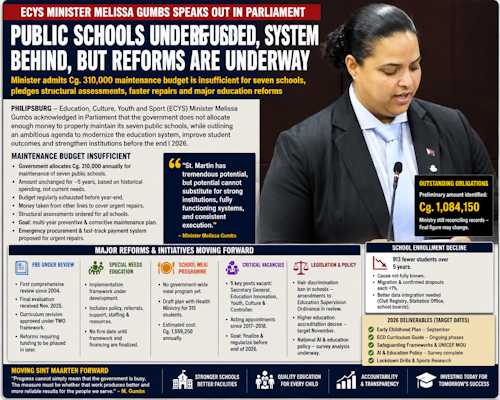 PHILIPSBURG:--- Minister of Education, Culture, Youth and Sport (ECYS) Melissa Gumbs delivered one of her most extensive accounts yet of the condition of Sint Maarten's education system during the 2026 budget debate, acknowledging that government does not presently allocate enough money to properly maintain its seven public schools while laying out an ambitious list of reforms she wants advanced before the end of the year.
Gumbs did not attempt to defend the current Caribbean guilder 310,000 annual maintenance allocation as adequate.
Instead, the Minister told Parliament that the amount has remained essentially unchanged for approximately five years, was based on historical spending for routine and on-call maintenance, and was not calculated from a recent comprehensive assessment of the actual structural and preventive-maintenance needs of the seven schools.
Her conclusion was unequivocal.
“Experience has demonstrated that this allocation is insufficient.”
According to Gumbs, the maintenance budget is regularly exhausted before the financial year ends, forcing ECYS to transfer money from other budget lines to cover urgent and unavoidable repairs.
That admission provides official government confirmation of what parents, teachers and school communities have repeatedly experienced: Sint Maarten is trying to maintain seven public schools with a budget the responsible ministry itself says cannot sustainably do the job.
Structural Assessments Ordered for All Public Schools
Gumbs said ECYS has published a public tender for comprehensive structural assessments of the public schools.
Those assessments are intended to identify the work required at each school, establish priorities and attach actual cost estimates to the deficiencies. Government then intends to use those findings to develop a multi-year preventive and corrective maintenance programme.
That represents an important shift because Gumbs acknowledged that public education currently operates largely through a reactive maintenance system: problems are generally repaired after defects are reported or discovered rather than prevented through a structured maintenance program.
The government's procurement system compounds the problem.
Even when a school experiences an urgent plumbing, sanitation or infrastructure problem, ECYS does not have a dedicated emergency procurement and payment mechanism for public schools. Purchases can therefore still be forced through the regular procurement-to-payment process.
Gumbs said the Division of Public Education has prepared an emergency and fast-track payment framework and submitted it to the Finance Department for discussion. The proposed system would allow qualifying health, safety and infrastructure emergencies to move through an accelerated process while retaining documentation, approval and audit requirements.
Minister: Not Everything Promised for 2026 Can Be Finished
The Minister also injected a dose of realism into the 2026 budget discussion.
With the country already in August, Gumbs told Parliament it would be unrealistic to suggest that every ECYS activity identified for 2026 can be completed before December 31.
Implementation, she said, depends on staffing, procurement, legislation, approvals, available capacity and the remaining months in the financial year.
ECYS will therefore focus on projects it can realistically advance or complete while continuing recruitment for critical vacancies.
Gumbs identified five major deliverables she wants to advance or complete before year-end. These include finalizing the draft national decree concerning higher-education accreditation by November; finalizing the Early Childhood Development and Afterschool Education Plan by September; completing phases of the ECD curriculum guide; finalizing child-friendly and child-safeguarding frameworks and pursuing an MOU with UNICEF Netherlands; completing survey analysis supporting the national AI and education policy; and advancing school lockdown drills and sports-sector research.
FBE Under Review After More Than Two Decades
Foundation-Based Education is also headed for reform.
Gumbs said her administration completed the first comprehensive review of FBE since its introduction in 2004, describing it as the first system-wide assessment of implementation and effectiveness in approximately 22 years.
The Ministry received the final evaluation in November 2025 and presented it to Gumbs in January 2026, after the principal inputs for the draft 2026 budget had already been prepared. Consequently, the Ministry could not translate all recommendations into new 2026 budget lines.
However, the Ministry received approval through the TWO framework to begin revising the FBE curriculum. Recommendations that can be implemented using existing resources are expected to move forward, while reforms requiring substantial additional funding, personnel, technology, materials or legislation will have to be costed and incorporated into later budget cycles.
Importantly, the Minister cautioned against claiming that FBE itself produced significant system-wide improvements in learning.
According to the evaluation described by Gumbs, FBE established a common foundation for compulsory education and supported a more student-centered, competency-based approach, but available evidence does not justify attributing significant system-wide learning gains to FBE alone.
913 Fewer Students — But Government Cannot Fully Explain Why
Another striking figure emerged from the debate: school enrollment has declined by 913 students over five years.
Yet ECYS cannot presently provide Parliament with a definitive explanation for where those students went.
The Inspectorate, according to Gumbs, lacks sufficient integrated data to determine how much of the decline resulted from demographic changes, migration, transfers to schools on French Saint Martin, movement into private education, or other causes.
Identified migration and confirmed dropouts each account for less than one percent of the reported decline, but Gumbs stressed that leaving the local system does not automatically mean a child dropped out.
She said better integration of information from the Civil Registry, Bureau of Statistics, school boards and other stakeholders, together with continued development of the National Student Information System, is necessary to understand the decline.
That leaves government with an important policy problem: Sint Maarten knows enrollment has fallen by 913 students, but it does not yet have the data infrastructure to fully explain why.
Special-Needs Education Still Has No Firm Implementation Date
Special-needs education remains another unfinished piece of the system.
Gumbs said the Special Needs Education Implementation Framework remains under development and stakeholder coordination is continuing. The framework is expected to address policy, referrals, support arrangements, institutional responsibilities, staffing and resources.
But the Minister would not give Parliament a date for full implementation.
She said doing so would be irresponsible until the framework is completed and validated and questions involving financing, staffing and approvals are resolved.
No Government-Wide School Meal Programme
The budget debate also exposed another gap: Sint Maarten does not currently have a formally approved structured school-meal programme across the public-school system.
Schools provide limited breakfast assistance to students identified as needing help, supplemented by Rotary Clubs and private sponsors.
ECYS has, however, explored a comprehensive feeding programme with the Ministry of Public Health, Social Development and Labor.
A draft proposal estimated that approximately Cg. 1,559,250 annually would be needed to provide breakfast, a mid-morning snack and lunch for approximately 315 students. The proposal has not been finalized.
Hair-Discrimination Legislation Still Not Before Parliament
Gumbs also addressed the proposed prohibition against discrimination based on hair type and hairstyle in schools.
The provisions form part of amendments to the draft Education Supervision Ordinance.
The legislation had already passed an earlier stage and received Council of Ministers approval, but Gumbs said she made a policy decision to strengthen the amendments so school regulations would explicitly prohibit discrimination based on hair type and hairstyle.
That required revising and re-reviewing the legislative package.
The legislation remains in the pre-parliamentary legislative review phase, with the Minister saying the intention is still to get it before Parliament before the end of 2026.
Nearly Cg. 1.1 Million in Preliminary Outstanding Obligations
The Ministry's own finances also came under scrutiny.
Responding to MP Ludmila de Weever, Gumbs disclosed that ECYS departments and divisions have identified a preliminary Cg. 1,084,150 in outstanding obligations.
But that is not yet the final figure.
The Ministry's financial statements and supporting records remain under reconciliation, meaning ECYS cannot presently provide an exact final balance or a complete year-by-year breakdown going back to 2017. The amount could rise or fall as invoices are identified and records reconciled.
Critical Leadership Posts Remain Unfilled
ECYS is also trying to fill long-standing vacancies at the top of the Ministry.
Gumbs identified five critical positions: Secretary General, Head of the Division of Education Innovation, Head of Youth, Head of Culture and a Ministry controller.
Several acting arrangements date back to 2017 and 2018.
The Minister acknowledged that prolonged acting appointments are undesirable and can affect institutional continuity and governance, declaring that acting appointments should not become substitutes for permanent appointments.
After MP Lyndon Lewis pressed her for timelines, Gumbs said the Secretary General interview process had continued, and the Ministry was awaiting finalization of the advice. ECYS has also retained an HR consultant to help move the outstanding appointments forward.
Her target is to have the positions “finalized and regularized before the end of 2026.”
Gumbs: Sint Maarten Is “Severely Behind”
Perhaps the strongest part of Gumbs' presentation went beyond individual programmes.
She told Parliament that she has not been satisfied with the country's direction for the past 25 years and argued that greater geopolitical exposure makes clear how far Sint Maarten has fallen behind structurally — in some cases even compared with neighboring countries.
“St. Martin has tremendous potential,” Gumbs said, but warned that potential cannot replace strong institutions, functioning systems and consistent execution.
Her prescription is not another collection of plans.
Gumbs said government must make evidence-based decisions, fill critical vacancies, modernize legislation, strengthen data and monitoring, prioritize what can actually be funded and executed, and hold itself accountable for implementation.
She also acknowledged that government cannot pursue every priority simultaneously and must be prepared to admit when something cannot responsibly be delivered within the available time or resources.
That may ultimately be the central issue facing ECYS.
The Ministry has identified an extensive reform agenda: aging public-school infrastructure, inadequate maintenance financing, FBE reform, special-needs education, student-data deficiencies, school nutrition, leadership vacancies, youth development, AI policy, hair discrimination legislation and cultural programmes.
The question Parliament must now keep asking is not whether ECYS has identified the problems.
It is whether the country will finally provide the money, manpower, legislation and institutional capacity required to fix them.