





 PHILIPSBURG:--- It is now becoming clearer why Member of Parliament Franklin Meyers proposed at the beginning of the Budget Debate that MPs' speaking time be reduced by 30 minutes. Meyers is expected to travel for vacation, potentially leaving the coalition down one member and placing additional pressure on Parliament to complete critical portions of the budget proceedings before his departure.
The circumstances also highlight the importance of Parliament maintaining clear and transparent records of attendance. When the country's most important financial debate may have to be accelerated because an elected representative has personal travel plans, the public has a legitimate interest in knowing who is present, who is absent, and who is consistently carrying out the parliamentary work they were elected to perform.
The situation is particularly noteworthy because it bears a striking resemblance to what occurred during last year's budget proceedings.
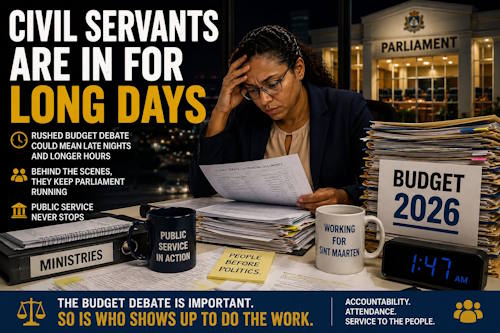
During that debate, Parliament continued until about 2:00 a.m., reportedly to accommodate Meyers' travel schedule. Now, one year later, civil servants and other government personnel supporting the Budget Debate could again face long days and rushed proceedings as Parliament tries to complete its work while the coalition has its full complement of members available.
Civil servants from the various ministries play a critical behind-the-scenes role during the Budget Debate. They must remain available to assist ministers with figures, technical information, and responses to questions raised by Members of Parliament. Compressing the parliamentary schedule can therefore have consequences extending well beyond the 15 elected MPs sitting in the chamber.
The proposal to reduce speaking time by 30 minutes also takes on additional significance in this context.
The Budget Debate is one of Parliament's most important opportunities to scrutinize government. MPs question ministers on how taxpayers' money will be spent, challenge policy priorities and propose changes before ultimately voting on the country's financial plan.
Reducing the time available for MPs to question government should therefore not be treated merely as a matter of convenience or scheduling. If the motivation for shortening the debate is tied to an individual MP's private travel schedule, that raises a broader question about whether Parliament's timetable should be adjusted around the personal plans of elected officials.
This makes the eventual official parliamentary report on attendance even more interesting.
The public debate over attendance should not depend on claims from government or opposition politicians. Parliament's own records should provide an objective picture of who attends meetings, who is frequently absent, and who consistently shows up to do the work entrusted to them by the people of Sint Maarten.
The Budget Debate provides an especially important measure. It determines how hundreds of millions in public funds are allocated across education, justice, infrastructure, healthcare, social programs, government operations and other priorities affecting residents every day.
Sint Maarten's civil servants may therefore once again find themselves working extended hours, possibly deep into the night, to accommodate a compressed parliamentary timetable.
When the debate is finished, however, attention should not end with the budget's passage.
It will be very interesting to see what Parliament's official attendance records ultimately show — and, beyond political rhetoric, who is actually showing up and working for the people of Sint Maarten.