






~Minister says more than Cg. 3.5 million already paid in 2026; Phase Two formally underway while retired workers must wait for Phase Three~
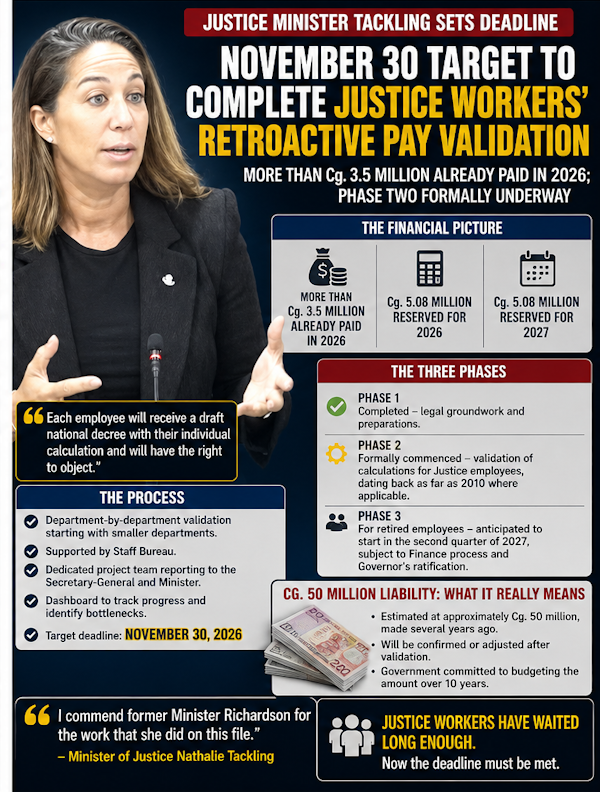 PHILIPSBURG:--- Justice Minister Nathalie Tackling has responded to mounting pressure over the long-running placement and retroactive-payment saga affecting Justice workers, telling Parliament that Phase Two has formally commenced and setting November 30, 2026, as the target for completing the validation of calculations.
Her answers came against renewed political criticism over years of delays affecting Justice personnel and pensioners. MP Lyndon Lewis publicly accused the Minister last week of failing to provide sufficient clarity to workers awaiting placement and retroactive entitlements.
Tackling, however, presented Parliament with specific figures and deadlines.
The Minister said more than Cg. 3.5 million in retroactive payments has already been disbursed during 2026.
She further said approximately Cg. 5.08 million has been reserved for 2026 and another Cg. 5.08 million for 2027 under the back-payment arrangements.
Phase Two formally started
According to Tackling, Phase Two is no longer merely being prepared.
It has formally commenced.
Calculations for Justice employees dating as far back as 2010, where applicable, are being validated department by department, beginning with smaller departments before moving to the larger ones.
Each department is responsible for reviewing its calculations with support from the Staff Bureau.
A dedicated project team is also being established that will report directly to the Secretary-General and Minister, while a dashboard is being introduced to track progress and identify bottlenecks.
Most importantly for workers who have waited years for clarity, Tackling said each employee will eventually receive a draft national decree containing their individual calculation and will have the right to object.
The Minister said the process is being organized around the November 30 deadline.
Files remaining unresolved after that date should, according to her explanation, involve either an individual HR matter or an objection lodged by the employee after receiving the draft decree.
Cg. 50 million remains an estimate
The overall financial exposure is substantial.
Tackling said the liability covering all three phases had previously been estimated at approximately Cg. 50 million.
Under the covenant signed between the CCSU and a former Minister of Justice, the Government committed to budgeting the amount over ten years and paying Justice workers what they are owed.
But Tackling cautioned that Cg. 50 million remains an estimate made several years ago.
The validation now underway will determine whether that figure is ultimately confirmed or adjusted.
That distinction matters because the Government still cannot state exactly how much of the overall liability belongs specifically to Phase Three.
Retired Justice workers come later
Phase Three concerns retired employees.
Tackling said that phase will begin only after Phase Two is completed and is currently anticipated to commence during the second quarter of 2027, subject to completion of the Finance Ministry's process and ratification by the Governor.
That means pensioners and former Justice workers caught in the placement saga could remain waiting even as active employees move through Phase Two.
Tackling refuses to blame former Minister Anna Richardson
The Minister also made a notable intervention when asked whether former Justice Minister Anna Richardson was responsible for delays because the correct legal documentation allegedly had not been filed.
Tackling refused to accept that characterization.
“I commend former Minister Richardson for the work that she did on this file,” she told Parliament.
She said the Ministry still cannot explain exactly how the legislative problem occurred and maintained that it would be inaccurate simply to blame Richardson.
According to Tackling, one significant obstacle was that the LBHAM had to be amended because the different departmental function books needed to take effect retroactively on different dates, something the regulation as originally published did not accommodate.
Without that amendment, she said, Phase Two could not legally commence.
The deadline now becomes the test
Tackling's answers provide considerably more detail than workers had previously received, but they also establish a measurable political and administrative deadline.
November 30, 2026 is now the date to watch.
Justice workers have spent years navigating function books, placements, calculations, national decrees, objections and retroactive entitlements.
Government has put millions of Caribbean guilders into the budget, and the Minister says the machinery for Phase Two is finally operating.
The issue therefore moves from promises to execution.
If the November deadline is met, Government will have cleared a major hurdle in one of the Justice Ministry's longest-running personnel disputes.
If it is missed, Parliament and Justice workers will have a very simple question for the Minister:
What went wrong this time?
The Justice Ministry's 2026 allocation is approximately Cg. 113.8 million, while Tackling has separately acknowledged the enormous staffing challenge confronting the Ministry—591 filled positions out of an approved establishment of 1,096.
I can also pull a third front-page article from Tackling's answers focused exclusively on the tourist police force, armed officers, security companies and the proposed business/STA funding mechanism; there is substantial material for that story as well.