






MP Labega reveals two-year inter-ministerial cannabis workgroup as York challenges PM: “It is your Cabinet” — Questions mount over Native Nations research, draft legislation and what government intends to do about cannabis already widely used in Sint Maarten
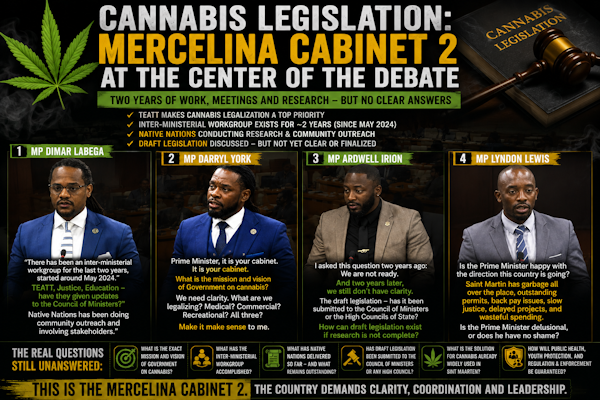 PHILIPSBURG:--- Cannabis legalization has emerged as one of the most controversial policy initiatives surrounding the Mercelina Cabinet 2, with the Ministry of Tourism, Economic Affairs, Transport and Telecommunication (TEATT) placing the development of a regulated cannabis industry among its stated priorities. But the latest budget debate has exposed a fundamental question that Prime Minister Dr. Luc Mercelina has yet to resolve publicly: What exactly is his government trying to legalize, how far has that process already advanced, and what is the government’s practical solution to the cannabis that is already widely used in Sint Maarten?
That question became even more pressing following interventions from MPs Dimar Labega and Darryl York during the clarification round in Parliament.
What Parliament heard raises questions not simply about whether cannabis should eventually be legalized or regulated, but whether different parts of the Mercelina Cabinet 2 are moving in different directions on one of the administration’s most consequential policy initiatives.
The significance cannot be dismissed as a disagreement between Parliament and government. This is the Mercelina Cabinet 2.
If TEATT is advancing cannabis legalization as a major policy priority, if an inter-ministerial working group has reportedly been operating for approximately two years, if Native Nations has been carrying out research and stakeholder engagement, and if draft legislation is already being discussed, then the Prime Minister cannot stand outside that process as a commentator.
He heads the Cabinet responsible for it.
Labega: Inter-Ministerial Cannabis workgroup has existed for two years
MP Dimar Labega, importantly a member of the ruling coalition, placed significant new information on the parliamentary record when he questioned Mercelina.
Labega said there has been an inter-ministerial workgroup dealing with cannabis for approximately two years, which he believed began around May 2024.
According to Labega, the group included representation from several government areas, including TEATT, Justice and Education. He therefore asked Mercelina whether he was aware of the workgroup and whether it had been providing updates to the Council of Ministers.
That intervention is crucial.
The cannabis initiative cannot simply be presented as something that suddenly appeared during the 2026 budget debate. According to a coalition MP, government has had an inter-ministerial structure working on the matter for roughly two years.
Labega also asked whether Native Nations or the workgroup had presented its findings and updates to obtain feedback.
He challenged the impression that government does not know what is happening, saying there appeared to be “extreme sensationalism” surrounding the issue. Labega went further, commending Native Nations for what he described as community outreach and stakeholder involvement, arguing that policymaking requires data and communication.
This now creates an unavoidable accountability question for Mercelina.
If the inter-ministerial workgroup has existed since approximately May 2024, what has it produced?
What recommendations were submitted? What did the Council of Ministers receive? What decisions were taken? Which ministries agreed with those recommendations? And why, two years later, does the government's direction remain so difficult to define?
York: “Prime Minister, it is your cabinet”
MP Darryl York attacked precisely that contradiction.
York acknowledged Mercelina's answers on cannabis and said they were largely consistent with answers he received when he questioned the issue approximately two years earlier.
York recalled that he had used a substantial portion of his speaking time in Parliament at that time arguing that St Maarten was not ready.
But his criticism now is considerably more serious: two years have passed.
According to York, listening to Mercelina now could leave the impression that the Prime Minister is merely another MP expressing an opinion about a government programme rather than the head of the government executing it.
York reminded him that it is called the Mercelina Cabinet 2 for a reason.
His point went directly to ministerial responsibility.
The Prime Minister cannot distance himself from the cannabis initiative while ministries operating under his Cabinet continue advancing it.
York told Mercelina plainly:
“It is your cabinet. It is your cabinet.”
That may prove to be one of the most important statements made during the entire cannabis debate.
Government cannot have two cannabis policies
Mercelina's concerns, as characterized during the debate, appear to point toward unresolved questions about whether Sint Maarten has sufficiently established the regulatory, health, social, and institutional framework necessary for legalization.
York referenced the Prime Minister's own characterization that government had effectively “put the cart before the horse.”
But that raises a much bigger problem.
Who put the cart before the horse?
This is not somebody else's administration.
If the process is premature, the Mercelina Cabinet 2 is responsible for correcting it.
If it is properly structured, the Prime Minister should be able to explain the structure.
If government lacks sufficient information, it should explain why the initiative has advanced before that information was obtained.
And if TEATT is driving cannabis legalization while the Prime Minister himself believes fundamental prerequisites remain unresolved, then Sint Maarten does not merely have a cannabis-policy problem—it has a Cabinet coordination problem.
York described exactly that disconnect.
He questioned how the Prime Minister's position could be reconciled with what his government is executing outside Parliament, particularly after Labega disclosed that meetings and presentations have already been taking place.
What Is the Government Actually Legalizing?
There is another issue that must no longer be buried beneath the broad word “cannabis.”
What exactly does government intend to legalize?
Medical cannabis?
Commercial cultivation?
Recreational adult use?
Importation?
Export?
Retail dispensaries?
Licensing of growers?
Cannabis tourism?
Or some combination of these?
York pointed directly to this confusion, arguing that government still appeared unable to clearly distinguish what its policy is for medical versus commercial cannabis.
He demanded that Mercelina clarify the mission and vision of the government on cannabis.
That is the question that should now be answered before the initiative advances another step.
Sint Maarten cannot sensibly develop legislation first and determine the actual public policy afterward.
What about Cannabis already being used in St Maarten?
There is also an uncomfortable reality that a future cannabis industry cannot solve by itself.
Cannabis is already widely used in Sint Maarten.
The real policy challenge therefore extends beyond creating a legal commercial industry. The government must explain its regulatory solution for the existing reality.
How will possession be treated?
How will existing users be treated?
What happens to the illicit market?
How will minors be protected?
What limits will apply?
Who will test products?
Who will license businesses?
What enforcement responsibilities will fall upon Justice?
What public-health protections will be established?
What happens with impaired driving?
How will government prevent organized criminal interests from entering a legal market?
And critically, what public-health and mental-health infrastructure will accompany legalization?
The material provided does not show that Mercelina has yet supplied Parliament with a comprehensive answer addressing all those questions.
That is precisely why Parliament's scrutiny matters.
Native Nations Research Versus Draft Legislation
York then raised perhaps the sharpest procedural question of the debate.
He asked whether draft cannabis legislation had already been submitted either to the Council of Ministers or the High Councils of State.
His reasoning was straightforward: if Native Nations was contracted to conduct research and that research has not yet been completed, how could government already have draft legislation moving through the system?
“Make it make sense to me, Mr. Prime Minister,” York said.
That question requires a precise government response.
There is nothing inherently unusual about legislation and research being developed simultaneously. But if the research was commissioned specifically to inform the policy and regulatory framework, government must explain what information formed the basis of any draft legislation prepared before that research was completed.
Government should therefore disclose the timeline.
When was Native Nations contracted?
What exactly was the scope of the assignment?
What has been delivered?
What remains outstanding?
When was the inter-ministerial workgroup established?
What has it recommended?
When was draft legislation first prepared?
Has it reached the Council of Ministers?
Has it reached any High Council?
Those dates would immediately establish whether research is actually driving policy—or whether policy was already moving ahead while the research was still underway.
Even a Coalition MP Wants Answers
Labega's intervention makes the matter particularly significant politically.
This was not simply opposition criticism.
A member of the ruling coalition asked the Prime Minister whether he knew about a cannabis workgroup that Labega says has existed for about two years and whether the Council of Ministers had been receiving updates.
Labega's position also differed sharply from suggestions that the cannabis initiative was moving forward recklessly. He defended Native Nations' outreach, arguing that the organization had been communicating and engaging stakeholders rather than rushing the process.
That makes the government's obligation even clearer.
Competing narratives now need to be reconciled publicly.
One says research, consultation, meetings, and stakeholder engagement have been occurring for years.
Another says fundamental questions remain unresolved and that the cart may have been placed before the horse.
Both cannot simply hang in the air without explanation.
Mercelina asked for time to research clarifications
The Prime Minister did not provide the final clarification during this portion of the meeting.
Following the MPs' interventions, Mercelina told Parliament that the volume of questions required additional background research and requested permission to return with answers, potentially the following day.
That makes his coming response critical.
Parliament should not accept another general discussion about whether cannabis presents opportunities or risks.
The country needs specifics.
What is the official cannabis policy of the Mercelina Cabinet 2?
What does the Prime Minister support?
What does he oppose?
What has the two-year inter-ministerial workgroup accomplished?
What exactly is Native Nations contracted to deliver?
Has draft legislation already reached the Council of Ministers or any High Council?
And above all: what is Mercelina's solution for the cannabis already circulating and being consumed throughout Sint Maarten while the government debates building a legal industry around it?
The cannabis initiative is no longer an abstract TEATT proposal.
After two years of reported inter-ministerial work, research, presentations, and political discussion, the Mercelina Cabinet 2 owns this policy.
Now its Prime Minister must tell the country exactly what that policy is.