





~Prime Minister says GEBE disputes parts of RAC-BTP findings; Government’s contribution capped at US$42 million while utility seeks financing for third generator.~
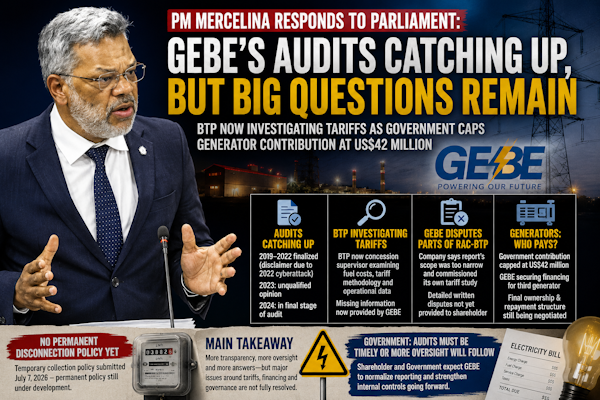 PHILIPSBURG:--- Prime Minister Dr. Luc Mercelina gave Parliament one of Government’s more detailed updates yet on the financial, regulatory and generation challenges confronting NV GEBE, revealing that the utility has caught up substantially on its delayed financial statements while acknowledging that major questions surrounding tariffs, the RAC-BTP investigation and financing of three permanent generators remain unresolved.
Responding to Members of Parliament during the 2026 budget debate, Mercelina acknowledged that concerns surrounding GEBE’s financial reporting are legitimate and declared that timely audited financial statements are a fundamental requirement for a publicly supported utility.
“Timely audited financial statements are not a luxury,” the Prime Minister told Parliament, describing them as essential to transparency, accountability, corporate governance and public confidence.
The Prime Minister then disclosed significant movement in GEBE’s longstanding financial-reporting backlog.
According to Mercelina, GEBE’s audited financial statements for 2019 through 2022 have been finalized and submitted to the shareholder. Those statements received a disclaimer of opinion because of consequences associated with the 2022 cyberattack.
More significantly, he told Parliament that the 2023 financial statements have been finalized and received an unqualified audit opinion, while the 2024 statements are now in the final stage of the external audit process.
The financial statements covering 2019 through 2024 are expected to be handled at a shareholder meeting scheduled for September.
Mercelina nevertheless made clear that Government is not satisfied with how long it has taken GEBE to normalize its financial reporting.
He said the expectation going forward is that audited statements be produced on time and warned that failure to remain current could force Government and the shareholder to consider additional governance oversight or corrective measures to protect the public interest.
BTP now inside GEBE’s numbers
The Prime Minister also addressed one of the most contentious issues surrounding the utility: the RAC-BTP examination of GEBE’s tariffs and fuel costs.
Mercelina rejected the suggestion that Government received the initial RAC-BTP findings and simply sat on the recommendations.
He told Parliament that Government has already acted on what it considered one of the report’s most critical findings — the need for independent and legally established regulatory oversight of GEBE.
Pending permanent legislative amendments, BTP has been formally appointed concession supervisor under GEBE’s electricity concession.
That gives the regulator a much stronger position than simply offering advice.
According to the Prime Minister, BTP is now examining GEBE’s fuel-cost methodology, tariff calculations, operational metrics and supporting financial information.
Mercelina said the earlier RAC-BTP assessment had been hindered because important operational and financial information was unavailable.
Following BTP’s appointment as concession supervisor, however, the regulator formally requested information from GEBE under its legal authority.
The Prime Minister told Parliament that the requested operational, financial and technical documents have now been handed over.
“The missing information is no longer missing,” Mercelina said, adding that the material is now being reviewed by engineers, financial experts and legal analysts.
That review could prove crucial for consumers.
For years, GEBE customers have questioned electricity costs and particularly the methodology behind the fuel component of their bills. The Prime Minister’s response confirms that those underlying calculations are now undergoing regulatory scrutiny rather than merely being debated politically.
Mercelina cautioned, however, that the RAC-BTP recommendations cannot all simply be imposed at once.
Some require action from GEBE management or its Supervisory Board; others require intervention by BTP, decisions by the responsible minister, legislative amendments or the establishment of a lawful national tariff decree.
GEBE disputes parts of RAC-BTP report
Mercelina also confirmed something Parliament specifically questioned: GEBE does not agree with certain aspects of the RAC-BTP report.
According to the Prime Minister, GEBE argues the assessment's scope was too narrow because it focused mainly on specific tariff components rather than the utility’s broader financial sustainability.
GEBE consequently commissioned its own tariff study to assess the company's profitability and long-term viability.
The utility has also indicated that it considers some RAC-BTP findings and conclusions incorrect.
However, an important problem remains.
Mercelina told Parliament that GEBE has not provided the shareholder representative with a detailed written breakdown of all the findings it disputes.
That leaves Parliament and the public with two competing positions: the regulator's findings on one side and GEBE's objections on the other, without the shareholder yet having a detailed written account of precisely what GEBE disputes and why.
Permanent generators: Government caps contribution at US$42 million
The generator project produced another major disclosure.
MPs questioned what happens now that the financing initially secured is reportedly insufficient for the permanent generation package being pursued.
Mercelina acknowledged that Parliament has a legitimate interest in knowing who will ultimately own the generators, who carries which financial obligations and how repayment will work.
But those answers are not yet finalized.
“At this time, the legal and financial structure is being finalized between the relevant parties,” the Prime Minister said, explaining that Government could therefore not yet make definitive public statements about the eventual financing structure or settlement of future obligations between Government and GEBE.
He did, however, draw one clear financial line:
Government’s contribution will be limited to US$42 million.
GEBE, according to Mercelina, is securing the additional financing required for the third generator.
The contractual arrangements for all three generators are now being prepared, including a lease-to-own construction for the two generators financed by Government.
The final ownership and repayment architecture therefore remains a work in progress.
Mercelina said negotiations are covered by confidentiality and non-disclosure obligations and argued that Government cannot release commercially sensitive information that could compromise the negotiating position.
He assured Parliament that Government is seeking a structure that is legally sound, financially responsible and capable of getting additional permanent generation capacity installed as quickly as possible.
US$42 million follows emergency-generation intervention
Mercelina later described the permanent-generator project as his Government’s response to Sint Maarten’s electricity crisis.
He said Government supported the introduction of 10 megawatts of leased emergency generating capacity and another 20 megawatts through an additional arrangement.
The Government subsequently secured a US$42 million concessional loan for permanent generation capacity, along with US$1 million in technical assistance for GEBE.
Mercelina conceded that procurement of the permanent generators remains ongoing, but argued that the emergency measures provided short-term capacity while establishing a pathway toward a more reliable electricity supply.
Disconnection policy still not permanent
The Prime Minister's responses also confirmed that GEBE still does not have a finalized permanent collection and disconnection policy.
Instead, the company is using a temporary collection policy as an interim operational measure while the permanent policy remains under development.
Management submitted the temporary policy to the Supervisory Board for information on July 7, 2026, and indicated that a summary would be made available through Customer Service.
Mercelina stressed an important governance distinction: GEBE management developed and implemented the temporary policy under its operational responsibility.
Although it was submitted to the Supervisory Board, the board did not formally approve it.
The temporary policy nevertheless contains several provisions on disconnection, while GEBE’s existing conditions for connection and rates also include provisions governing interruption and termination of electricity service.
That means consumers remain subject to collection and disconnection procedures while the permanent policy itself is still being developed.
Parliament now has more answers — but major questions remain
Mercelina's presentation provides considerably more detail on GEBE, but it also exposes how much work remains unfinished.
The audits are catching up, but the 2024 audit is not yet complete.
BTP now has access to information previously missing and is examining GEBE’s fuel-cost and tariff calculations, but that regulatory review is still underway.
GEBE disputes portions of the RAC-BTP report, but Government has not received a detailed written breakdown of every disputed finding.
Government has capped its generator contribution at US$42 million, but the final financing, ownership and repayment arrangements have not yet been concluded.
And while customers remain exposed to disconnection procedures, the permanent collection and disconnection policy remains under development.
For a company controlling one of the most essential services in Sint Maarten, those are not minor administrative details. They go directly to the questions Parliament and consumers have been asking for years: What does electricity actually cost to produce? Are consumers being charged under a properly regulated tariff structure? Who is independently checking GEBE's calculations? And exactly what financial obligations will the country and the utility carry when the new generators finally arrive?
Mercelina has now put the Government's position on the parliamentary record. The next major test will be whether the BTP review, September shareholder meeting and generator negotiations finally convert those answers into measurable transparency and a more reliable electricity system.