






MP Demands Outstanding Bills Since 2017, Questions NAf. 1 million-Plus Lease, Cg. 45 million GEBE Gap and Whether Government’s Plans are Actually Improving People’s Lives
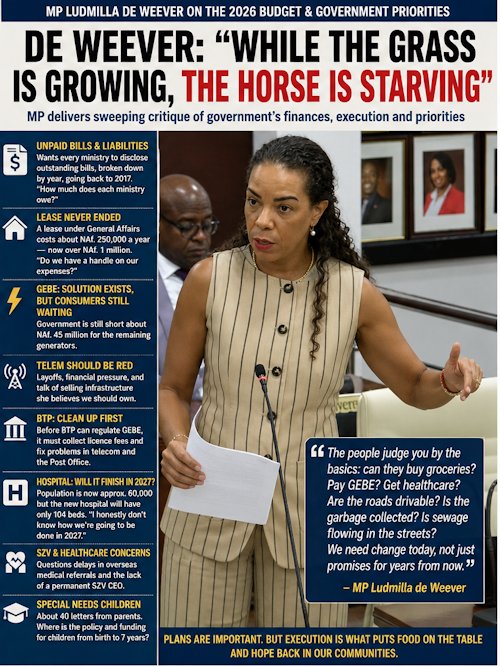 PHILIPSBURG:--- Member of Parliament Ludmila de Weever used the 2026 budget debate to deliver a sweeping assessment of the state of government, arguing that Sint Maarten has become exceptionally good at producing plans, studies and projects but painfully slow at delivering improvements residents can actually feel.
Her message to the Council of Ministers was summarized in one phrase she repeatedly returned to:
“While the grass is growing, the horse is starving.”
“The horses are people,” De Weever explained.
According to the MP, government may be pursuing worthwhile long-term plans, but residents struggling with groceries, utilities, school expenses, healthcare, roads, sewage and garbage collection cannot survive on promises of benefits years from now.
“The people are the ones struggling,” she said. “Today, we’re not seeing any direct change.”
A 2026 Budget Eight Months into 2026
De Weever began by questioning the circumstances under which Parliament was being asked to consider the budget.
Sint Maarten was already in the eighth month of 2026.
She said some presentations appeared to speak from the perspective of 2024, when the administration came in, rather than concentrating on what matters in communities today.
Government has plans, studies, committees and Country Package projects, she acknowledged, but the population is not sufficiently feeling the results.
Instead, De Weever said she hears frustration, anger and disappointment, along with repeated complaints that nothing is improving while life becomes more expensive.
Lease Never Ended — Potential Cost Above Cg. 1 Million
De Weever then raised a financial issue she said she had already flagged during the previous budget debate.
She said a lease associated with a property managed under General Affairs was never terminated.
According to De Weever, it costs approximately Cg 250,000 annually and has now potentially accumulated to more than Cg 1 million.
Yet she said the obligation was not reflected in the budget information before Parliament.
“If we didn’t end the lease agreement, it makes me wonder: do we have a handle on our expenses? Do we have a handle on our costs?” she asked.
And the potential liability may not end with the lease.
De Weever warned that government could also face litigation and legal expenses associated with the matter.
For the MP, that lease illustrates a much larger problem: Does government actually know everything it owes?
She pointed out that existing contracts and liabilities do not disappear simply because administrations change.
De Weever questioned whether poor tracking of outstanding obligations could even contribute to the collapse of local suppliers waiting for government payment.
“Sometimes I wonder if government is also responsible for certain businesses failing because they can’t pay them,” she said.
Government-Owned Companies: Picture “Not Realistic”
De Weever also challenged the picture presented of government-owned companies.
She said GEBE was presented as red, TelEm as orange, while the Port, WINAIR and Airport were green and the Post Office red.
But De Weever argued that profitability alone does not determine whether a company is financially healthy.
Debt matters.
She said some of the ratings painted a more positive picture than she believes the underlying liabilities justify.
GEBE — Cg. 45 Million Short
On GEBE, De Weever acknowledged that the government had responded to the generation crisis and developed a solution.
But she asked when consumers would actually feel that solution through lower utility costs.
She then highlighted a major problem: according to De Weever, the government is now about Cg 45 million short of what is required to obtain the remaining generators connected to the solution pursued during the energy emergency.
For her, it exemplifies the execution problem.
“We take so long to have the plans executed,” she said, arguing that by the time projects reach implementation, the financial realities have changed.
De Weever: TelEm Should Be RED
TelEm's orange rating also did not survive De Weever's scrutiny.
“I would put TelEm in red,” she said.
She pointed to restructuring, layoffs, continuing financial needs, and the government's role as guarantor.
More importantly, De Weever placed herself firmly on record against selling critical national infrastructure.
“I am not a fan of selling infrastructure that we should actually own,” she declared.
BTP Wants GEBE? “Clean Up Your Books First”
Her criticism then shifted to BTP.
As discussions about BTP potentially regulating GEBE continued, De Weever questioned why the regulator should take on additional responsibility before addressing problems under its existing mandate.
She alleged that license fees remain uncollected from some telecommunications license holders and questioned why entities should retain licenses when they are not paying.
Her message was direct:
“If BTP wants to be the regulator of GEBE, clean up your books first.”
De Weever connected that criticism to the state of both telecommunications and postal services, questioning the logic of adding electricity regulation to an organization she believes has not adequately demonstrated success with its existing responsibilities.
Airport and Port: Don't Ignore the Debt
De Weever was also unwilling to accept green assessments for the Port and Airport without qualification.
She stressed that financial statements showing a profit do not erase debt.
The Port, she noted, has debt while pursuing further expansion. The Airport has completed its major reconstruction project but remains heavily indebted and still has outstanding plans, including the fuel-farm relocation and other infrastructure.
De Weever said she would classify the Airport as orange rather than green.
WINAIR, in her assessment, was the company that genuinely deserved the green classification.
Hospital: Will It Really Be Finished in 2027?
De Weever's account of a recent parliamentary visit to the hospital project was particularly critical.
She said she left disappointed.
The project traces back to 2011, and De Weever said she could not see how construction would be completed in 2027 based on what she observed.
“I honestly don’t know how we’re going to be done in 2027 with the construction of it,” she said.
The number of workers she observed was also troubling.
De Weever said explanations for the delays included difficulties sourcing materials, rising costs, shortages of construction workers, and delays with government permits.
That prompted her to ask government directly whether ministries had contributed to the hospital delay by failing to process permits on time.
Population Near 60,000 — Hospital Heading to Just 104 Beds
Then came the numbers.
According to information De Weever said parliamentarians received during their hospital visit, Sint Maarten's population was approximately 23,000 in 1991 and is now estimated at approximately 60,000.
Hospital capacity went from 66 beds to 80, and the completed new hospital is expected to have 104 beds.
“That’s not really a lot,” De Weever observed.
She questioned whether 104 beds will be remotely sufficient by the time the project is completed.
SZV Still Without Permanent CEO
De Weever coupled those concerns with questions about SZV.
She said SZV remained without a permanent CEO and demanded an update on the recruitment process.
The MP warned against allowing prolonged management uncertainty at SZV to resemble what happened at GEBE.
“I am not going to allow a GEBE that has been without management since 2020 to happen with SZV,” she said, describing SZV as the government's biggest liability.
Why Are Patients Told Curaçao and Then Sent to Colombia?
Medical referrals also came under scrutiny.
De Weever said residents repeatedly complain about delays when procedures cannot be performed locally and they must be sent abroad.
She described cases in which patients are initially told they will go to Curaçao but ultimately end up being sent to Colombia.
“What exactly is going on?” she asked.
For De Weever, residents already dealing with serious medical problems should not face additional uncertainty and delays over where they will receive treatment.
Special-Needs Children: Where Is the Policy?
Education was another significant component of De Weever’s intervention.
She recalled MPs receiving approximately 40 letters from parents connected to an independent foundation concerning special-needs children.
De Weever questioned progress on the special-needs policy and specifically raised concern about what she understands to be a gap affecting children between birth and age seven.
She asked the ECYS Minister to clarify the situation and explain what government is doing.
De Weever spoke about greater recognition of autism, ADHD and other special needs and argued that greater awareness must now be matched by policy and funding.
“I need to understand that we are actually budgeting for it,” she said.
Met Office and Transportation Still Waiting
De Weever also questioned delays surrounding the Meteorological Office and public transportation.
She called the Met Office important for the airport, maritime sector and weather services and asked why there had been so little visible progress.
She similarly questioned why implementation of public transportation routes associated with the Country Packages continues to take so long.
The Vendor Market also became an example of what she sees as government's stop-start approach to execution: periods when work appears to happen followed by periods when little appears to move.
De Weever warned that such a record makes it difficult for the public to trust promised completion dates.
Cut Events, Travel and Car Rentals
With ministries repeatedly citing limited resources, De Weever said government should begin examining its own discretionary spending.
She compared the situation to a private company under financial pressure: management would begin identifying expenditures that could be eliminated.
She specifically mentioned events, travel expenses, and rented vehicles among areas government should scrutinize.
“There’s a lot of things that you can cut,” De Weever said. “And quite frankly, I don’t see that.”
De Weever Wants Every Unpaid Government Bill Since 2017
She ended with a demand that could reveal the true scale of the government's outstanding financial obligations.
De Weever wants every ministry to disclose its unpaid bills, broken down by year, going back to 2017.
“How much outstanding does every ministry have?” she asked.
She said each ministry's financial controller should be able to produce the information.
De Weever also demanded that the Finance Minister state when Parliament can expect the outstanding financial statements.
“We can’t continue like this, guys,” she said.
De Weever's intervention matters because she did not confine her criticism to one ministry or minister. Her argument cut across government: unrecorded liabilities, unpaid bills, struggling government companies, delayed projects, insufficient healthcare capacity, unfinished policies, and limited resources are all symptoms of the same failure to convert government planning into timely execution.
Meanwhile, she said, ordinary residents measure government by much simpler standards: whether they can buy groceries, pay GEBE, afford school, drive without destroying their vehicles in potholes, have their garbage collected, live without sewage running through their streets, and receive medical care when they need it.
With De Weever estimating that the administration has perhaps a year and a half remaining, she left the Council of Ministers with a question far more consequential than what appears in the budget books:
What has government done that people can actually feel today?
“While the grass is growing,” De Weever warned, “the horse is starving.”