





~Hotel tax overhaul, Airbnb compliance, higher TEATT fees, tourism certification, aviation, maritime and film permits under consideration — Minister stresses measures are not yet budgeted revenues.~
 PHILIPSBURG:--- The government is examining a potentially significant expansion and modernization of the revenue it collects from Sint Maarten’s tourism and wider economy, with short-term vacation rentals, TEATT fees, tourism operators, aviation, maritime activities, and the film industry all appearing on the Ministry’s list of possible future revenue measures.
TEATT Minister Grisha Heyliger-Marten disclosed the initiatives during her presentation of the Ministry’s 2026 Budget to Parliament.
But the Minister was careful to draw an important distinction: these are not approved revenue measures and Government has not counted the projected income in the 2026 Budget.
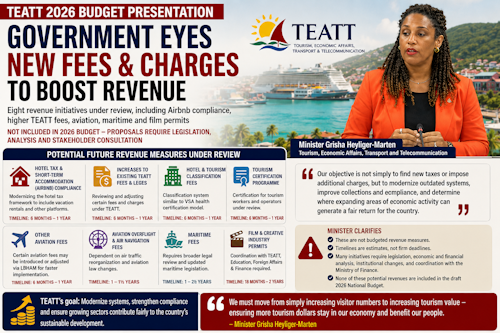
The Ministry’s presentation lists eight areas being explored: hotel tax and short-term accommodation/Airbnb compliance; increases to existing TEATT fees and levies; hotel and tourism classification fees; a tourism certification program; other aviation fees; aviation overflight and air-navigation fees; maritime fees; and film and creative-industry permits.
Airbnb and Vacation Rentals Under Scrutiny
One of the most advanced measures concerns the rapidly expanding short-term accommodation sector.
Heyliger-Marten told Parliament that work on modernizing the hotel tax and short-term accommodation framework — including Airbnb and other vacation rentals — has reached the drafting and internal Government review stage.
The Ministry estimates a potential implementation window of approximately six months to one year, although Heyliger-Marten emphasized that the timelines shown in the presentation should not be interpreted as firm deadlines.
The development could have significant implications for property owners and operators participating in the vacation-rental market.
It also raises an important enforcement question: how many short-term rental properties are presently operating in Sint Maarten, how many are registered, and how much potential revenue is currently going uncollected?
The presentation itself does not provide those figures.
Existing TEATT Fees Could Increase
Government is also examining increases to existing TEATT fees and levies.
According to Heyliger-Marten, relevant fees have already been identified, proposed adjustments are being considered, and a committee has been established to review the process.
The Ministry’s presentation places the potential implementation period at roughly six months to one year.
For businesses, that makes the eventual details critical.
Which fees could increase? By how much? Which sectors would pay? What economic-impact assessment will be conducted before the increases are introduced?
The presentation does not provide those answers.
Tourism Workers and Operators Could Face Certification Fees
Government is additionally examining hotel and tourism classification fees and a separate tourism certification programme.
The Ministry says a classification-fee system could potentially follow a legislative and administrative structure similar to the health-certification/food-handlers model administered under VSA.
A tourism certification programme could use a comparable framework for tourism-facing workers and operators.
Both concepts have an estimated development period of approximately six months to one year, according to the budget presentation.
Aviation and Maritime Revenue Also Targeted
St. Maarten’s airspace and maritime sectors are also being examined as potential sources of additional Government income.
Certain aviation fees may be introduced or adjusted through an LBHAM, which TEATT says could allow faster implementation than a complete legislative overhaul.
More complex overflight and air-navigation fees, however, depend on broader air-traffic-control reorganization and changes to aviation laws and institutional arrangements. TEATT puts that process at about one year to 18 months.
Maritime fees could take even longer — approximately one to two years — because the Ministry says they require broader legal and institutional review and potentially updated maritime legislation.
Government is also examining permits for the film and creative industries, an initiative requiring coordination among TEATT, Education, Culture, Foreign Affairs and Finance. The presentation estimates approximately 18 months to two years for that framework.
Minister: These Are Not Budgeted Revenues
Heyliger-Marten cautioned Parliament against treating the list as a menu of taxes already approved.
“These are not budgeted revenue measures,” she said, explaining that the timelines should likewise not be interpreted as guaranteed implementation dates.
The Minister said several initiatives still require legislation, economic and financial analysis, institutional changes, stakeholder consultation and coordination with the Ministry of Finance.
Importantly, she said the Government's objective is not simply to find new taxes or impose additional charges, but to modernize outdated systems, improve collections and compliance, and determine where expanding areas of economic activity can generate a fair return for the country without unnecessarily burdening the economy.
And because implementation costs and reliable revenue projections have not yet been finalized, none of these potential revenues were built into the draft 2026 Budget.
That distinction is important.
But so is what the presentation reveals about the direction Government is heading.
Airbnb and vacation rentals, existing TEATT fees, tourism certification, aviation, maritime activity and potentially the creative industries are all being examined as areas from which Government could eventually collect additional revenue.
For Parliament, businesses and residents, the next question is no longer whether Government is looking for new revenue streams.
It is which of these proposals will ultimately become law — and who will end up paying.