





~Household mortgages increased in 2024, but growth was driven by non-residents as local buyers struggled to afford real estate.~
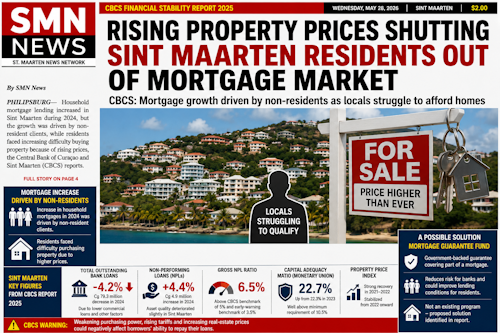 PHILIPSBURG— Household mortgage lending increased in Sint Maarten during 2024, but the growth did not mean that more local families were successfully purchasing homes. According to the Centrale Bank van Curaçao and Sint Maarten’s Financial Stability Report 2025, the increase was driven by mortgages granted to non-resident clients, while residents faced increasing difficulty buying property because of rising real-estate prices.
The finding presents a troubling household-finance picture beneath Sint Maarten’s continued economic and tourism growth: mortgage activity is increasing, but residents are not necessarily the primary beneficiaries.
CBCS reported that Sint Maarten’s total outstanding bank loans fell by Cg 79.3 million, or 4.2 percent, in 2024. The decline resulted mainly from reductions in commercial mortgages and commercial term loans.
The Central Bank attributed the reduction partly to the transfer of loans from a branch office to its overseas head office, the completion of a major reconstruction project, and slower loan growth at other banks. Household mortgages, however, moved in the opposite direction and increased during the year.
Non-Residents Drove Mortgage Increase
CBCS stated clearly that the rise in household mortgages was driven by an increase in mortgages granted to non-resident clients.
At the same time, residents encountered difficulty purchasing property because higher prices reduced their ability to qualify for or secure mortgages.
The report therefore points to a widening gap between activity in the property market and the ability of ordinary residents to become homeowners.
An increase in mortgage lending might ordinarily suggest that households are improving their financial position and entering the housing market. In Sint Maarten’s case, however, the Central Bank’s findings show that the increase must be viewed more carefully because a significant part of the growth came from people who do not reside in the country.
CBCS did not state that non-residents caused all increases in property prices. It did establish, however, that residents faced affordability challenges as prices rose and that additional mortgages were issued to non-resident borrowers.
Bankers Call Affordable Housing Essential
The Sint Maarten Bankers Association told CBCS that affordable housing is essential for the country’s residents.
One solution identified in the report is the possible establishment of a Mortgage Guarantee Fund for residents. Such a fund would provide a government-backed guarantee covering part of a mortgage, reducing the lending risk faced by banks and potentially allowing borrowers to receive more favorable lending conditions.
The report presents the fund as a proposed solution rather than an existing programme. It does not state that the Government has approved or implemented such a facility.
A mortgage guarantee would not automatically reduce property prices. Its purpose would be to make financing more accessible by lowering part of the risk banks assume when lending to qualifying residents.
The findings nevertheless raise an immediate policy issue for Sint Maarten: whether residents can realistically compete for homes in a property market where prices are increasing, and mortgage growth is being driven by buyers from outside the country.
Property Market Hit by Irma and Pandemic
CBCS also examined the longer-term development of Sint Maarten’s property market through a preliminary Property Price Index.
The index shows that the market suffered a significant decline following Hurricane Irma in 2017, which damaged more than 70 percent of the country’s housing stock to some degree and severely disrupted tourism and commercial activity.
A second downturn began during the third quarter of 2019 and continued until the second quarter of 2021. CBCS associated that decline with the COVID-19 pandemic and the collapse in tourism activity.
The property index then recorded a strong recovery between the second quarter of 2021 and the second quarter of 2022, in line with Sint Maarten’s economic recovery, increased visitor arrivals and public and private investment. According to CBCS, the trend appeared to stabilize from 2022 onward.
Problem Loans Increased in Sint Maarten
The report also contains a warning about the quality of loans carried by Sint Maarten’s banks.
While the quality of bank assets improved in Curaçao, CBCS found that it deteriorated slightly in Sint Maarten during 2024. Non-performing loans in the Sint Maarten banking sector increased by Cg 4.9 million, or 4.4 percent.
The report defines non-performing loans as loans where borrowers have fallen significantly behind on their payments.
Sint Maarten recorded a reduction in loans classified in the most serious “loss” category, but an increase in loans considered “doubtful”—those between 120 and 179 days past due. Some loans left the loss category because they were transferred abroad, paid off or reclassified as doubtful.
CBCS advised banks to monitor their loan portfolios closely, paying particular attention to problematic household and commercial loans.
The Central Bank warned that weakening purchasing power, rising tariffs and increasing real-estate prices could negatively affect borrowers’ ability to repay their debts.
Sint Maarten Above CBCS Loan-Risk Benchmark
The report’s chart on gross non-performing loans showed Sint Maarten’s ratio at approximately 6.5 percent in 2024, compared with the CBCS benchmark of 5 percent and a financial-stability early-warning benchmark of 3.5 percent.
This does not mean that 6.5 percent of all borrowers had defaulted. It means that non-performing loans represented approximately 6.5 percent of the total value of loans recorded for Sint Maarten’s banking sector.
CBCS reported that around the monetary union, asset quality generally improved and the overall ratio of non-performing loans fell. However, approximately 80 percent of the remaining problem loans were more than 180 days overdue, showing that credit risk remained a concern. These figures apply to the wider Curaçao–Sint Maarten banking sector and not to Sint Maarten alone.
Banks Remain Well Capitalized
Despite the loan-quality concerns, the Central Bank found that banks across the monetary union remained strongly capitalized.
The sector’s Capital Adequacy Ratio increased from 22.3 percent in 2023 to 22.7 percent in 2024, well above CBCS’s minimum requirement of 10.5 percent and its 15-percent financial-stability benchmark. These are monetary-union figures rather than figures reported separately for Sint Maarten.
CBCS nevertheless warned that provisions set aside for possible loan losses may be underestimated. It also noted that dividend payments could place pressure on banks’ capital positions.
Residents Caught Between Prices and Credit Requirements
The report’s strongest Sint Maarten household finding is therefore not simply that mortgages increased.
It is that mortgage lending increased while residents faced greater difficulty buying homes, and that non-resident clients accounted for the growth identified by the Central Bank.
At the same time, Sint Maarten recorded an increase in non-performing loans and remained above CBCS’s credit-risk benchmark.
Together, these findings show a housing and household-finance market under conflicting pressures: property investment is continuing, banks are still lending, and the broader financial system remains stable, but residents face rising prices, restricted mortgage access and the risk that higher living costs could further weaken borrowers’ repayment capacity.
The unresolved question for policymakers is whether Sint Maarten’s expanding property market will create a realistic route to homeownership for its own residents—or continue growing increasingly beyond their financial reach.