






~Political Movement says hundreds of thousands of Dutch citizens in the Caribbean are being denied equal democratic rights.~
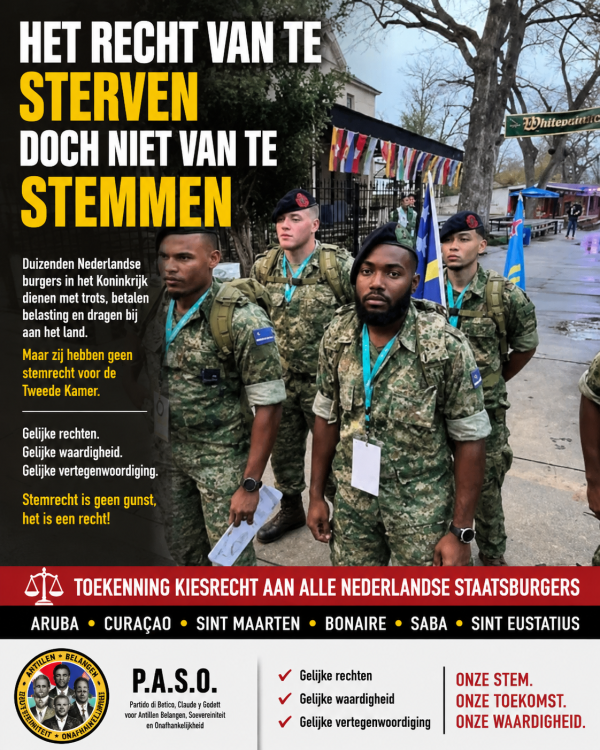 PHILIPSBURG / THE HAGUE — The political movement P.A.S.O. (Partido di Betico, Claude y Godett voor Antillen Belangen, Soevereiniteit en Onafhankelijkheid) has launched a direct appeal to King Willem-Alexander and members of the Dutch Parliament, arguing that Dutch citizens living in the Caribbean parts of the Kingdom continue to be denied equal voting rights in elections for the Dutch House of Representatives.
In two letters dated July 4 and July 7, 2026, PASO Chairman Marco Marlin BSc calls on the Dutch monarchy and Parliament to address what the organization describes as a long-standing democratic inequality affecting Dutch citizens residing in Aruba, Curaçao, Sint Maarten and the Caribbean Netherlands.
Letter to the King
In a letter addressed to His Majesty King Willem-Alexander, PASO respectfully asks the monarch to support what it calls a "morally correct decision" by ensuring that all Dutch citizens, regardless of where they reside within the Kingdom, are granted voting rights.
The letter carries the heading:
"THE KING, OUR FRIEND, NOT OUR ENEMY."
PASO argues that Dutch nationals living in Kingdom territories have allegedly been deprived of both active and passive voting rights for approximately 70 years.
According to the letter, the organization believes this affects a population of roughly 300,000 predominantly Black Dutch citizens living within the Kingdom.
The party draws comparisons with major civil rights milestones abroad, including:
- Women's suffrage in the early twentieth century.
- The United States' civil rights movement.
- Dr. Martin Luther King Jr.'s famous call to "Give Us the Ballot."
- The Voting Rights Act of 1965 in the United States.
PASO argues that extending equal voting rights would be consistent with Article 4 of the Dutch Constitution, which concerns the right of Dutch citizens to elect members of representative bodies.
The letter concludes with an emotional appeal stating:
"Your turn King Willem, confer voting rights to your majority Black Dutch citizen population today."
Appeal to Dutch Parliament
Three days later, on July 7, PASO addressed a second letter to Member of Parliament Tom Russcher of the Dutch House of Representatives.
In that correspondence, the organization argues that elections cannot be considered entirely fair if not all Dutch citizens enjoy equal political rights.
PASO writes that if elected officials derive their mandate from elections in which certain Dutch citizens are excluded, questions arise regarding the fairness of the democratic process.
The movement also makes a historical comparison with South Africa's apartheid system, arguing that withholding voting rights from certain groups of Dutch citizens living within Kingdom territory should not be accepted as morally justified.
Request for Parliamentary Action
PASO asks Parliament to support legislation or policy that would grant voting rights to all Dutch citizens living within Kingdom territory under the authority of the States General.
The organization states that equal voting rights are a matter of constitutional equality rather than political preference.
Chairman Marco Marlin writes that PASO hopes to receive both:
- A personal response from MP Tom Russcher.
- The official position of the Dutch Parliament regarding what it describes as "the granting of voting rights to all Dutch citizens."
Historical Comparisons
The letters also compare the Dutch situation with developments elsewhere.
PASO notes that:
- The United States eliminated racial barriers to voting through the Voting Rights Act of 1965.
- France has allowed residents of its overseas territories to participate in French national elections for decades.
- Greenland has participated in Danish parliamentary elections since the 1950s.
Using these examples, PASO argues that the Kingdom of the Netherlands should likewise ensure equal democratic participation for all its citizens.
A Constitutional Debate
The campaign is expected to reignite debate over one of the Kingdom's longstanding constitutional questions: who is entitled to vote in elections for the Dutch House of Representatives?
Voting rights within the Kingdom are governed by the Dutch Constitution and the Kingdom's electoral laws, which distinguish between different categories of Dutch citizens depending on their place of residence and constitutional status. PASO contends that these distinctions result in unequal treatment, while any change to the franchise would require action through the Kingdom's constitutional and legislative processes.
Whether PASO's appeal will lead to parliamentary debate remains to be seen, but its letters place the issue of democratic representation for Dutch citizens in the Caribbean squarely back before both The Hague and the Dutch Crown.