




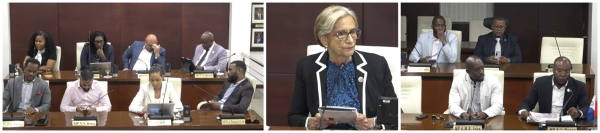
 PHILIPSBURG:--- The handling of St. Maarten's 2026 national budget came under renewed scrutiny on Monday when members of Parliament openly questioned the pace at which they were being asked to approve a 292-page report containing hundreds of questions submitted during the Central Committee examination of the Draft National Ordinance Budget 2026.
What was expected to be a procedural meeting to ratify Parliament's final report quickly evolved into a heated debate over transparency, parliamentary oversight, and whether legislators were being afforded sufficient time to properly review one of the country's most important financial documents.
Chairlady of Parliament Sarah Wescot-Williams began the meeting by outlining the next steps in the legislative process, stressing that Parliament was not debating the budget itself, but rather ratifying the comprehensive report of questions submitted by Members of Parliament. That report will be forwarded to the Council of Ministers, which is expected to provide written responses before the budget advances to a public meeting.
Wescot-Williams explained that Parliament hopes to receive the government's responses by July 20, although she emphasized that this timeline has not been confirmed by the government.
"It is not the government that has indicated this will happen," she said. "We are anticipating that this could happen. It is up to the government to indicate when the answers can be provided."
Should the responses arrive within that timeframe, Parliament intends to begin the public debate on the 2026 budget on August 4, although the Chair acknowledged that several MPs have already indicated they may not be available due to the parliamentary recess.
She further explained that handling the budget in early August would effectively shorten Parliament's annual recess by one week.
The Chair also praised Parliament's Secretariat for producing what has become one of the most extensive parliamentary reports in recent history.
The document now spans 292 pages, incorporating questions submitted both in writing and orally by Members of Parliament during previous budget discussions. Wescot-Williams acknowledged that an earlier version distributed to MPs had inadvertently omitted part of the Opposition faction's submission but said the revised document had since been corrected.
Nevertheless, several MPs immediately questioned whether they could responsibly approve such an extensive document after receiving the final version only hours before the meeting.
Doran: "This is not the way we should handle the people's business"
MP Egbert Jurendy Doran was among the first to object, arguing that Members had received the original report shortly before midnight and an amended version only hours before Monday's meeting.
Doran questioned why Parliament was placing unnecessary pressure on its own Secretariat and on Members by expecting immediate approval without adequate time for review.
He said it was "humanly impossible" to thoroughly examine nearly 300 pages in the limited time provided.
"I've never experienced a budget being handled in this manner," Doran stated.
He argued that approving the country's national budget requires careful scrutiny rather than rushing through procedural requirements.
According to Doran, Parliament should not be expected to rubber-stamp documents simply because government is under pressure to move the budget process forward. He also questioned whether there was an effort to accelerate the process to accommodate the Executive rather than ensuring Parliament fulfills its constitutional oversight responsibilities.
Roseburg calls for practical solutions
Coalition MP Sjamira Roseburg acknowledged concerns about the limited review period but urged Members to remain focused on the purpose of Monday's meeting.
She noted that the immediate objective was to verify whether each faction's submitted questions had been accurately reflected in the report.
Roseburg suggested that technology, including Artificial Intelligence, could assist Members in comparing their submitted questions with the compiled report to more efficiently identify any omissions.
She emphasized that AI should be viewed as a practical tool to support Members' work and suggested that if questions were indeed missing, Parliament could briefly adjourn to allow corrections before proceeding.
Her comments underscored the need to balance efficiency with thorough parliamentary oversight while ensuring the budget process continues moving forward.
Lacroes produces list of missing questions
Opposition MP Francisco Lacroes challenged the assertion that all parliamentary questions had been included in the report.
Having already begun reviewing the document, Lacroes identified what he said were numerous missing questions spanning several ministries, including General Affairs, Education, Public Health, and VROMI.
Rather than requesting a lengthy postponement, Lacroes proposed a one-hour adjournment to allow every Member to verify whether their submissions had been accurately incorporated.
"If I, who asked 1,072 questions, can do it in that time, I think anyone else should be able to do it," Lacroes remarked.
He maintained that Parliament should not approve the report until Members were satisfied that every question submitted by each faction appeared in the official record.
Lacroes also expressed concern that the majority appeared prepared to move forward despite unresolved issues, describing such an approach as unfair to Members carrying out their oversight responsibilities.
Irion warns against blind reliance on AI
MP Ardwell Irion entered the discussion by cautioning Parliament against placing too much confidence in Artificial Intelligence.
Responding directly to Roseburg's comments, Irion acknowledged that AI can be a useful research tool but stressed that it cannot replace human judgment.
"AI hallucinates. It makes mistakes," Irion said.
"I'm not going to be governed by AI."
Irion also criticized what he described as inconsistent calls for parliamentary efficiency.
He argued that some Members advocating greater use of AI were themselves asking repetitive or unnecessary budget questions that were already answered within the draft budget documents.
Efficiency, he said, begins with Members asking focused, informed questions rather than relying on technology to compensate for poor preparation.
His remarks highlighted a growing debate over how Parliament should integrate emerging technologies into legislative work without compromising accountability or accuracy.
Chair Moves to Defuse Tensions
As debate continued, Chairlady Wescot-Williams reminded Members that the committee was not discussing the substance of the budget but merely confirming whether the compiled report accurately reflected every question submitted.
Rejecting suggestions that Parliament was rushing government business, she emphasized that the only issue before the committee was the completeness of the report itself.
Acknowledging Members' concerns, Wescot-Williams indicated she had no objection to granting additional time if Parliament believed further verification was necessary.
She subsequently adjourned the meeting for five minutes to allow faction leaders to determine how much additional time to allocate before returning to consider the report's ratification.
The exchange illustrated the delicate balance Parliament now faces between meeting constitutional deadlines for the 2026 budget and ensuring Members have adequate opportunity to scrutinize one of the most consequential pieces of legislation before the legislature. The meeting has been adjourned until 4 pm today.