




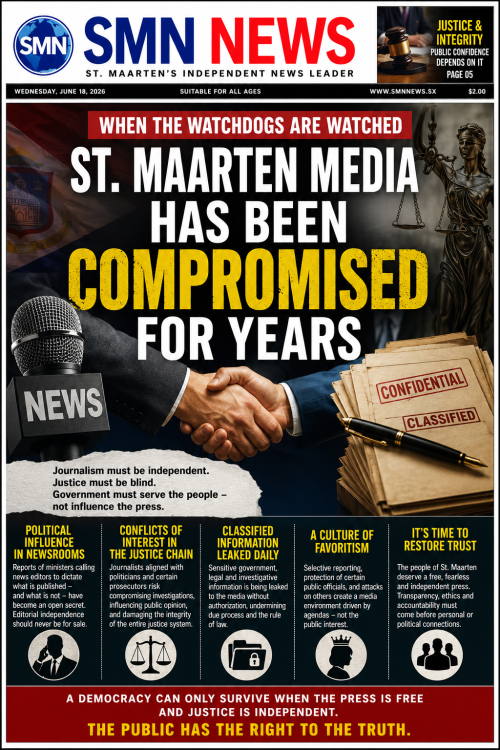
 PHILIPSBURG:--- A free and independent press is one of the cornerstones of any democratic society. It exists to question those in power, expose wrongdoing, and provide citizens with accurate, balanced, and independent information. But what happens when the lines between journalism, politics, and the justice system become blurred?
Across St. Maarten, concerns continue to surface about the growing perception that parts of the media landscape have become entangled with political interests, government officials, and individuals within the justice chain. While such concerns are often discussed quietly behind closed doors, they raise broader questions about conflicts of interest, editorial independence, and public confidence in both the media and public institutions.
The issue extends beyond politics alone. When journalists, government officials, prosecutors, politicians, or other public servants develop relationships that create either actual conflicts of interest or the appearance of undue influence, public trust can quickly erode. Even where no laws are broken, the perception that information is being managed rather than independently reported can damage confidence in democratic institutions.
Editorial Independence Under Pressure
Journalists are expected to operate independently from the institutions they cover. Editors should determine what is published based on news value, verification of facts, and the public interest—not because of pressure from political figures, government offices, or other influential actors.
When editorial decisions appear to be influenced by outside interests, several questions naturally arise:
- Are stories being published because they are newsworthy?
- Are important stories being delayed or ignored?
- Are some public officials receiving favorable treatment?
- Are others facing disproportionate scrutiny?
Even the perception that these questions need to be asked is damaging.
The Danger of Confidential Information
Another issue frequently discussed within public circles is the unauthorized disclosure of confidential information.
Government files, investigative documents, legal correspondence, cabinet papers, and internal memoranda often contain sensitive information protected by law or by the integrity of ongoing investigations. If such material reaches the public through unauthorized leaks, several concerns arise.
First, there is the question of how the information was obtained.
Second, whether releasing it serves the public interest or instead undermines due process, privacy rights, or ongoing investigations.
Third, whether leaks are occurring selectively to benefit particular individuals or political agendas.
Whistleblowing that exposes genuine wrongdoing can play an important role in a democracy. However, selective or politically motivated leaking is a different matter and can distort public understanding rather than strengthen accountability.
When Questions Become Enemy
An equally troubling development occurs when journalists fulfill their most fundamental responsibility: asking difficult questions. In every democracy, those entrusted with public office should expect to be questioned about their decisions, the use of public funds, and the exercise of their authority. Yet there are times when legitimate scrutiny is met not with answers, but with hostility. Reporters who persist in asking uncomfortable questions may find themselves publicly attacked, denied access to information, excluded from official briefings, or portrayed as adversaries rather than professionals carrying out their duty. Such reactions can create a chilling effect, discourage robust reporting and weaken the public's right to know. A government that welcomes accountability strengthens democracy; one that treats critical questioning as a threat risk undermining the very transparency and openness upon which public trust depends.
Public Officials and the Media
Government officials routinely communicate with journalists. Press conferences, interviews, official statements, and requests for comment are all part of normal democratic governance.
The concern arises if public officials move beyond providing information and begin directing editorial decisions or attempting to influence what is or is not published. Any such conduct, if it occurs, would be inconsistent with the principle of an independent press.
Editorial judgment belongs to editors and publishers—not public officials.
Justice must also be seen to be Independent
The justice system relies heavily on public confidence.
Investigators, prosecutors, defense attorneys, judges, and journalists all have distinct roles that should remain separate. Where those roles appear to overlap in ways that create conflicts of interest, public confidence can suffer, even if no misconduct is ultimately established.
The administration of justice depends not only on impartiality, but also on the appearance of impartiality.
A Small Island's Unique Challenges
St. Maarten's size presents challenges that are familiar to many small jurisdictions. Journalists, politicians, lawyers, police officers, prosecutors, judges, and business leaders often know one another personally. Those realities make strong professional boundaries even more important.
International standards on media ethics emphasize transparency, editorial independence, and the avoidance of conflicts of interest. Likewise, public officials are expected to avoid situations that could reasonably call their impartiality into question.
Maintaining those standards helps protect both institutions and the public's confidence in them.
Trust is earned through transparency
A healthy democracy does not require journalists and public officials to be adversaries. It requires each institution to respect the other's independence.
The public deserves confidence that news reporting is driven by verified facts rather than political influence, that editorial decisions are made independently, and that public institutions conduct their work free from improper interference.
These principles are not unique to St. Maarten. They are foundational to democratic governance everywhere.
As public debate continues about accountability, transparency, and integrity, one truth remains clear: democracy depends not only on free elections, but also on citizens having access to independent journalism and public institutions that operate—and are seen to operate—with integrity.
Only by safeguarding those principles can public trust be strengthened and preserved.