




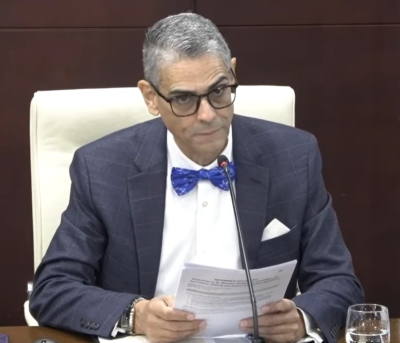
 PHILIPSBURG:--- A pivotal moment in St. Maarten’s ongoing cannabis legalization debate unfolded this week as a medical expert delivered a powerful and deeply personal testimony before Parliament, challenging long-held assumptions about the drug’s impact on public health.
Appearing before the Committee for Agriculture, Fisheries and Animal Husbandry, Dr. Joseph Rosado, a physician specializing in medical cannabis and behavioral health, addressed concerns ranging from mental illness to addiction and healthcare costs. His remarks have since sparked renewed discussion among lawmakers and the wider public.
Dispelling a Common Fear
Central to the debate was the question of whether cannabis use leads to serious mental illnesses such as schizophrenia. Dr. Rosado was unequivocal in his response.
He explained that the widely referenced figure of 3%—often linked to psychosis—actually represents the baseline rate in the general population, not cases caused by cannabis use.
“There is no established primary causal relationship between cannabis use and psychosis in healthy individuals,” he told Members of Parliament, adding that risks are primarily associated with those who already have a genetic predisposition.
The doctor emphasized that if cannabis were a direct cause, global schizophrenia rates would have risen alongside increasing cannabis use over the past several decades. Instead, those rates have remained largely unchanged.
Regulation as a Public Health Tool
Rather than dismissing potential risks, Dr. Rosado argued that legalization—when properly regulated—actually provides stronger safeguards than prohibition.
Under the current system, he said, users often rely on unregulated street products with unknown potency and contaminants. A legal framework, by contrast, would introduce controls such as product testing, potency limits, labeling, and age restrictions.
“Regulation does not increase harm—it reduces it,” he stated.
He also pointed to international data suggesting that legalization does not lead to higher rates of substance abuse treatment. In some cases, it even results in a decline, as individuals shift away from more dangerous substances.
A Patient’s Transformation
In one of the most striking moments of the session, Dr. Rosado shared the story of a patient whose life had been dominated by prescription medication.
The woman, suffering from multiple chronic conditions, relied on up to 58 pills a day. After transitioning to medical cannabis in a regulated system, her dependence on pharmaceuticals dropped dramatically—to just three pills within months, and eventually none at all.
“She was able to live again,” he said, recounting how the patient regained her independence and returned to work and family life.
The Hidden Dangers of Prohibition
The doctor also highlighted the risks posed by the illegal market, sharing a case involving a young man who unknowingly consumed cannabis laced with fentanyl.
The incident nearly proved fatal.
According to Dr. Rosado, such cases underscore the dangers of leaving cannabis outside a regulated system, where quality and safety cannot be guaranteed.
“That is the reality of prohibition,” he said.
Funding Mental Health Services
Another key aspect of the proposed cannabis framework is the allocation of funds for mental health and addiction services.
Dr. Rosado noted that, unlike the current situation—where cannabis generates no direct support for healthcare—a regulated industry could dedicate a fixed portion of revenue to institutions such as the Mental Health Foundation.
“This funding would be protected by law,” he explained, describing it as a major step forward in strengthening the island’s healthcare system.
A More Nuanced Conversation
Dr. Rosado’s testimony stood out not only for its scientific grounding but also for its human perspective. Responding to lawmakers who shared personal experiences with mental illness, he acknowledged the emotional weight behind the policy debate.
“This is not just data—it’s about people and families,” he said.
Parliament Faces a Defining Decision
As St. Maarten moves closer to drafting legislation on cannabis regulation, the discussion is becoming increasingly complex. Economic opportunities, public health considerations, and social concerns are all competing for attention.
This week’s testimony has added a new layer to that conversation—one that suggests the issue may not be whether cannabis poses risks, but whether regulation offers a better way to manage them.
With further deliberations expected in the coming weeks, Parliament now faces a decision that could shape the island’s public health and economic future for years to come.