




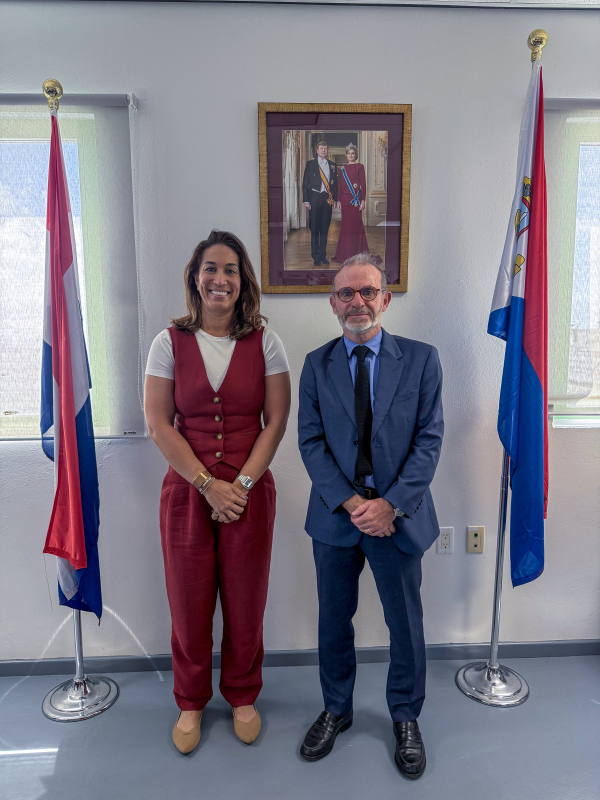
 PHILIPSBURG:--- Recently, the Ministry of Justice, together with its implementation partner the United Nations Office for Project Services (UNOPS), welcomed the new Prefect of Saint-Barthélemy and Saint-Martin, Cyrille Le Vély, his chief of staff Marie-Hildegarde Chauveau, and representatives from the Agence Publique pour l’Immobilier de la Justice (APIJ) for a working meeting focused on prison reform and opportunities for strengthened cooperation between the French and Dutch sides of the island.
The meeting aimed to foster dialogue, exchange technical insights, and explore areas of mutual interest regarding correctional infrastructure initiatives underway on both sides of Saint-Martin/Sint Maarten. During the meeting, Minister of Justice Nathalie M. Tackling provided historical context of Sint Maarten’s correctional reform trajectory, and the developments that led to the current reform efforts within the detention system. The Minister outlined how international rulings highlighted the need for structural improvements, placing Sint Maarten on a path toward comprehensive reform.
As part of this reform effort, the Ministry partnered with the United Nations Office for Project Services (UNOPS) to implement the Detention Sector Reform Program (DSRP) infrastructure component, focused on the reconstruction of Point Blanche Prison. During the meeting, UNOPS delivered a technical presentation on the project, valued at approximately USD 52 million, introducing a modern correctional model that moves beyond the traditional “lock-up” approach by integrating security, rehabilitation, and structured inmate management. The design incorporates a rehabilitation-centered model aligned with international detention standards and integrates social, gender, environmental, and sustainability considerations.
The facility is being designed with differentiated housing units for various categories of inmates, allowing individuals to move through units based on behavior and rehabilitation progress. The design also incorporates therapeutic and mental health-oriented environments, reflecting international best practices aimed at reducing reoffending and supporting reintegration into society.
“Across Caribbean Small Island Developing States, strengthening the rule of law is essential to resilient institutions and long-term stability,” assures William Squier, Portfolio Development Advisor for UNOPS in Latin America and the Caribbean. “In contexts such as Sint Maarten’s dual-jurisdiction geography, closer cooperation and a more integrated justice chain are critical. Building on our experience supporting justice infrastructure reforms in Sint Maarten and Aruba, UNOPS is committed to providing the technical expertise needed to advance modern, rehabilitation-focused correctional systems.
The French delegation expressed particular interest in the construction methodology and phased development approach being applied in Sint Maarten. During the exchange, the French authorities shared that they are currently exploring the possibility of constructing a new prison facility that applies techniques that reduce costs and accelerate timelines. Prefect Cyrille Le Vély emphasized that, for effective reintegration, it is preferable for detainees from the French side of the island to be housed locally rather than abroad.
“ We need to strengthen the cooperation bonds tying together the French and the Dutch side on security matters in order to build relevant devices. In this regard, maintaining a dialogue along our respective projects appears as strategic as it is necessary to create fit for purpose facilities on both sides of the island. ” declared Cyrille Le Vely.
Minister Tackling emphasized that Sint Maarten’s reform efforts extend beyond infrastructure alone.
“Individuals who enter the justice system often arrive there because systems around them failed earlier,” the Minister stated. “Our objective is not simply to detain individuals, but to ensure that when they leave the system they are better equipped to reintegrate into society. The facility is important, but equally important are the programs, staffing, and structures that support rehabilitation.”
Discussions involved shared challenges related to detention infrastructure, capacity pressures, and rehabilitation strategies, highlighting the importance of continued dialogue and technical exchange between the two sides of the island. They also explored potential avenues for future collaboration, including continued technical exchanges with UNOPS and the possibility of deeper operational cooperation.
Following the meeting, the delegation toured the prison, gaining a closer understanding of the infrastructure plans and reform objectives guiding the development of the future facility.
The Ministry of Justice welcomed the visit as an important step in strengthening constructive cooperation between the French and Dutch sides of the island, recognizing that both jurisdictions face similar challenges and can benefit from continued knowledge exchange.
Both parties expressed interest in maintaining dialogue and exploring further opportunities for collaboration in the future.