




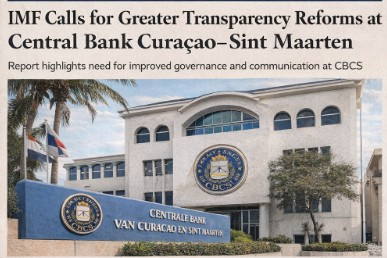
 Washington, D.C./ WILLEMSTAD CURACAO:--- The International Monetary Fund (IMF) has called for deeper transparency reforms at the Centrale Bank van Curaçao en Sint Maarten (CBCS), warning that while the institution has made “significant progress,” key gaps in governance, communication, and public accountability still remain.
The findings come in the IMF’s latest Central Bank Transparency Code Review, which evaluates how effectively the CBCS communicates its policies, operations, and decision-making to the public and stakeholders.
Strong Progress, But Trust Still Recovering
The IMF acknowledged that the CBCS has taken meaningful steps in recent years to rebuild credibility after past financial sector failures that eroded public trust. Enhanced communication efforts, regulatory reforms, and modernization initiatives have helped restore confidence.
The report highlights that transparency is now central to the bank’s strategy, particularly as it operates across two countries—Curaçao and Sint Maarten—within a shared monetary union.
Notably, stakeholders have recognized improvements in communication, with over three-quarters reporting better transparency compared to previous years.
Transparency Strengths: Monetary Policy and Communication Gains
The IMF praised the CBCS for its high level of transparency in key policy areas, especially:
- Monetary policy framework and objectives
- Foreign exchange (FX) reserve management
- Lender of last resort (LOLR) operations
The bank’s communication surrounding the launch of the Caribbean Guilder in 2025 was cited as a standout example, with effective messaging reaching a wide audience.
Additionally, the introduction of new reports—such as the Financial Stability Report—and increased use of newsletters and multilingual communication have strengthened public engagement.
Key Concerns: Governance, Communication, and Accountability Gaps
Despite progress, the IMF identified several structural weaknesses:
1. Weak Transparency in Governance
The report notes that while legal frameworks and mandates are publicly available, they are not sufficiently clear or comprehensive.
- The hierarchy of the bank’s objectives is not clearly defined
- Responsibilities of decision-making bodies lack transparency
- Internal governance structures are not fully disclosed
This makes it difficult for stakeholders to fully understand how decisions are made.
2. Limited Disclosure of Government Interactions
The IMF raised concerns about minimal transparency in relations between the central bank and governments.
- Little public information exists on agreements with public institutions
- Parliamentary engagement is irregular and largely informal
The Fund suggested that regular reporting to both national parliaments would strengthen accountability and public trust.
3. Communication Strategy Needs Strengthening
Although communication has improved, challenges remain:
- Messaging is not always accessible to all stakeholders
- Website usability issues limit access to information
- Some audiences—particularly in Sint Maarten—feel underserved
The IMF recommended publishing a formal communication strategy and simplifying technical content for broader understanding.
4. Gaps in Policy Transparency (FX and AML/CFT)
The report identified insufficient clarity in foreign exchange policies, particularly:
- Lack of explanation of licensing rules
- Limited disclosure of policy outcomes and rationale
Similarly, transparency around anti-money laundering (AML/CFT) supervision is uneven, with internal controls and enforcement outcomes largely undisclosed.
Major Recommendations
The IMF outlined a comprehensive reform agenda, including:
- Clarifying the legal framework and institutional autonomy
- Publishing governance structures, committee roles, and decision processes
- Improving risk disclosure and internal audit transparency
- Enhancing engagement with parliaments and public institutions
- Publishing a formal communication strategy
- Increasing transparency in FX policies and AML/CFT supervision
A Complex Operating Environment
The CBCS operates in a unique and challenging context as the central bank of a two-country monetary union. The financial system it oversees is large—exceeding 300% of GDP—and includes banks, insurers, and pension funds.
While the system remains broadly stable, past institutional failures have underscored the importance of transparency and effective supervision.
Looking Ahead
The IMF emphasized that the review is not a ranking exercise but a tool to help central banks align with global best practices.
For the CBCS, the path forward is clear: deepen transparency, improve communication, and strengthen accountability mechanisms to sustain public trust.
“The progress is notable,” the report concludes, “but further steps are needed to ensure transparency supports both independence and credibility.”
Conclusion
The IMF’s review underscores a broader global trend: central banks are increasingly judged not only by policy outcomes, but by how clearly and openly they communicate them.
For Curaçao and Sint Maarten, strengthening transparency at the CBCS will be critical—not just for institutional credibility, but for financial stability and public confidence in the years ahead.
Click here to read IMF Report.