




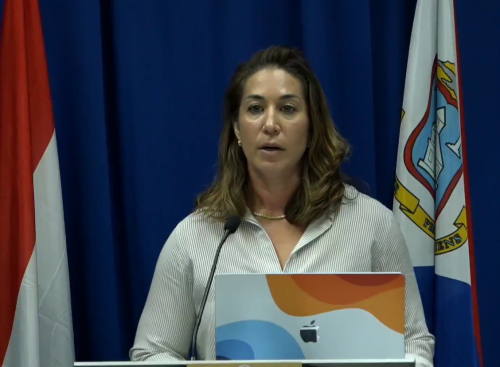
 PHILIPSBURG:--- On Wednesday, during the Council of Ministers press briefing, Minister of Justice Nathalie Tackling took the opportunity to clarify ongoing concerns about insurance coverage for justice workers, an issue that has sparked significant debate and misinformation in recent weeks. The Minister emphasized the government's commitment to ensuring the safety and rights of justice workers, while also providing transparency on the steps being taken to resolve the matter.
Legal Protections for Justice Workers
Minister Tackling began by reiterating that under Article 114 of the Rechtpositie Law (legal position), justice workers, particularly police officers, are legally protected. This means that if an officer is injured or killed while lawfully performing their duties, the government of St. Maarten is legally obligated to provide compensation. The Minister stressed that this obligation exists regardless of whether an insurance policy is in place.
"The insurance does not create the rights of the worker. The right of the worker comes from the law," she stated. Insurance, she explained, is merely a tool the government uses to manage financial risk in the event of unforeseen incidents.
Background on the Insurance Lapse
The lapse in insurance coverage for justice workers dates back to October 2022, when the then Council of Ministers decided to limit insurance coverage to frontline, high-risk functions. The government also committed to bearing the full cost of this insurance. However, as the Ministry of Justice prepared a tender for a new insurance policy in 2023, it became evident that the policy decision was not fully aligned with the draft being negotiated. This misalignment delayed the tender process until a formal agreement with the unions was reached in the third quarter of 2023. By that time, the previous insurance policy had already expired.
In 2024, the Ministry of Justice conducted an inventory of frontline personnel to be covered and explored funding options, including the Crime Fund. However, the Ministry of Finance denied the request to use the Crime Fund for insurance purposes, necessitating a budgetary reservation that further delayed the process.
Focus on 2026 Coverage
Minister Nathalie outlined the government's current approach, which aims to secure insurance coverage for frontline, high-risk workers by 2026. She clarified that the insurance is intended to hedge and leverage the government's liability, rather than to establish individual rights for employees.
"Not because you wear a uniform means that you are a frontline worker," the Minister explained, highlighting the importance of identifying and prioritizing those in high-risk roles, such as police officers, national detectives, immigration border control, prison workers, and court guardianship staff.
Ongoing Efforts and Next Steps
Since late 2024, the Ministry of Justice has been working to publish a new tender for insurance coverage. The Ministry has sought assistance from SOAB to conduct the tender process, obtain quotes, and assess the financial implications. The goal is to ensure that all frontline, high-risk workers within the Ministry are covered by 2026.
The Minister also emphasized the government's broader responsibility under civil law to compensate civil servants for any harm or costs incurred in the line of duty. However, she reiterated the importance of leveraging insurance to manage risk and ensure financial sustainability.
Conclusion
While the issue of insurance for justice workers has been contentious, Minister Tackling's address provided much-needed clarity and reassurance. The government remains committed to protecting its justice workers and is actively working to resolve the insurance coverage gap. With plans underway to secure comprehensive coverage for frontline workers by 2026, the Ministry of Justice is taking concrete steps to address this critical issue.